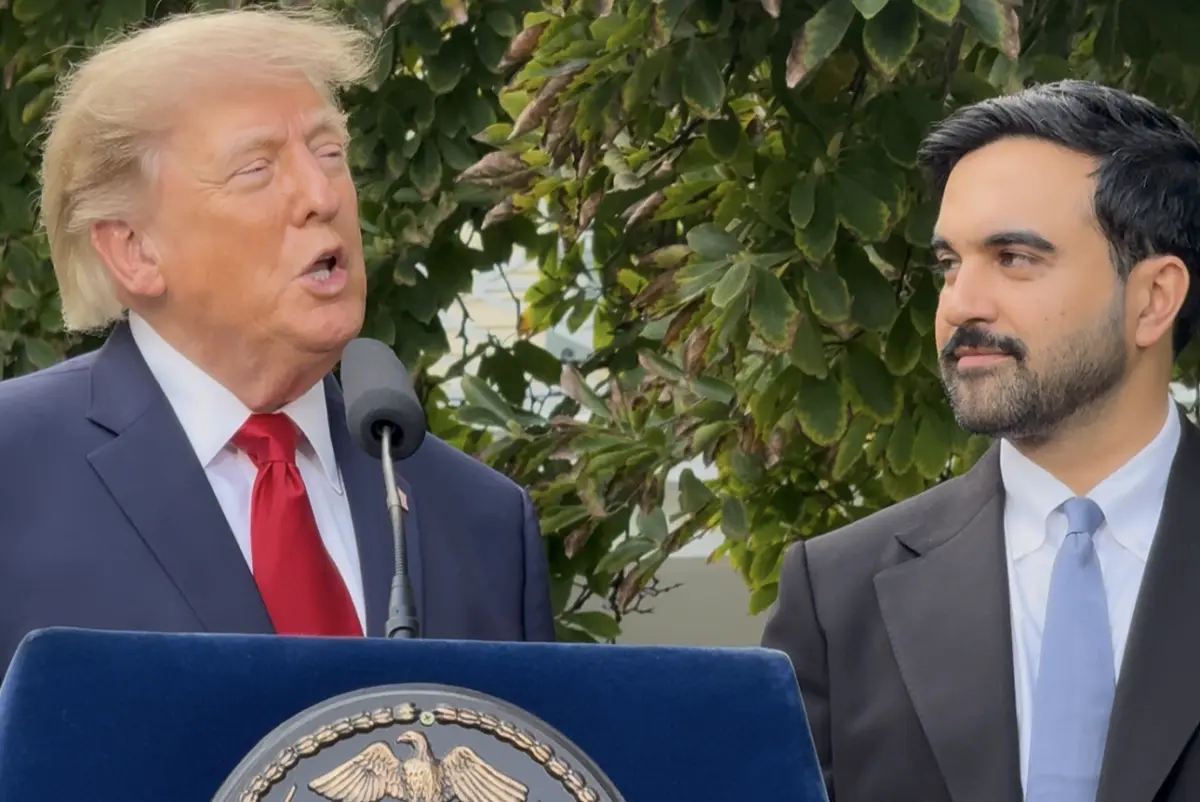
In a meeting defined by sharp ideological contrasts and a shared sense of political theater, President Donald Trump joined New York City Mayor Zohran Mamdani at Gracie Mansion on Monday. The encounter highlighted a central contradiction of the Trump presidency: a leader who maintains an unprecedented level of accessibility to the media while simultaneously waging an aggressive legal and rhetorical war against the institutions of the press. Against the backdrop of the historic mayoral residence, the two leaders navigated a tense dialogue that touched on the constitutional rights of journalists and the fate of hundreds of thousands of Haitian immigrants facing the loss of their legal status in the United States.
President Trump has long navigated an antagonistic relationship with the press, a dynamic that has become a cornerstone of his political identity. He famously popularized the phrase “fake news” to delegitimize critical coverage and has frequently labeled reporters “the enemy of the people.” Yet, in a departure from the more controlled media environments of his recent predecessors, Trump remains remarkably accessible. During stretches of his second term, the president has made media appearances on roughly 80% of his days in office, frequently engaging in lengthy, unscripted exchanges, taking far more shouted questions and sit-down interviews than either Barack Obama or Joe Biden did during their respective tenures.
Monday’s events at Gracie Mansion served as a microcosm of this friction. It was a day that showcased a president who grants extraordinary access on his own terms but revokes it entirely when the resulting coverage displeases him. As Trump stood on the lawn of the famed city house, Mayor Mamdani made a pointed effort to demonstrate a different approach to transparency, signaling his commitment to a free and open press even in the presence of a commander-in-chief who has recently moved to curtail it.
“I told the president that we’re going to have all of the members of the press here on the lawn, and that is something that I believe in,” Mamdani said, addressing the gathered reporters with Trump standing by his side.
The Mayor’s comments were a direct response to the administration’s latest escalation in its battle with the media. On Friday, Trump announced a ban on CNN, MS NOW, and Politico, barring them from White House grounds. The president justified the move by citing what he described as the “constant ‘reporting’ [of] FAKE NEWS” by the three outlets. The ban sent shockwaves through the Washington press corps, prompting an immediate and coordinated legal response.
By Monday morning, the three banned organizations had filed a joint First Amendment lawsuit in federal court in Washington, D.C. The plaintiffs argue that the administration’s actions amount to unconstitutional viewpoint discrimination and a violation of their due-process rights. The legal fallout also triggered a rare display of industry solidarity; several other major networks refused to provide the standard White House pool coverage that day. Because CNN was originally scheduled to handle the pool rotation, the other outlets opted to stand down in a collective protest against the exclusion of their colleagues.