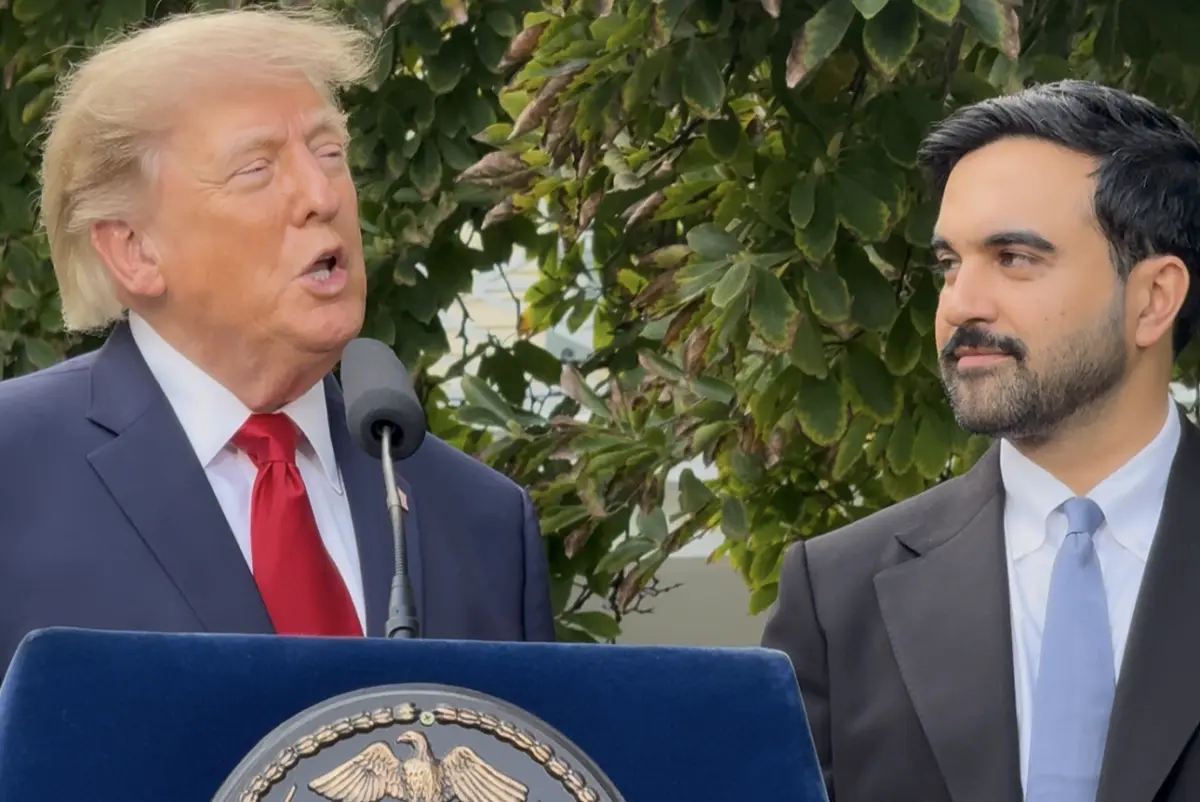
In a meeting defined by sharp ideological contrasts and a shared sense of political theater, President Donald Trump joined New York City Mayor Zohran Mamdani at Gracie Mansion on Monday. The encounter highlighted a central contradiction of the Trump presidency: a leader who maintains an unprecedented level of accessibility to the media while simultaneously waging an aggressive legal and rhetorical war against the institutions of the press. Against the backdrop of the historic mayoral residence, the two leaders navigated a tense dialogue that touched on the constitutional rights of journalists and the fate of hundreds of thousands of Haitian immigrants facing the loss of their legal status in the United States.
President Trump has long navigated an antagonistic relationship with the press, a dynamic that has become a cornerstone of his political identity. He famously popularized the phrase “fake news” to delegitimize critical coverage and has frequently labeled reporters “the enemy of the people.” Yet, in a departure from the more controlled media environments of his recent predecessors, Trump remains remarkably accessible. During stretches of his second term, the president has made media appearances on roughly 80% of his days in office, frequently engaging in lengthy, unscripted exchanges, taking far more shouted questions and sit-down interviews than either Barack Obama or Joe Biden did during their respective tenures.
Monday’s events at Gracie Mansion served as a microcosm of this friction. It was a day that showcased a president who grants extraordinary access on his own terms but revokes it entirely when the resulting coverage displeases him. As Trump stood on the lawn of the famed city house, Mayor Mamdani made a pointed effort to demonstrate a different approach to transparency, signaling his commitment to a free and open press even in the presence of a commander-in-chief who has recently moved to curtail it.
“I told the president that we’re going to have all of the members of the press here on the lawn, and that is something that I believe in,” Mamdani said, addressing the gathered reporters with Trump standing by his side.
The Mayor’s comments were a direct response to the administration’s latest escalation in its battle with the media. On Friday, Trump announced a ban on CNN, MS NOW, and Politico, barring them from White House grounds. The president justified the move by citing what he described as the “constant ‘reporting’ [of] FAKE NEWS” by the three outlets. The ban sent shockwaves through the Washington press corps, prompting an immediate and coordinated legal response.
By Monday morning, the three banned organizations had filed a joint First Amendment lawsuit in federal court in Washington, D.C. The plaintiffs argue that the administration’s actions amount to unconstitutional viewpoint discrimination and a violation of their due-process rights. The legal fallout also triggered a rare display of industry solidarity; several other major networks refused to provide the standard White House pool coverage that day. Because CNN was originally scheduled to handle the pool rotation, the other outlets opted to stand down in a collective protest against the exclusion of their colleagues.
Friday’s ban is not an isolated incident but rather the latest chapter in a long-standing pattern of attempts to restrict press access. In 2018, the White House revoked the press pass of then-CNN reporter Jim Acosta following a heated exchange during a news conference. That move was eventually overturned by a federal judge who ordered the pass restored. More recently, in February 2025, the administration barred the Associated Press from the Oval Office and other small-pool events. That specific dispute arose from the news agency’s refusal to adopt the administration’s preferred terminology, “Gulf of America,” in place of the globally recognized “Gulf of Mexico.” While a lower court initially ordered the AP’s access restored, the D.C. Circuit overruled that decision in June 2025, handing the administration a temporary legal victory in its effort to dictate the language used by the press.
At Gracie Mansion, reporters seized the opportunity to ask the president about his closed-door conversation with the mayor regarding these restrictions. Mamdani reiterated that he had been firm with Trump about ensuring the press would be present for the public portion of the visit. Trump, seemingly unfazed, responded with a mix of humor and renewed attacks. He joked that the press would never truly boycott him because of the ratings he generates, before once again disparaging the outlets he had banned.
“If you look at CNN, it’s fake news. If you look at MS NOW, I don’t even know what MS NOW is,” Trump said, dismissing the organizations. He defended his decision to bar them from the White House by drawing a comparison between the two residences. “I really think I have an obligation not to allow them into another very special house. This is a special house, Gracie Mansion. Well, the White House is the most special of all houses.”
Temporary Protected Status
Beyond the debate over press freedom, the meeting between Trump and Mamdani delved into a critical policy issue with profound implications for New York City’s economy and social fabric: the future of Temporary Protected Status (TPS). When The City reporter Katie Honan questioned the president on the matter, Mamdani revealed that he had used their private time to advocate for the restoration of TPS for Haitian immigrants.
Mamdani framed the issue not just as a humanitarian concern, but as an economic necessity. He informed the president that a broad coalition of New York leaders—including pastors, real estate developers, and executives in the healthcare and hospitality sectors—had expressed deep anxiety over the potential mass loss of work authorization for Haitian nationals. Mamdani emphasized that by controlling the designation of TPS, the president holds the power to “either deliver or deny stability” for thousands of individuals who have built lives, families, and careers in New York.
TPS is a designation granted to nationals of countries where ongoing armed conflict, environmental disasters, or other extraordinary and temporary conditions make it unsafe for them to return. While it allows recipients to live and work legally in the U.S., it does not provide a direct pathway to permanent residency or citizenship. Haiti has held this status since the devastating 2010 earthquake, but the program has been a frequent target of the Trump administration’s restrictive immigration agenda.
The history of Trump’s relationship with the Haitian community has been marked by dramatic shifts. During his 2016 campaign, he visited Miami’s Little Haiti and declared himself the community’s “biggest champion.” However, once in office, his administration moved to terminate TPS for Haitians in 2017, with then-Department of Homeland Security (DHS) Secretary Kristi Noem arguing that the administration was “returning TPS to its original status: temporary.” That decision was challenged in a Brooklyn federal court, where a judge ruled in April 2019 that the termination was motivated by political bias and could not proceed.
The conflict reignited in 2025 when Trump again moved to revoke the status. Following another round of protracted legal battles, the Supreme Court ruled in June 2026 that the DHS had the authority to proceed with cutting off protections. This decision affects an estimated 330,000 to 350,000 Haitians nationwide. Although a new lawsuit has been filed alleging that the termination was racially motivated, the ruling remains in effect, and the protections are set to expire.
The consequences of this policy shift are already being felt in New York City. As of July 24, the expiration of TPS has cut off legal work authorization for hundreds of thousands of people. The impact reached into the halls of local government itself; New York City Hall was recently forced to terminate Haitian employees who had no other legal pathway to maintain their employment.
“The mayor feels very strongly about [TPS],” Trump acknowledged before departing Gracie Mansion on Monday. “I feel strongly about a lot of things. I feel strongly about taking care of people, and that’s what we do. We’re doing a good job of it.”
The stakes for New York are particularly high. The city is home to the nation’s second-largest Haitian population, trailing only Miami. More than 160,000 Haitians live in the five boroughs, with the largest concentrations in Brooklyn’s Flatbush and East Flatbush neighborhoods. This community is a pillar of the city’s essential workforce, particularly in healthcare. According to data from the Center for Migration Studies, New York State has approximately 7,000 Haitian TPS holders working as nursing assistants and home caregivers. In a city where 57% of the healthcare workforce is composed of immigrants—and nearly 75% of home health aides are foreign-born—the loss of these workers threatens to destabilize an already strained system.
After the president’s departure, Mayor Mamdani disclosed that the meeting had come about through a personal invitation. He noted that the two had previously discussed the president’s own fond memories of Gracie Mansion from his years as a private citizen in New York, a rare point of personal connection in a relationship otherwise defined by the friction between city and federal priorities. Despite the cordiality of the visit, the fundamental disagreements over the role of the press and the rights of immigrant workers remain unresolved, leaving the city to navigate the fallout of a federal agenda that continues to challenge the status quo.