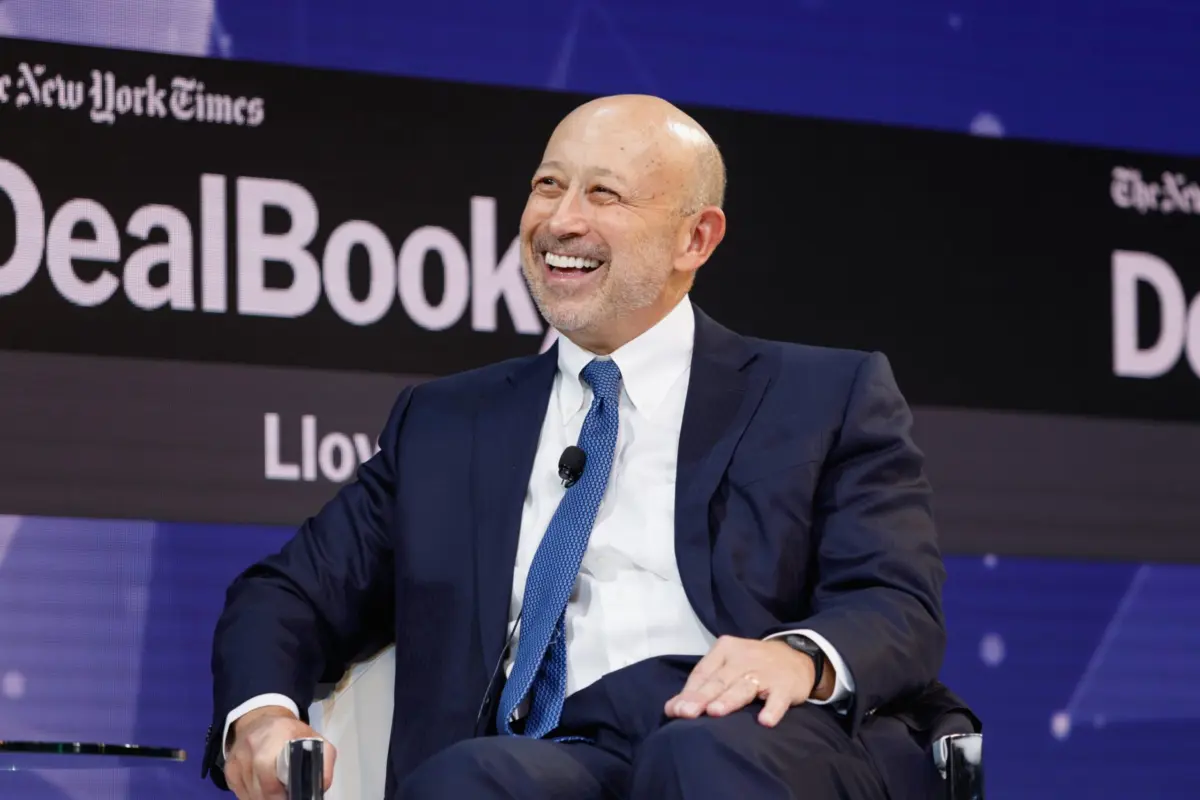
In an era where the traditional path to professional success is increasingly scrutinized by tech visionaries and the rising capabilities of artificial intelligence, Lloyd Blankfein is doubling down on a classic American tenet: the transformative power of a college education. The former chairman and CEO of Goldman Sachs, who navigated the global financial titan through some of its most turbulent years, remains a staunch advocate for the university experience, positioning it not merely as a credentialing exercise, but as the essential "accelerator" for social and economic mobility.
Blankfein’s perspective is deeply rooted in a personal narrative that mirrors the mid-century promise of the American Dream. Long before he was a billionaire finance leader, Blankfein was a young boy growing up in public housing in Brooklyn. His early years were defined by shared spaces and limited resources; he lived in a small New York City apartment where he shared a bedroom with either his grandmother or his sister until the day he left for university. The environment outside his home was equally challenging. During his formative years, his local high school was on the verge of being shut down—a detail Blankfein shared in a recent interview with CBS.
Despite the systemic hurdles of his upbringing, Blankfein adopted a rigorous discipline, "battening down the hatches" to focus on his studies. His academic commitment paid off when he became his high school’s class valedictorian, an achievement that served as his ticket out of the housing projects. At the exceptionally young age of 16, he was accepted into Harvard University. For Blankfein, Harvard was more than just a school; it was the launchpad for a career that eventually led him to a 12-year tenure at the helm of Goldman Sachs, one of the most powerful financial institutions in the world.
Now, five decades after he first stepped onto a college campus, Blankfein’s conviction has not wavered. Even as the rapid advancement of generative artificial intelligence threatens to automate many of the white-collar roles that have traditionally been the prize of a college degree, Blankfein maintains that schooling remains the ultimate wealth equalizer. "I think education is the real accelerator for most people into the middle and upper classes," he told CBS, reinforcing the idea that the value of a degree transcends the immediate technical skills it provides.
Blankfein argues college helps develop a ‘complete person’
The debate over the necessity of higher education has intensified in recent years, fueled by the astronomical rise in tuition costs and a growing "skills-first" movement in the labor market. Some prominent figures in the technology sector have become vocal critics of the university system, suggesting that the four-year model is an antiquated relic of a pre-digital age.
Among the most prominent of these skeptics is Peter Thiel, the cofounder of PayPal and Palantir. Thiel, despite being an alumnus of Stanford University and Stanford Law School, has famously characterized higher education as a "corrupt institution" that saddles young people with debt while stifling innovation. To back his rhetoric, Thiel established the Thiel Fellowship, which offers $200,000 grants to young entrepreneurs under the condition that they drop out of college—or skip it entirely—to "build new things."
Blankfein has emerged as a primary counter-voice to Thiel’s philosophy. In an excerpt from his upcoming memoir, Streetwise, shared with Vanity Fair, Blankfein directly addressed the tech mogul’s stance. "I strongly disagree with the technology investor Peter Thiel," Blankfein wrote. He argued that while technical proficiency is a baseline requirement for any career, it is far from the only ingredient for long-term success. "To succeed in a career, you have to know the technical minutiae of your field, of course. But you also need to be a complete person—the kind of person other people want to engage with."
Blankfein’s defense of college is centered on the holistic development of the individual. As a graduate of both Harvard University and Harvard Law School, he credits his time in the Ivy League with nurturing a specific set of "soft skills" that are often difficult to quantify but essential in the boardroom. He points to the development of his writing skills, a deep-seated love of history, and a consistent engagement with current events as products of his education. Perhaps most importantly, he credits the university environment with building his confidence—a trait necessary for a young man from a Brooklyn housing project to eventually lead a global investment bank.
Interestingly, Blankfein does not describe his time at Harvard as a period of pure academic bliss. In his memoir, he admits that he "survived" the experience more than he enjoyed it, suggesting that the rigor and the social adjustment were significant challenges. However, he maintains that the struggle was intrinsic to the benefit. "Your undergraduate years are your best opportunity to make yourself uncomfortable in a way that can help make you more curious and interesting," he wrote. For Blankfein, the value of college lies in that very discomfort, which forces students to broaden their horizons beyond their immediate technical interests.
Other CEOs agree: college builds essential skills, including the liberal arts
Blankfein is not alone in his defense of the university system. While the "dropout-to-founder" narrative remains popular in some corners of Silicon Valley, several other prominent CEOs have stepped forward to credit their diverse educational backgrounds for their executive success. These leaders argue that the most effective workforce is one that can marry hard technical data with the nuanced understanding provided by the humanities.
Uber CEO Dara Khosrowshahi is a vocal proponent of this balanced approach. An alumnus of Brown University, Khosrowshahi has often spoken about how his degree in engineering provided him with the logical framework to solve complex problems. However, he also emphasizes that it was his exposure to the liberal arts that truly prepared him for the corner office. During a panel at Brown last year, Khosrowshahi described his balanced education as one of his "secrets" to success.
"Learning all of the… really important basics of engineering, but then marrying that with liberal arts, that really taught me to communicate in a compelling way, which is an absolute necessity when you’re in a leadership position," Khosrowshahi said. His perspective suggests that while engineering might build the product, the liberal arts provide the narrative and the communication skills required to lead the people who build it and the customers who use it.
The conversation around education has taken on a new urgency with the rise of artificial intelligence. As AI becomes increasingly capable of handling data analysis, coding, and basic administrative tasks, the "human" element of work is expected to become more valuable. Ali Ghodsi, the CEO of Databricks, expressed optimism about this shift. Speaking to Fortune last year, Ghodsi suggested that rather than making education obsolete, AI will "completely revolutionize" it for the better. He believes the technology will eliminate drudgery and create new categories of jobs that require higher-level thinking and creativity—skills that are traditionally honed in a university setting.
This sentiment is echoed by Daniela Amodei, the cofounder of the AI safety and research company Anthropic. Despite being at the forefront of the technology that many fear will displace human workers, Amodei is adamant that the humanities will remain critical. In an interview with ABC News earlier this year, she argued that the "soft skills" associated with a liberal arts education—such as critical thinking and interpersonal interaction—will only grow in importance as AI handles more technical tasks.
"I actually think studying the humanities is going to be more important than ever," Amodei said. "The ability to have critical thinking skills and learn how to interact with other people will be more important in the future, rather than less."
The consensus among these leaders suggests a pushback against the purely vocational view of education. While Peter Thiel and his supporters argue that the university system is a bloated obstacle to innovation, Blankfein and his contemporaries view it as the essential crucible for developing the "complete person." For Blankfein, the journey from public housing to the heights of Wall Street is proof enough that the traditional academic path remains the most reliable bridge between potential and achievement. As the workforce enters the age of AI, the debate is no longer just about what a student learns, but about who they become during those four years on campus.