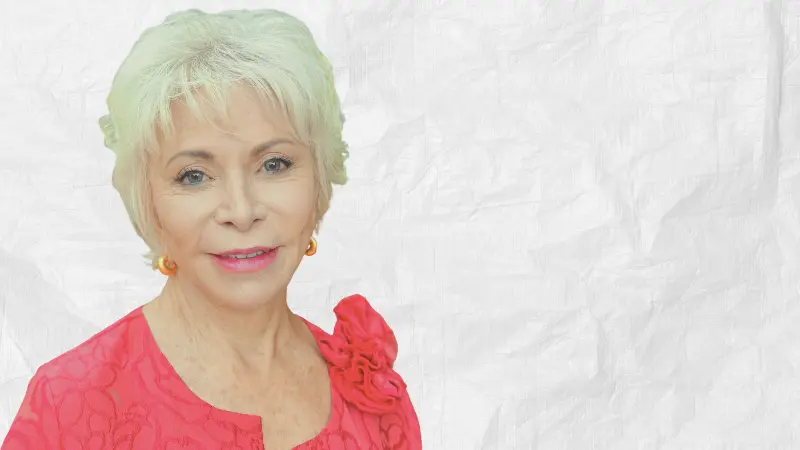
In the annals of contemporary literature, few debut novels carry the weight and enduring legacy of Isabel Allende’s The House of the Spirits. For over four decades, the sprawling family saga has served as a cornerstone of Latin American fiction, blending the ethereal with the visceral, and the personal with the political. However, as Allende reveals in her latest reflections on the craft of writing, the masterpiece that defined her career was never intended to be a novel at all. It began, quite simply, as an act of grief and remembrance—a final letter to a dying man.
The date was January 8, 1981. Allende was living in exile in Caracas, Venezuela, having fled the political upheaval of her native Chile following the 1973 military coup. Word had reached her that her beloved grandfather, a towering figure in her life and a repository of family lore, was nearing the end of his life in Chile. Distance and political circumstances prevented her from being at his bedside. In an effort to maintain a spiritual connection and to offer him a final tribute, she sat down to write.
"My original idea was to let him know that I remembered all the stories he’d told me," Allende recalls. "They would not be forgotten when he was gone."
What began as a private correspondence, however, soon took on a life of its own. As she poured her memories onto the page, the boundaries of the letter began to dissolve. The stories her grandfather had shared—tales of eccentric ancestors, clairvoyant women, and the harsh realities of rural life—began to knit themselves together into a tapestry far more complex than a standard missive. Allende notes that the letter kept growing, expanding beyond the constraints of a personal goodbye until she was forced to recognize that she was engaged in something entirely different.
The House of the Spirits Started Out as a Letter to Allende’s Grandfather
The transition from letter-writer to novelist was facilitated by a unique psychological freedom. Allende admits that had she sat down with the explicit goal of "writing a novel," the weight of the ambition might have paralyzed her. The literary world can be an intimidating space for a first-time author, but the epistolary nature of her project acted as a shield against self-doubt.
"If I had given myself the task of writing a novel, probably I never would have gone beyond the first few sentences," she explains. Because she viewed the work as just another letter—similar to the many she sent to her mother—she wrote without the burden of expectations. There was no pressure for perfection, no looming shadow of a publisher, and no fear of critical reception.
By the second page, the tone had shifted. Allende describes the emerging narrative as having the "tone of a soap opera," a dramatic and heightened style that suited the larger-than-life characters she was resurrecting from her memory. Even when it became clear that her grandfather would not live to read her words, the momentum did not falter. If anything, his passing granted her a newfound sense of creative autonomy.
"It gave me wings," she says. "I could write anything I wanted without fear of offending him. I could embroider his stories and change them. Never again have I had that incredible feeling of absolute freedom to write."
This freedom was exercised under grueling physical conditions. At the time, Allende was not a full-time writer but a school employee working twelve-hour shifts. Her creative output was relegated to the late-night hours and the quiet corners of her home. Each evening, returning from a long day of work, she would sit in her kitchen and type. Despite the exhaustion of her professional life, she was fueled by what she describes as "unbound enthusiasm."
The kitchen table in Caracas became the birthplace of the Trueba-del Valle family. Characters appeared one by one, most of them drawn from the "extravagant relatives" and acquaintances of her youth. As the pages accumulated, Allende found herself in a state of flow, where the magnitude of the endeavor failed to intimidate her. She was, in her own words, a "sleepwalker," functioning in the real world while her mind remained anchored in the fictional universe she was constructing.
The resulting narrative was more than just a family history; it was a mirror held up to a continent in turmoil. While the name "Chile" is famously absent from the text of The House of the Spirits, the country serves as the novel’s central, unspoken character. The saga of the Trueba family serves as a micro-history that reflects the macro-history of a nation grappling with social stratification, political polarization, and eventual collapse.
Allende’s writing was deeply informed by the dark realities of the Cold War era in Latin America. During the late 1970s and early 1980s, the region was a patchwork of repressive military regimes and "dirty wars." Backed by the CIA and fueled by anti-communist fervor, dictatorships in Chile, Argentina, Uruguay, and Brazil engaged in systematic brutality against leftist movements, indigenous populations, and the poor.
"The atrocities committed in Chile were similar to those in Argentina, Uruguay, Brazil, and Central America," Allende notes, emphasizing that her novel, while deeply rooted in her own experiences, was a universal story of a "tormented continent." The struggle between the patriarchal landowner Esteban Trueba and the shifting social tides around him captured a zeitgeist that resonated far beyond the borders of any single nation.
By the end of 1981, the "letter" had transformed into a manuscript of over five hundred pages. In an era before digital backups and cloud storage, the physical existence of those pages was fraught with anxiety. There was only one copy, and Allende treated it with a maternal ferocity. She carried the manuscript everywhere in a canvas bag, refusing to part with it.
This protective instinct led to a near-disaster that has since become a piece of literary lore. Allende recalls leaving the bag at a hair salon and falling into a state of panic upon realizing its absence. By the time she returned to the salon, the bag—and the only copy of her life’s work—had been thrown into a large trash container on the street.
"I had to get into the large container in the street to retrieve it," she remembers. "There it was, intact, mocking me."
That rescued pile of paper would eventually find its way to a publisher, launching Allende into the international spotlight and establishing her as one of the most widely read Spanish-language authors in the world. Since those nights in the Caracas kitchen, Allende has authored dozens of books, spanning historical fiction, memoirs, and crime thrillers. Yet, the experience of writing her first novel remains a singular moment of "absolute freedom."
Reflecting on her long career, Allende views the act of writing as a bridge across time and space. To her, a novel is not a static object but a "living creature" that enters a symbiotic relationship with its reader. She describes the process as an intimate conversation held in silence and privacy, where the writer proposes a world and the reader interprets it through the lens of their own life.
"A novel is reborn each time someone reads it," she asserts. This philosophy has allowed her to detach from her creations once they are published. In her view, the books no longer belong to her; they belong to the world, sent out to fulfill their destinies and, with luck, "provoke the imagination of some readers or move their hearts."
The legacy of that first letter continues to shape Allende’s professional life in a very literal way. To this day, she begins every new book on the same date she started that letter to her grandfather: January 8. It is a ritual that honors the accidental nature of her beginning and the enduring power of a story that refused to stay within the lines of a simple goodbye.
As Allende continues to share her insights on the "Craft of Writing," her story serves as a testament to the idea that the most profound works of art often emerge not from a grand plan, but from a deeply felt need to remember, to honor, and to speak to those we have lost. What began as a way to ensure her grandfather’s stories would not be forgotten ended up ensuring that the world would never forget the name Isabel Allende.