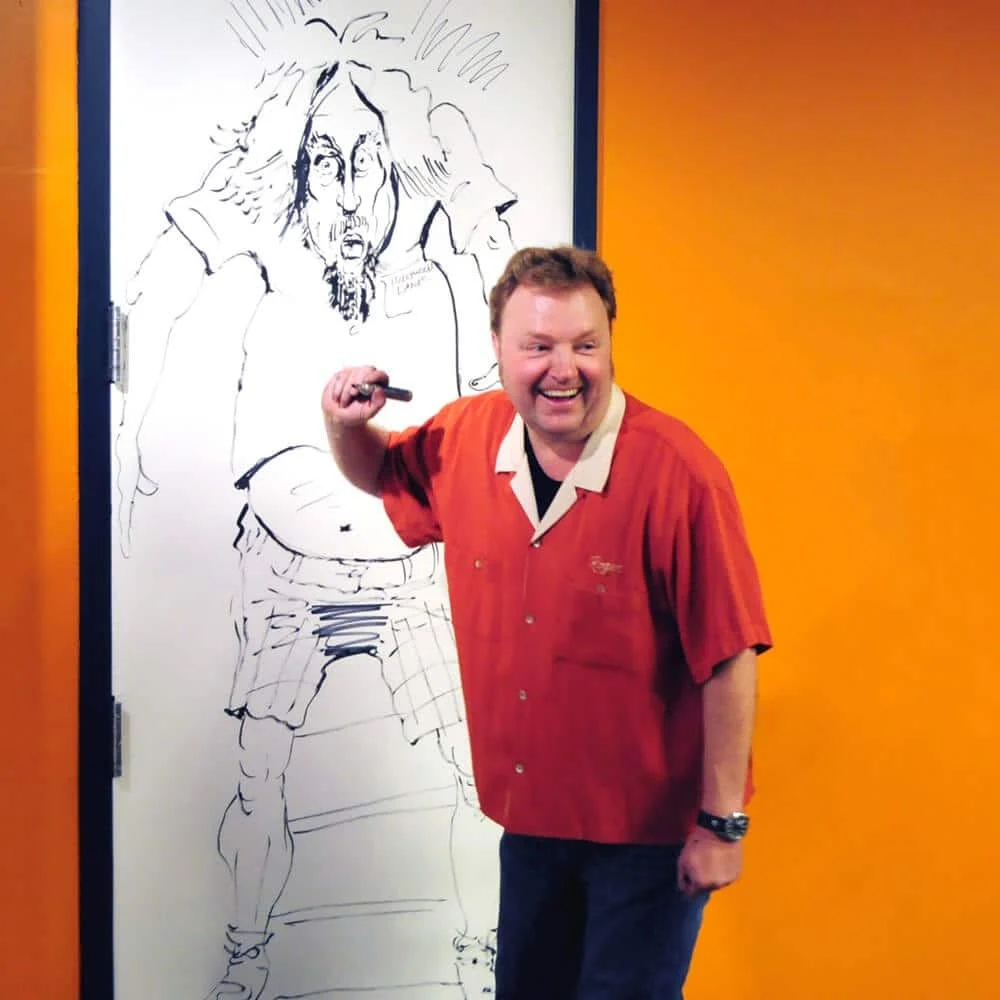
J. Todd Anderson, the prolific storyboard artist whose meticulous illustrations provided the visual blueprint for some of the most celebrated films in modern American cinema, has died. Anderson, a quintessential behind-the-scenes force in Hollywood and a foundational collaborator for directors Joel and Ethan Coen, passed away on October 2 in California following a prolonged battle with cancer. He was 67 years old.
His passing was confirmed by his longtime friend and creative partner, George Willeman, with whom he co-hosted the cinema-focused podcast Filmically Perfect. In a poignant tribute shared to social media on October 3, Willeman expressed the depth of the loss, noting that the duo had recently discussed reviving their program.
“My erstwhile pod-partner, J. Todd Anderson, passed away October 2nd in California,” Willeman wrote. “We had gotten together just a few months back, making plans to bring the show back as we still have/had lots of movies to talk about. While that cannot happen now, we hope to keep the website alive so that our old episodes can still be enjoyed.”
The news of his death was further corroborated by Anderson’s sister, Kimberly Patterson, through the non-profit organization FilmDayton. The Dayton, Ohio-based film commission, which serves the region where Anderson was raised and educated, shared its own tribute to the artist, acknowledging his massive contributions to the industry and his roots in the Buckeye State.
Born John Todd Anderson in Springfield, Ohio, he would eventually become one of the most sought-after storyboard artists in the industry. However, it was his enduring partnership with the Coen Brothers that defined his career and, by extension, the visual language of independent and mainstream cinema alike. For nearly forty years, Anderson acted as the bridge between the Coens’ idiosyncratic scripts and the final images captured on celluloid.
The collaboration began in the late 1980s with the neon-soaked, kinetic comedy Raising Arizona. It was a formative period for both the directors and the artist. The Coens are famously meticulous filmmakers who storyboard every single shot of their movies before production begins—a practice that demands an artist of immense patience, technical skill, and a shared sense of humor. Anderson proved to be the perfect match for their sensibilities.
Following the success of Raising Arizona, Anderson became a permanent fixture in the Coen Brothers’ inner circle. His hand-drawn frames mapped out the dark, snowy landscapes of the Academy Award-winning Fargo and the smoke-filled rooms of the neo-noir Miller’s Crossing. He was responsible for visualizing the surreal dream sequences and bowling-alley aesthetics of the cult classic The Big Lebowski, a film whose visual identity is so distinct that Anderson eventually published a book dedicated solely to the storyboards he created for it.
As the Coen Brothers’ filmography expanded in scope and genre, Anderson’s versatility grew with them. He provided the visual foundations for the Ovidian odyssey O Brother, Where Art Thou?, the cruel ironies of The Ladykillers, the gritty Western vistas of True Grit, and the Hollywood satire of Hail, Caesar!. Even as the brothers began to explore solo directorial projects in recent years, their reliance on Anderson remained a constant. He worked with Joel Coen on the stark, expressionistic The Tragedy of Macbeth and collaborated with Ethan Coen on the road comedy Drive-Away Dolls and the upcoming project Honey Don’t.
While his work with the Coens remains his most cited legacy, Anderson’s influence extended far beyond a single partnership. His credits include a diverse array of high-profile films that showcase his ability to adapt to various directorial styles. He contributed his talents to the 1989 disaster epic Twister, the gothic comedy of 1991’s The Addams Family, Drew Barrymore’s directorial debut Whip It in 2009, and the 2018 sci-fi actioner The Predator. His work on Shane Black’s 2016 detective comedy The Nice Guys was particularly noted for its sharp visual timing, a testament to his deep understanding of how action and comedy intersect on screen.
Throughout his career, Anderson’s peers frequently recognized his technical excellence. He earned three nominations from the Art Directors Guild (ADG) for his contribution to the Excellence in Production Design categories. These nominations came for his work on the stylized noir of Hail, Caesar!, the episodic Western anthology The Ballad of Buster Scruggs, and the haunting, minimalist visuals of The Tragedy of Macbeth.
Beyond the drawing board, Anderson was a multi-faceted creator who explored various avenues of storytelling. He stepped into the director’s chair for the 1999 feature The Naked Man, a quirky crime comedy he co-wrote with Ethan Coen, and later directed the 2008 film My Mummy. His creative output also included the world of theater and music; he wrote both the words and music for the pop musical Nativity, demonstrating a lyrical sensibility that mirrored his visual artistry.
His educational roots remained a point of pride throughout his life. After growing up in Springfield, Anderson attended Wright State University, where he honed the skills that would eventually take him to the heights of the film industry. His connection to the university remained strong, and following his passing, the Tom Hanks Center for Motion Pictures at Wright State released a heartfelt statement reflecting on his career and his character.
“A diverse storyteller, he directed two features, published a book of his storyboards for ‘The Big Lebowski,’ co-hosted Filmically Perfect, and wrote the words and music for the pop musical ‘Nativity,’” the university’s tribute read. “He also generously shared his stories and knowledge with emerging filmmakers whenever they asked. Rest well, JT. We’ll raise a glass to you tonight.”
This mentorship was a recurring theme in the tributes that followed the news of his death. Colleagues and former students remembered him not only for his immense talent but for his willingness to demystify the process of filmmaking. In an industry often characterized by gatekeeping, Anderson was known for his accessibility and his belief that the craft of storyboarding was a vital, living part of the cinematic process.
On the Filmically Perfect podcast, Anderson and Willeman explored the nuances of film history, preservation, and the technical aspects of the medium. The show served as a platform for Anderson to share his encyclopedic knowledge of cinema, often punctuated by the same wit and insight that he brought to his illustrations. Willeman’s commitment to keeping the podcast’s archives alive ensures that Anderson’s voice—and his passion for the "perfectly filmed" moment—will continue to reach audiences.
The role of a storyboard artist is often misunderstood by the general public, yet it is essential to the architecture of a film. The artist must understand cinematography, acting, pacing, and lighting, translating a director’s abstract ideas into a concrete plan that hundreds of crew members can follow. Anderson was a master of this translation. He didn’t just draw pictures; he blocked out the soul of a movie before a single camera ever rolled.
In the wake of his passing, the film community mourns a man who was often described as the "secret weapon" of the directors he worked with. His storyboards were more than just sketches; they were the first glimpse of some of the most iconic moments in cinema history. From the frantic energy of a kidnapping in the desert to the quiet, atmospheric tension of a 1940s courtroom, Anderson’s hand was the first to give those moments life.
J. Todd Anderson is survived by his sister, Kimberly Patterson, and a vast community of friends, colleagues, and admirers within the film industry. As fans and collaborators reflect on his nearly four-decade career, his legacy remains etched in the frames of the movies he helped build—a testament to an artist who saw the world in pictures and helped the rest of us see it that way, too.