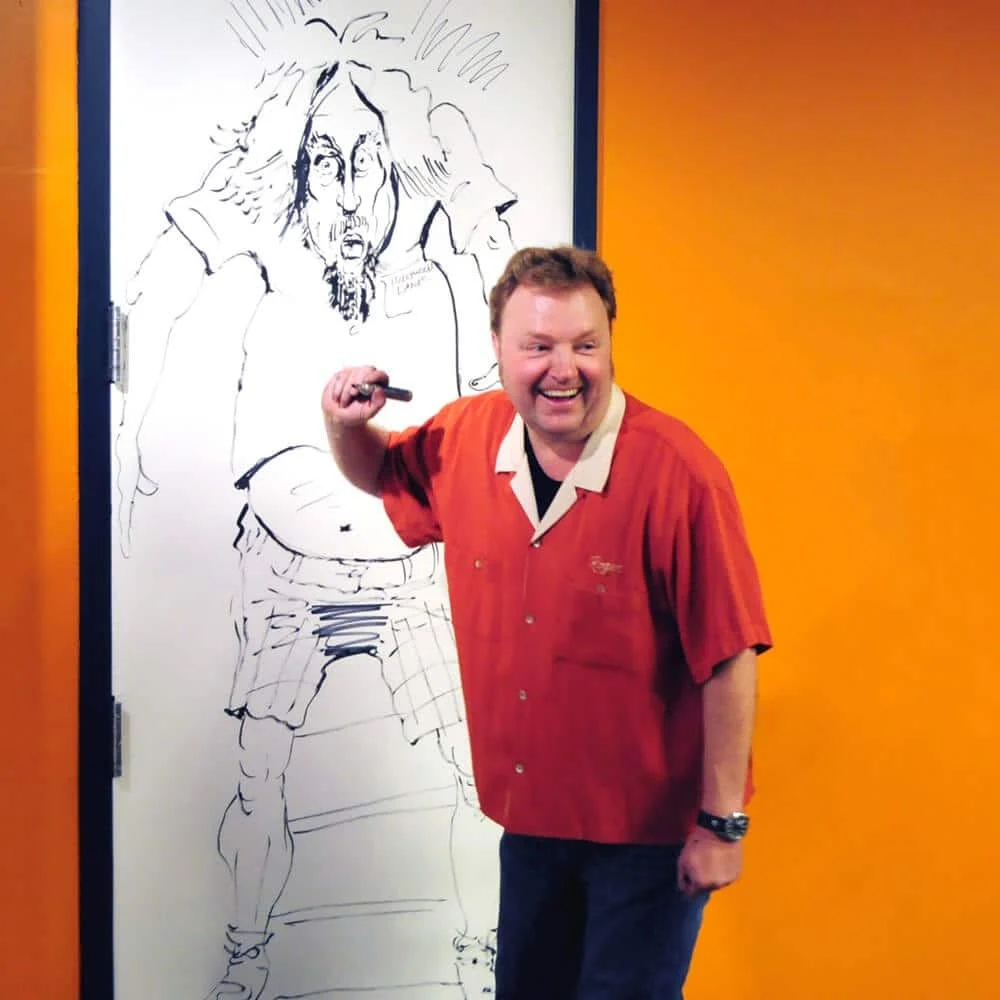
Following the success of Raising Arizona, Anderson became a permanent fixture in the Coen Brothers’ inner circle. His hand-drawn frames mapped out the dark, snowy landscapes of the Academy Award-winning Fargo and the smoke-filled rooms of the neo-noir Miller’s Crossing. He was responsible for visualizing the surreal dream sequences and bowling-alley aesthetics of the cult classic The Big Lebowski, a film whose visual identity is so distinct that Anderson eventually published a book dedicated solely to the storyboards he created for it.
As the Coen Brothers’ filmography expanded in scope and genre, Anderson’s versatility grew with them. He provided the visual foundations for the Ovidian odyssey O Brother, Where Art Thou?, the cruel ironies of The Ladykillers, the gritty Western vistas of True Grit, and the Hollywood satire of Hail, Caesar!. Even as the brothers began to explore solo directorial projects in recent years, their reliance on Anderson remained a constant. He worked with Joel Coen on the stark, expressionistic The Tragedy of Macbeth and collaborated with Ethan Coen on the road comedy Drive-Away Dolls and the upcoming project Honey Don’t.
While his work with the Coens remains his most cited legacy, Anderson’s influence extended far beyond a single partnership. His credits include a diverse array of high-profile films that showcase his ability to adapt to various directorial styles. He contributed his talents to the 1989 disaster epic Twister, the gothic comedy of 1991’s The Addams Family, Drew Barrymore’s directorial debut Whip It in 2009, and the 2018 sci-fi actioner The Predator. His work on Shane Black’s 2016 detective comedy The Nice Guys was particularly noted for its sharp visual timing, a testament to his deep understanding of how action and comedy intersect on screen.
Throughout his career, Anderson’s peers frequently recognized his technical excellence. He earned three nominations from the Art Directors Guild (ADG) for his contribution to the Excellence in Production Design categories. These nominations came for his work on the stylized noir of Hail, Caesar!, the episodic Western anthology The Ballad of Buster Scruggs, and the haunting, minimalist visuals of The Tragedy of Macbeth.
Beyond the drawing board, Anderson was a multi-faceted creator who explored various avenues of storytelling. He stepped into the director’s chair for the 1999 feature The Naked Man, a quirky crime comedy he co-wrote with Ethan Coen, and later directed the 2008 film My Mummy. His creative output also included the world of theater and music; he wrote both the words and music for the pop musical Nativity, demonstrating a lyrical sensibility that mirrored his visual artistry.
His educational roots remained a point of pride throughout his life. After growing up in Springfield, Anderson attended Wright State University, where he honed the skills that would eventually take him to the heights of the film industry. His connection to the university remained strong, and following his passing, the Tom Hanks Center for Motion Pictures at Wright State released a heartfelt statement reflecting on his career and his character.