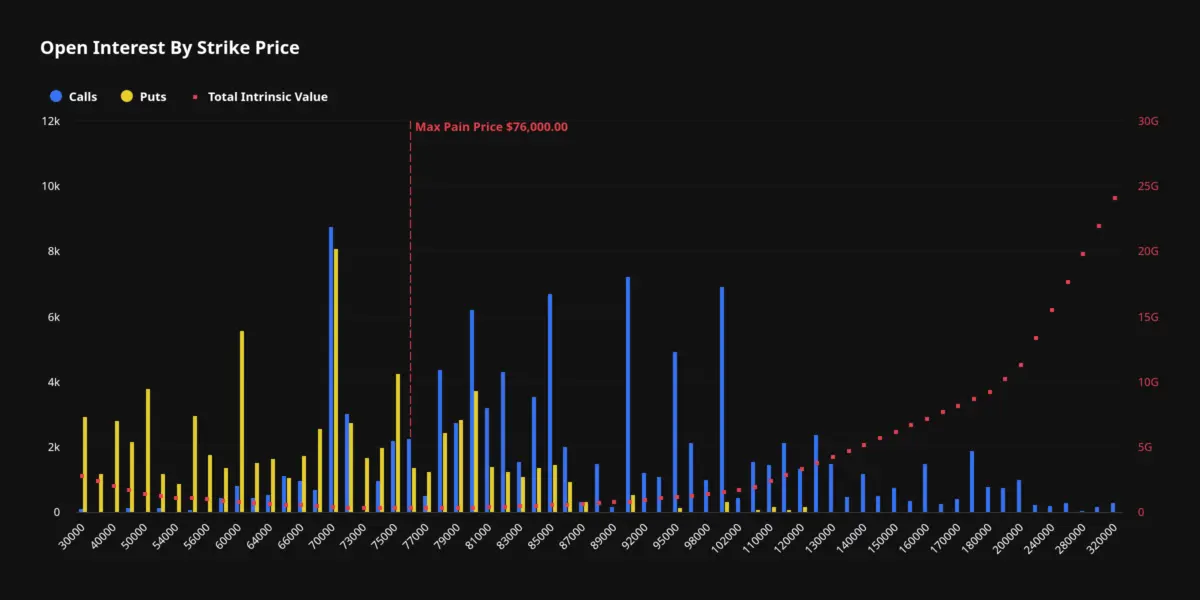
The cryptocurrency derivatives market is bracing for one of its most significant liquidity events of the year as nearly $18 billion worth of Bitcoin and Ether options contracts approach their final settlement. Scheduled for Friday at 08:00 UTC, the quarterly expiry is poised to trigger a massive shift in capital, potentially resetting the short-term trading range for the world’s largest digital assets and introducing a fresh wave of volatility into a market already heightened by bullish sentiment.
According to data provided by Deribit, the world’s leading crypto options exchange, the upcoming settlement involves approximately $15.9 billion in Bitcoin (BTC) options and roughly $2.1 billion in Ether (ETH) options. The scale of this event is difficult to overstate; the Bitcoin expiry alone is set to remove roughly 37% of Deribit’s total outstanding Bitcoin open interest, which currently stands at an estimated $43.5 billion. Open interest represents the total dollar value of all active, unsettled options contracts, where each contract signifies the right to buy or sell one full unit of the underlying cryptocurrency.
Luuk Strijers, CEO of Deribit, highlighted the magnitude of the upcoming window, noting that the September 25 quarterly expiry stands as a landmark event for the exchange. Strijers pointed out that the current positioning in the Bitcoin market is overwhelmingly "call-heavy," characterized by a put/call open-interest ratio of 0.69. This ratio suggests that for every 100 call options, there are only 69 put options, a clear indicator that market participants have been positioning themselves for a sustained move toward higher price levels.
Understanding the Mechanics of the Bullish Bias
To understand why this expiry is being watched so closely, one must look at the mechanics of the instruments involved. A call option is a derivative contract that provides the buyer the right, but not the obligation, to purchase an underlying asset at a pre-determined "strike price" before a specific expiration date. Conversely, a put option grants the right to sell at a specific price, offering protection against a market downturn.
In a professional trading context, these instruments are far more than simple bets on price direction. Traders utilize them to hedge existing spot or futures positions, speculate on market volatility, or earn yield through time decay. For instance, the current "call-heavy" environment suggests that a significant portion of the market expects Bitcoin to either hold its current levels or climb higher. Using a conceptual example, a trader might pay a premium to reserve the right to buy Bitcoin at $80,000. If the market price surges to $90,000, the trader can exercise that right, acquiring the asset at a discount relative to the current market. If the price remains below the strike, the trader simply loses the premium paid for the option.
Since the explosive growth of the crypto derivatives landscape in 2020, quarterly settlements have evolved into "must-watch" events. Unlike weekly or monthly expiries, quarterly settlements represent a massive consolidation of long-term institutional and retail strategies. As these contracts expire, the "pinning effect"—where the price of the underlying asset is often drawn toward strikes with high open interest—begins to fade, often leaving a vacuum that can lead to sharp price movements.
The "Max Pain" Theory and Price Support