The cryptocurrency derivatives market is bracing for one of its most significant liquidity events of the year as nearly $18 billion worth of Bitcoin and Ether options contracts approach their final settlement. Scheduled for Friday at 08:00 UTC, the quarterly expiry is poised to trigger a massive shift in capital, potentially resetting the short-term trading range for the world’s largest digital assets and introducing a fresh wave of volatility into a market already heightened by bullish sentiment.
According to data provided by Deribit, the world’s leading crypto options exchange, the upcoming settlement involves approximately $15.9 billion in Bitcoin (BTC) options and roughly $2.1 billion in Ether (ETH) options. The scale of this event is difficult to overstate; the Bitcoin expiry alone is set to remove roughly 37% of Deribit’s total outstanding Bitcoin open interest, which currently stands at an estimated $43.5 billion. Open interest represents the total dollar value of all active, unsettled options contracts, where each contract signifies the right to buy or sell one full unit of the underlying cryptocurrency.
Luuk Strijers, CEO of Deribit, highlighted the magnitude of the upcoming window, noting that the September 25 quarterly expiry stands as a landmark event for the exchange. Strijers pointed out that the current positioning in the Bitcoin market is overwhelmingly "call-heavy," characterized by a put/call open-interest ratio of 0.69. This ratio suggests that for every 100 call options, there are only 69 put options, a clear indicator that market participants have been positioning themselves for a sustained move toward higher price levels.
Understanding the Mechanics of the Bullish Bias
To understand why this expiry is being watched so closely, one must look at the mechanics of the instruments involved. A call option is a derivative contract that provides the buyer the right, but not the obligation, to purchase an underlying asset at a pre-determined "strike price" before a specific expiration date. Conversely, a put option grants the right to sell at a specific price, offering protection against a market downturn.
In a professional trading context, these instruments are far more than simple bets on price direction. Traders utilize them to hedge existing spot or futures positions, speculate on market volatility, or earn yield through time decay. For instance, the current "call-heavy" environment suggests that a significant portion of the market expects Bitcoin to either hold its current levels or climb higher. Using a conceptual example, a trader might pay a premium to reserve the right to buy Bitcoin at $80,000. If the market price surges to $90,000, the trader can exercise that right, acquiring the asset at a discount relative to the current market. If the price remains below the strike, the trader simply loses the premium paid for the option.
Since the explosive growth of the crypto derivatives landscape in 2020, quarterly settlements have evolved into "must-watch" events. Unlike weekly or monthly expiries, quarterly settlements represent a massive consolidation of long-term institutional and retail strategies. As these contracts expire, the "pinning effect"—where the price of the underlying asset is often drawn toward strikes with high open interest—begins to fade, often leaving a vacuum that can lead to sharp price movements.
The "Max Pain" Theory and Price Support
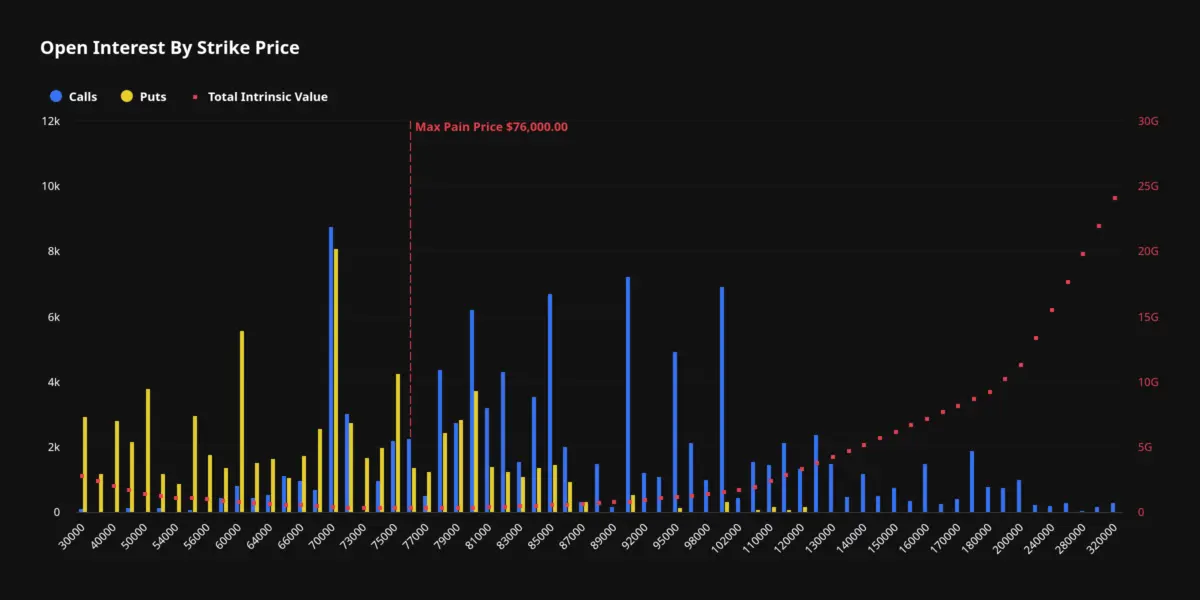
One of the most discussed metrics heading into Friday’s settlement is the "max pain" point. This refers to the specific price level at which the greatest number of option holders—the buyers—would experience the maximum financial loss upon expiry. In theory, options sellers, often large market makers or "dealers," have an incentive to see the spot price gravitate toward this level to minimize their own payouts.
For the current Bitcoin book, the maximum pain point is situated at $75,000. This is notably lower than the current spot price, which has been hovering around the $85,500 range. Deribit analysts have described this $75,000 level as a "soft magnet," suggesting that while there may be some downward pressure leading into the 08:00 UTC deadline, the sheer momentum of the current market may prevent a full retracement to that level.
The distribution of open interest further reinforces the idea of a market that is leaning heavily into a bullish breakout. Jean-David Péquignot, Chief Commercial Officer at Deribit, noted that the $70,000 strike price currently holds more open contracts than any other. Because Bitcoin is trading well above this level, those calls are considered "deep in the money," meaning they hold significant intrinsic value.
Open Interest Distribution and In-the-Money Positions
The current state of the options book reveals a market that is largely in profit. Strijers noted that approximately 55% of the $9.4 billion in Bitcoin call options due to expire are currently "in the money." In contrast, the vast majority of put options—those betting on a price drop—are currently worthless as the market price sits far above their strikes. When combined, roughly one-third of the entire $15.9 billion Bitcoin options book is currently in a profitable position for the buyers.
An option is considered "in the money" when the current market price is on the favorable side of the strike price. For a call option, this means the market price is higher than the strike; for a put, it means the market is lower. The high concentration of profitable calls suggests that if these traders choose to exercise their options rather than rolling them over, it could lead to significant movement in the underlying spot market.
Péquignot further analyzed the concentration of these bets, noting that open interest is heavily clustered around the $85,000, $90,000, $95,000, and even the psychological $100,000 call strikes. "These blocks are now coming directly into play as spot trades near the $86,000 mark," Péquignot explained. He also pointed out that on the defensive side, put options are firmly anchored at the $60,000, $70,000, and $75,000 levels. This creates what he describes as a "multi-layered support floor," suggesting that even if a post-expiry sell-off occurs, there is significant structural support to prevent a catastrophic slide.
What Happens on the Expiry Day?
As the clock ticks toward the Friday deadline, the primary concern for traders is the removal of dealer-related hedging flows. This process, often referred to as the "gamma roll-off," can have a profound impact on market stability.
Market makers, or dealers, who sell call options to traders typically hedge their exposure by buying the underlying asset (Bitcoin) as the price rises. This is known as delta hedging. Strijers explained that as Bitcoin moved through the $80,000 to $87,000 range, this dealer hedging likely added "fuel to the rally." Essentially, as the price went up, dealers were forced to buy more Bitcoin to stay neutral, creating a self-reinforcing upward cycle.
"Once that gamma and hedging flow rolls off after settlement, the pinning effect fades," Strijers said. This means the artificial stability created by dealers managing their positions disappears. Consequently, short-term volatility often spikes immediately following the expiry as the market seeks a new equilibrium. This "reset" allows the prevailing trading range to shift, potentially opening the door for Bitcoin to test new highs or undergo a healthy correction.
The Rollover Effect and the Road to December
Beyond the immediate volatility of Friday morning, market participants are closely watching how positions "rollover" into the next major expiry dates in October and December. A rollover occurs when a trader closes out their expiring position and simultaneously opens a new one with a later expiration date, maintaining their market thesis while extending their timeframe.
The December expiry is of particular interest, as it often captures the year-end sentiment of the broader financial markets. If a significant portion of the current $85,000 and $90,000 call positions are rolled over into December at even higher strikes, it would signal that institutional and professional traders believe the current bull run has more room to grow.
As the $18 billion settlement approaches, the crypto market remains at a crossroads. The heavy concentration of profitable call options and the multi-layered support floor provided by put strikes suggest a robust underlying structure. However, the removal of billions of dollars in hedging flows ensures that the transition into the next quarter will be anything but quiet. Traders will be watching the $85,000 level intently, looking for clues on whether the market will consolidate its gains or push toward the elusive $100,000 milestone as the quarterly "gamma" clears the way for a new price discovery phase.