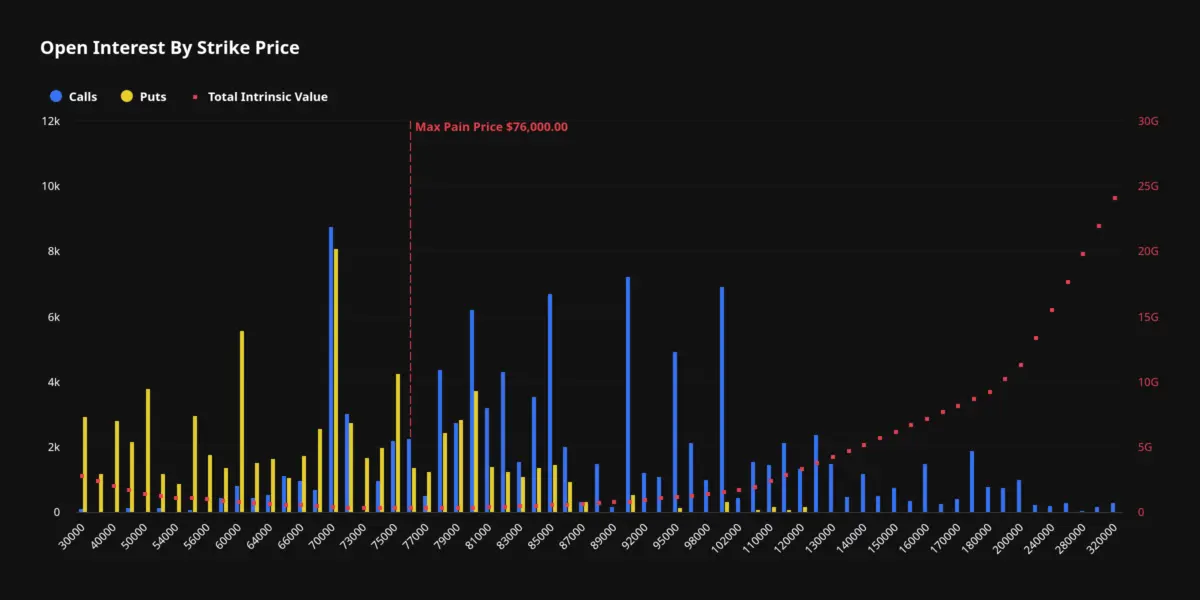
One of the most discussed metrics heading into Friday’s settlement is the "max pain" point. This refers to the specific price level at which the greatest number of option holders—the buyers—would experience the maximum financial loss upon expiry. In theory, options sellers, often large market makers or "dealers," have an incentive to see the spot price gravitate toward this level to minimize their own payouts.
For the current Bitcoin book, the maximum pain point is situated at $75,000. This is notably lower than the current spot price, which has been hovering around the $85,500 range. Deribit analysts have described this $75,000 level as a "soft magnet," suggesting that while there may be some downward pressure leading into the 08:00 UTC deadline, the sheer momentum of the current market may prevent a full retracement to that level.
The distribution of open interest further reinforces the idea of a market that is leaning heavily into a bullish breakout. Jean-David Péquignot, Chief Commercial Officer at Deribit, noted that the $70,000 strike price currently holds more open contracts than any other. Because Bitcoin is trading well above this level, those calls are considered "deep in the money," meaning they hold significant intrinsic value.
Open Interest Distribution and In-the-Money Positions
The current state of the options book reveals a market that is largely in profit. Strijers noted that approximately 55% of the $9.4 billion in Bitcoin call options due to expire are currently "in the money." In contrast, the vast majority of put options—those betting on a price drop—are currently worthless as the market price sits far above their strikes. When combined, roughly one-third of the entire $15.9 billion Bitcoin options book is currently in a profitable position for the buyers.
An option is considered "in the money" when the current market price is on the favorable side of the strike price. For a call option, this means the market price is higher than the strike; for a put, it means the market is lower. The high concentration of profitable calls suggests that if these traders choose to exercise their options rather than rolling them over, it could lead to significant movement in the underlying spot market.
Péquignot further analyzed the concentration of these bets, noting that open interest is heavily clustered around the $85,000, $90,000, $95,000, and even the psychological $100,000 call strikes. "These blocks are now coming directly into play as spot trades near the $86,000 mark," Péquignot explained. He also pointed out that on the defensive side, put options are firmly anchored at the $60,000, $70,000, and $75,000 levels. This creates what he describes as a "multi-layered support floor," suggesting that even if a post-expiry sell-off occurs, there is significant structural support to prevent a catastrophic slide.
What Happens on the Expiry Day?