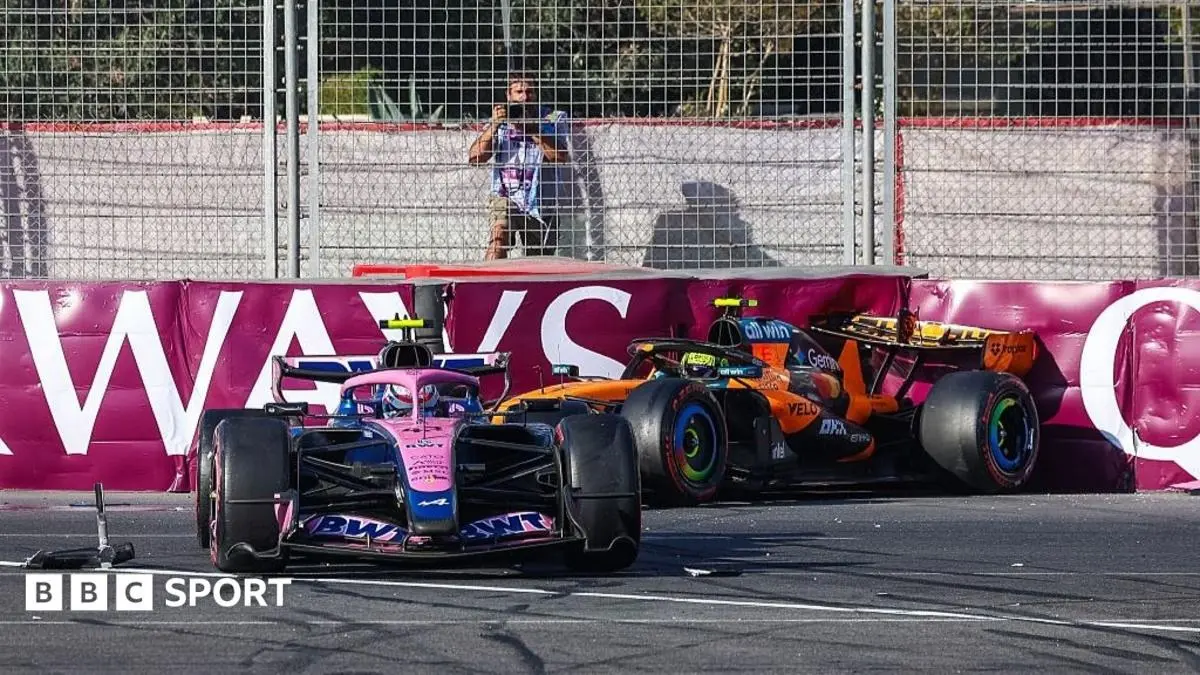
The high-octane atmosphere of the Azerbaijan Grand Prix was shattered during a chaotic restart that has left the Formula 1 paddock reeling and sparked a fierce debate over driver standards and disciplinary measures. In the center of the storm is reigning World Champion Lando Norris, who has directed a scathing critique toward Alpine’s Franco Colapinto. Following a multi-car incident that saw three drivers forced into early retirement, Norris has made an unprecedented call for the governing body to impose a race ban on the young Argentine driver, labeling his actions as careless and fundamentally incompatible with the standards required at the pinnacle of motorsport.
The incident occurred during a critical juncture of the race in Baku, a circuit already notorious for its unforgiving walls and high-speed restart sequences. As the field bunched up following a safety car period, the tension was palpable. In the tight confines of the street circuit, the margin for error is non-existent. As the green flags waved and the pack accelerated toward the first corner, Colapinto, driving for Alpine, suffered a catastrophic lock-up of his brakes. The mechanical failure to maintain control sent his car sliding helplessly into the path of his teammate, Pierre Gasly. The resulting impact triggered a violent chain reaction, with Gasly’s car being propelled into the side of Lando Norris’s machine.
The aftermath was immediate and devastating for all three competitors. What should have been a battle for crucial championship points ended in a cloud of carbon fiber dust and the somber sight of three high-performance vehicles being craned off the track. For Norris, the frustration was not merely about the loss of a single race result, but about the nature of the mistake that caused the carnage.
Speaking to BBC Radio 5 Live shortly after returning to the paddock, a visibly incensed Norris did not mince his words. When asked about the collision and what the appropriate response from the stewards should be, his answer was blunt and uncompromising. "Give him a ban. It’s quite simple," Norris stated. The World Champion’s demand reflects a growing impatience among the sport’s elite regarding errors that are perceived as avoidable and reckless, particularly during restarts where the entire field is at its most vulnerable.
The technical nature of the crash—a lock-up leading to an "out of control" slide—is something Franco Colapinto himself did not attempt to hide. The Alpine driver was quick to shoulder the burden of responsibility, appearing contrite in the face of the mounting criticism. "I can be sorry to everyone," Colapinto admitted in the wake of the incident. "It’s been a big mistake, of course. I just locked up and then I was very out of control."
While Colapinto’s apology was immediate, it did little to soothe the anger of Norris, who believes that the current system of penalties is insufficient to deter such "careless" behavior. Norris argued that the FIA (Fédération Internationale de l’Automobile) needs to recalibrate its approach to officiating, suggesting that the consequences for causing a multi-car retirement should be far more severe than the standard time penalties or license points.
Norris’s argument centers on two primary concerns: the sporting integrity of the race for blameless drivers and the staggering financial burden placed on teams due to repair costs. In the modern era of Formula 1, where a strict cost cap dictates every aspect of a team’s development and operational budget, the destruction of a car is no longer just a logistical headache—it is a strategic disaster.
"The FIA should be more strict and start handing out bans for this kind of stuff," Norris explained, highlighting the ripple effect that one driver’s error can have on the rest of the grid. "It’s careless from people. It costs a lot of money. All my parts are in the bin now, so people should just get banned for this kind of driving."
The phrase "all my parts are in the bin" resonates deeply within the technical side of the sport. Each wing, floor, and suspension component on a modern Formula 1 car represents hundreds of man-hours of engineering and hundreds of thousands of dollars in manufacturing. When a car is "taken out" in a chain reaction, the victimized team loses not only the opportunity to score points but also the physical hardware that may have been part of a specific upgrade package designed to improve performance in future races. For a driver of Norris’s caliber, seeing state-of-the-art technology reduced to scrap metal because of a rookie-level mistake is a bridge too far.
Norris went further, questioning whether drivers who commit such errors possess the necessary temperament for the series. "(They) don’t deserve to be in Formula 1," he asserted, a comment that underscores the immense pressure and the "elite-only" mindset of the paddock. "If you cause a crash on a restart like this, yeah, you should have at least a one-race ban."
The call for a one-race ban is a significant escalation in the ongoing dialogue regarding driver discipline. Historically, race bans in Formula 1 have been reserved for the most egregious of offenses or for drivers who have accumulated a specific number of penalty points over a rolling twelve-month period. By suggesting an automatic ban for causing a restart collision, Norris is advocating for a shift toward a "zero-tolerance" policy. He believes that the current environment allows for a level of recklessness because the penalties—often five or ten-second additions to a race time—do not match the severity of the damage caused to other competitors.
The incident also highlights the internal difficulties at Alpine, as Colapinto’s error directly eliminated his teammate, Pierre Gasly. Intrateam collisions are notoriously the most difficult for team principals to manage, as they result in a total loss of data and points for the organization, often leading to strained relationships within the garage. The fact that the error then cascaded to involve a championship frontrunner like Norris only amplified the visibility and the criticism of the mistake.
From the perspective of the FIA, the challenge lies in balancing the inherent risks of racing with the need for safety and fair play. Restarts are statistically one of the most dangerous moments of any Grand Prix. As drivers fight for position while trying to bring their tires and brakes up to the optimal operating temperature, the likelihood of a lock-up is significantly increased. However, Norris’s contention is that at this level of the sport, "out of control" driving should be a relic of the past.
The debate sparked by Norris’s comments is likely to dominate the briefings in the upcoming race weekends. Many in the paddock agree that the cost of accidents is becoming a major factor in how teams view driver errors. With the budget cap in place, every dollar spent on repairing a car after a crash is a dollar that cannot be spent on making the car faster. When a driver like Colapinto causes a "chain reaction" that bins the parts of several cars, the financial damage can reach into the millions, potentially hampering the development programs of multiple teams for the remainder of the season.
As the dust settles in Baku, the focus remains on the FIA’s potential response. While the stewards typically evaluate each incident on its individual merits, the vocal frustration of a World Champion like Lando Norris carries significant weight. His demand for a "simple" ban serves as a warning to the younger generation of drivers and a plea for a more rigid enforcement of the rules.
For Franco Colapinto, the road ahead is one of intense scrutiny. While he has shown flashes of the talent that brought him to the Alpine seat, this "big mistake" in Azerbaijan will serve as a defining moment in his early career. Whether the FIA chooses to heed Norris’s call for a ban or sticks to traditional penalty structures, the message from the front of the grid is clear: the margin for "careless" driving has evaporated, and the cost of failure has never been higher.
The Azerbaijan Grand Prix will be remembered not just for its winner, but for the wreckage at the restart and the subsequent demand for a new era of accountability in Formula 1. Norris’s insistence that certain drivers "don’t deserve to be in Formula 1" after such incidents sets a high bar for the standards expected on the grid, ensuring that the fallout from this collision will be felt long after the carbon fiber debris has been cleared from the streets of Baku.