The vast, churning expanse of the North Atlantic has long served as a canvas for tales of the unknown, a frontier where the boundary between the known world and the abyss remains dangerously thin. While modern science has made significant strides in mapping the seafloor and cataloging the bizarre biology of the deep, the sheer scale of the oceans ensures that a sense of ominous mystery persists. It is this primal fear of the deep—and the secrets we have buried within it—that serves as the foundation for "Below," a gripping new limited series from creator Jesse McKeown now streaming on Netflix. Set against the rugged, salt-sprayed backdrop of Newfoundland, the series offers a masterclass in atmospheric tension, blending the visceral thrills of creature horror with a poignant exploration of a community teetering on the edge of extinction.
At its core, "Below" is a story about the weight of the past and the uncertainty of a rapidly changing future. McKeown introduces viewers to Snook’s Arm, a small town in the Canadian province of Newfoundland that feels as though it is being slowly reclaimed by the sea. Through the eyes of a man haunted by a childhood tragedy and a family struggling to reconcile their love for their home with the reality of its decay, the series navigates the murky waters of human nature. It is a perfectly paced thriller that looks far beyond the traditional mythos of sea monsters to examine the real-world horrors of the climate crisis and the lengths to which individuals will go when their way of life is threatened.
The narrative journey begins with a haunting prologue set in 1986. The imagery is as evocative as it is unsettling: a nine-year-old Calvin Penney, portrayed with wide-eyed vulnerability by Azriel Dalman, sits in a small boat as his family attempts a "house-moving." In a tradition once common in outport Newfoundland, the family is relocating from the tiny settlement of Little Pot Rock to the slightly larger island of Snook’s Arm, physically towing their entire home across the water behind them. What begins as a hopeful journey toward a better life quickly descends into a nightmare. A mysterious incident occurs beneath the surface, a disturbance that threatens to drag the boat under along with the house. In a moment of sheer terror and impossible choice, young Calvin is forced to cut the tow line, watching in helplessness as his father is pulled into the depths to drown.
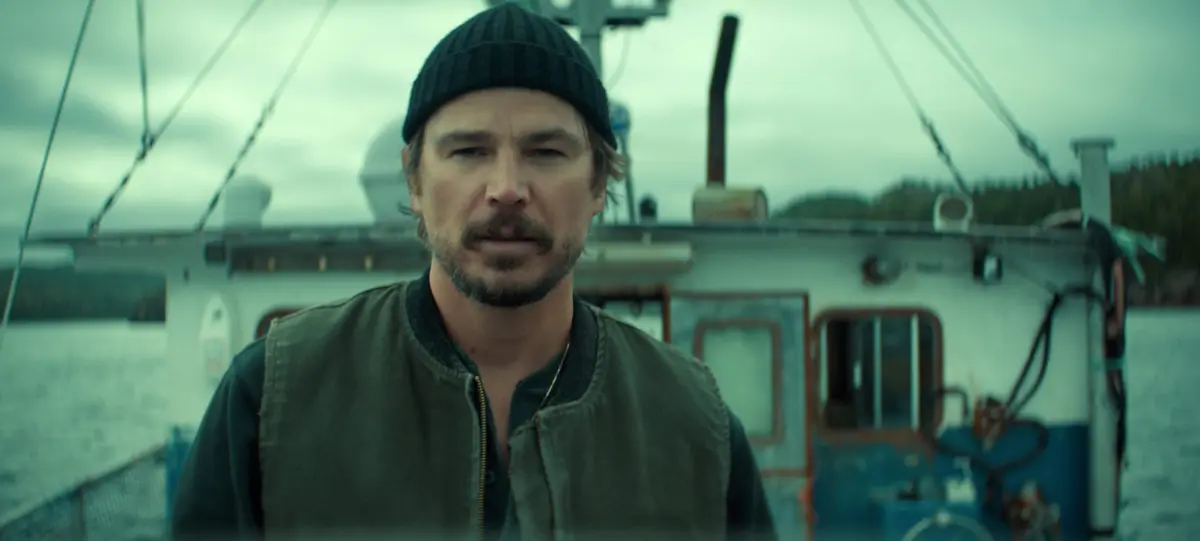
Fast-forward forty years, and the adult Calvin Penney, played by Josh Hartnett, remains a man defined by that singular, traumatic event. Despite the shadow of his father’s death, Calvin has grown into an affable and hardworking widower, a pillar of a community that is itself struggling to stay afloat. The fishing industry, once the lifeblood of Snook’s Arm, has long since dried up, leaving the residents to find increasingly creative—and often desperate—ways to survive. Calvin and his son Wade, played by Charlie Heaton, have pivoted to a modern form of scavenging: collecting ancient glacial ice to sell to a local high-end vodka brewery and operating an Airbnb out of their family home.
The arrival of "Come Home Year" brings a rare sense of celebration to the town, as former residents return to reconnect with their roots. For Calvin, the occasion is a source of genuine joy, as it brings his other two children, Mary (Ruby Stokes) and Jay (Rohan Campbell), back to the island for a week-long stay. However, the reunion is quickly overshadowed by a series of unsettling developments that suggest the ocean is no longer yielding its resources so easily. The local brewery rejects Calvin’s latest haul of ice, citing a pervasive and repulsive stench that emanates from the frozen blocks—a smell that suggests something organic and rotting has been trapped within the glacier for millennia.
This discovery leads Calvin to Dr. Fonda Howander, a scientist portrayed by Mackenzie Davis, who runs the local science center and possesses a keen understanding of the shifting environmental patterns of the region. As Calvin and Fonda begin to investigate the source of the contaminated ice, the social fabric of Snook’s Arm begins to unravel. Wade, who struggles with ADHD and attempts to self-medicate through a volatile combination of alcohol and hallucinogenic mushrooms, becomes involved in a horrific accident that sends shockwaves through the family. Simultaneously, the residents of Snook’s Cove begin to exhibit increasingly erratic and disturbing behavior, leading Calvin and Fonda to the terrifying realization that something catastrophic is occurring within the water itself.
While the series is a gripping watch from start to finish, it is not without its minor distractions. Much will likely be made of Josh Hartnett’s attempt at a specific Newfoundland accent, which at times leans toward the "hilarious" rather than the authentic. However, this quirk does little to diminish the power of his performance. Hartnett brings a grounded, soulful quality to Calvin, capturing the weariness of a man who has spent his life trying to outrun a ghost only to find himself standing exactly where his father fell. His chemistry with the rest of the cast, particularly with Charlie Heaton and Willow Kean—who plays Calvin’s sister and the town’s no-nonsense Harbor Master, Ruth—provides the emotional anchor the show needs to balance its more fantastical elements.
McKeown’s writing offers a beautiful and often heartbreaking snapshot of an eroding community. Snook’s Arm is a place where everyone knows everyone else’s business, but where secrets are nonetheless kept as a means of survival. While Calvin’s children and his sister Ruth recognize that the town is running out of time and resources, Calvin remains stubbornly determined to save it. He digs in his heels, clinging to the hope that the town can be revitalized, even as a massive, prehistoric iceberg emerges from the water like a sentinel of doom. As the residents descend into chaos, the connection between the current environmental upheaval and his father’s death forty years prior becomes impossible to ignore.
At a concise six episodes, with each installment running 45 minutes or less, "Below" avoids the narrative bloat that often plagues streaming limited series. It is an engrossing experience because it functions on multiple levels. On the surface, it is a creature feature, with a horrifying entity lurking in the periphery of the frame. But beneath that genre exterior, the show is a meditation on the human condition. It explores the desperation of a man trying to hold onto a decaying past, the complexities of a grieving family, and the way in which systemic greed can create monsters far more dangerous than anything found in the ocean.
The fourth episode, titled "The Ocean Will Have Us All," stands out as a particularly riveting piece of television. While the episode provides a more direct look at the creature that has been terrorizing the coast, its true impact lies in its portrayal of human frailty. It showcases the lengths to which individuals are willing to go when pushed to the brink, and the devastating sacrifices they are prepared to make for their own selfish gains. The final minutes of the episode offer gutting displays of inhumanity, portraying a breakdown of social order that only begins to find its context in the penultimate episode, "Little Pot Rock." This structural choice keeps the audience off-balance, mirroring the disorientation of the characters as their world is literally and figuratively submerged.
Ultimately, "Below" succeeds because it treats its central metaphor with sincerity. The climate crisis is not merely a background detail; it is the engine of the plot. By focusing on the Penney family and the specific geography of Newfoundland, McKeown addresses the fragility of life and the impermanence of the places we call home. The show serves as a stark reminder of how small humanity is when measured against the scale of the universe and the power of the natural world.
The series concludes by reminding its audience that change is an inevitable force, as relentless as the tide. In the face of such overwhelming shifts, the only path forward is to adapt and adjust. "Below" is a captivating ride that manages to blend horror, suspense, and environmental activism into a truly unique story. It challenges the viewer to look beneath the surface—not just of the ocean, but of our own motivations and the structures we have built to protect ourselves from a world that is rapidly becoming unrecognizable.
"Below" is now streaming on Netflix.