In the quiet, residential stretches of the Chicago suburbs where Brittany and Brennan Grosvenor grew up, the culinary landscape was defined by a specific, unpretentious ritual. It wasn’t called a "culinary movement" or a "regional sub-genre" back then. To the Grosvenors, and to thousands of families like theirs, it was simply pizza. The Friday night tradition didn’t involve artisanal debates over hydration levels or sourdough starters; instead, it hinged on a three-way choice that dictated the evening’s mood: thin-crust, deep-dish, or the locally beloved "double-dough."
Today, the Grosvenors are the founders of Proof, a celebrated pizzeria in Portland, Oregon. While they carry the torch of their Midwestern upbringing, the language they use to describe their craft has evolved to meet a shifting national consciousness. The "thin-crust" of their childhood has been rebranded for a broader audience as "tavern-style," a term that has rapidly transitioned from a hyper-local descriptor to a full-blown national trend. This crispy, square-cut phenomenon is currently sweeping across the United States, from the Pacific Northwest to the Atlantic coast, challenging long-held assumptions about what Chicago-style pizza actually represents.
For decades, the outside world has viewed Chicago through the lens of its famous deep-dish pizza. To many tourists, the city’s identity is synonymous with the thick, buttery, casserole-like pies served at legendary institutions downtown. However, Brittany Grosvenor points out that this perception is fundamentally disconnected from the daily reality of Midwestern life. Deep-dish, she explains, is an infrequent indulgence—a heavy meal reserved for special occasions or out-of-town guests. The true workhorse of the region is the thin-crust style, a pie that is as much a social lubricant as it is a meal.
"The pizza you get every week, or if you go to a kid’s birthday party, it’s always tavern-style," Brittany says. This is the pizza of the people—a style born in the bars and neighborhood joints where the priority was a snack that could be shared easily among friends over several rounds of beer.
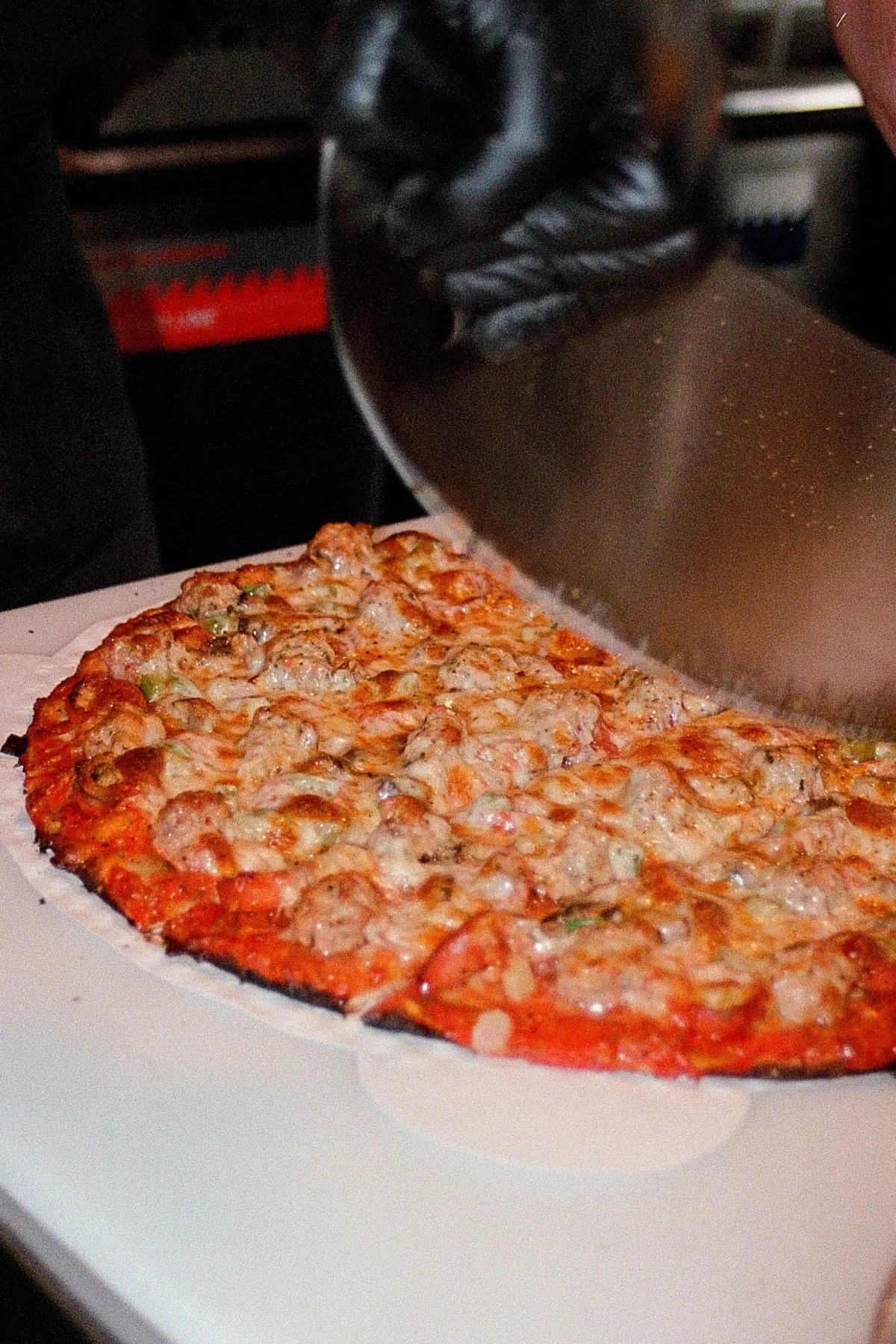
While Chicago is the primary engine of the current trend, the tavern-style DNA is woven throughout the Midwest. Cities like Milwaukee, St. Louis, and various enclaves across Minnesota all boast their own iterations of the thin, cracker-like crust. Regardless of the specific city, the hallmarks remain consistent: a dough that is rolled thin and baked until it achieves a distinct snap, topped with sauce and cheese that extend all the way to the very edge of the rim. Perhaps most importantly, the pizza is never cut into the traditional triangular wedges favored by New Yorkers. Instead, it is sliced into a grid, a technique known as the "party cut" or "lattice cut."
This grid yields a variety of pieces, from the saucy, cheese-heavy center squares to the tiny, ultra-crispy corner triangles. Depending on where a diner’s nostalgia lies, the sauce might lean toward a herbaceous spiciness or a sugary sweetness, but the lightness and crunch remain the style’s unique selling points. In 2023, writing for Esquire, food critic Omar Mamoon identified tavern-style as the perfect "foil" to the Detroit-style pizza trend that dominated the late 2010s. Where Detroit-style offered a heavy, pillowy, fried-bottom indulgence, tavern-style provides a lighter, more sustainable eating experience that doesn’t leave the diner in a state of immediate physical regret.

The beauty of the tavern-style pie lies in its inherent shareability. Bradley Shorten, a Chicago-area native and the mind behind Kim’s Uncle Pizza in Westmont, Illinois, as well as the newly opened La Merna in Washington, D.C., explains that the geometry of the grid is essential to the experience. A pizza cut into small squares simply yields more individual pieces, making it the ultimate food for a crowd. Furthermore, its size is practical; a small square of pizza fits perfectly onto a cocktail napkin, making it the ideal accompaniment for a standing-room-only bar or a crowded booth.
According to Shorten, a truly successful tavern-style pie requires a meticulous approach to toppings. Because the pieces are small, every square must contain a balanced ratio of every ingredient. There is no room for a "naked" crust; the toppings must reach the perimeter to ensure the outer pieces are as flavorful as the center. Interestingly, while the four tiny corner slices might seem like an afterthought to the uninitiated, Shorten notes they are often the most coveted pieces on the tray. "Everybody goes for them," he says, particularly those who grew up in the Chicago pizza tradition.
This shift toward the tavern-style aesthetic is part of a larger movement in the restaurant industry. In recent years, "taverns" have become a fixation for a new generation of restaurateurs looking to move away from the sterile minimalism of the 2010s. The goal is to create spaces that feel homey, lived-in, and unpretentious. This has led to a wave of tavern-style openings across the country, including Keepers in New York City, One Trick Pony in Fort Worth, Texas, and Tillie’s Tavern Pizza in Wheat Ridge, Colorado. Even in Chicago, the style is seeing a resurgence with new spots like Zarella and Dimmi Dimmi Corner Italian, where operators are leaning into the heritage of the "party cut" to reclaim the narrative of their city’s food culture.
For some Midwesterners, this national expansion is an opportunity to finally "correct the record" regarding Chicago’s pizza reputation. For others, it is a chance to claim their own stake in a regional tradition. Mike Fadem, the owner of the popular Brooklyn pizzeria Ops, recently decided to explore this territory when opening his second location. While Ops is famous for its wood-fired, Neapolitan-esque pies with pliant, sourdough crusts, Fadem—a St. Louis native—wanted to pay homage to the super-thin pizzas of his youth.
Fadem admits that the St. Louis style can be polarizing, largely due to its use of Provel, a processed cheese blend of cheddar, Swiss, and provolone that has a distinct, gooey consistency. "It’s maybe not the best version of tavern pizza," Fadem says with a laugh, acknowledging the style’s many critics. He views the evolution of tavern-style pizza as a long game of telephone: the St. Louis style was derived from Chicago’s thin-crust, which itself was an Americanized evolution of the original Neapolitan pies brought over by Italian immigrants. At each stage of the journey, the style diverged, picking up local quirks and ingredients.
Fadem’s take on the style, which he calls the "Tavernetta," is a regionally agnostic tribute. It incorporates the whole-grain sourdough flavors Ops is known for but focuses on the extreme crispness that New Yorkers crave. During his research, Fadem found that his favorite version of the style wasn’t actually in Chicago or St. Louis, but in Milwaukee. The Tavernetta has become a hit in Brooklyn, often ordered as an "extra" pie for the table—a testament to its lightness and addictive crunch.
On the West Coast, the trend is finding a home in the burgeoning cocktail scene. In Los Angeles, the cocktail destination Bar Next Door recently celebrated its third anniversary by introducing a food menu centered on tavern-style pies. Previously, the bar allowed guests to bring in pizza from the neighboring Prince Street Pizza, but owner and bar director Brynn Smith noticed a recurring problem. After eating a heavy, thick slice of Prince Street’s famous Sicilian-style pizza, customers often felt too full to continue drinking.

"After having a slice, sometimes you get a little full and you’re like, ‘I want to go to bed,’" Smith says. "That’s the whole goal for us: for people to stay a little longer, drink more. We thought the tavern-style pizza would be perfect." By branding them as "bar pies" on the menu, Smith emphasizes their role as a companion to the drinks. The pizzas are made exclusively for the bar by Prince Street, providing a unique draw that encourages patrons to linger in the dark, atmospheric space.
This connection between the food and the environment is perhaps the most vital component of the tavern-style’s success. The idea of the tavern as a social, convivial space is inseparable from the pizza itself. When Bradley Shorten and his wife, Meg Schmitt, designed La Merna in D.C., they aimed to replicate the specific "feel" of a Chicago dive bar or a Wisconsin supper club. They filled the space with wood-paneled walls, checkered floors, and red leather booths—elements that beckon diners to sprawl out and stay for a while.
In an era where many dining experiences feel increasingly transactional or optimized for social media, the tavern offers a return to something more grounded. It taps into a collective nostalgia for a simpler era, even for those who didn’t grow up in the Midwest. The archetype of the hometown pizza shop, with its pitchers of beer and shareable squares, represents a form of hospitality that is welcoming precisely because it is familiar and unpretentious.
Back in Oregon, the Grosvenors are leaning even further into this Midwestern nostalgia. At Proof, they have expanded their menu beyond pizza to include other regional staples like Bosco sticks—the cheese-stuffed breadsticks ubiquitous in Midwestern school cafeterias—and Italian beef sandwiches served with spicy giardiniera. For years, they felt the frustration of being able to find certain Midwestern hits in Portland but never all in one place.
As Brennan Grosvenor puts it, the mission is about more than just the recipe; it’s about capturing a specific cultural essence. "We’re just trying to embody the feeling," he says. "If you went into a tavern in Chicago, what could you order there?" By answering that question, they and other pizzerias across the country are proving that the "party cut" isn’t just a way to slice a pizza—it’s a way to bring people together.