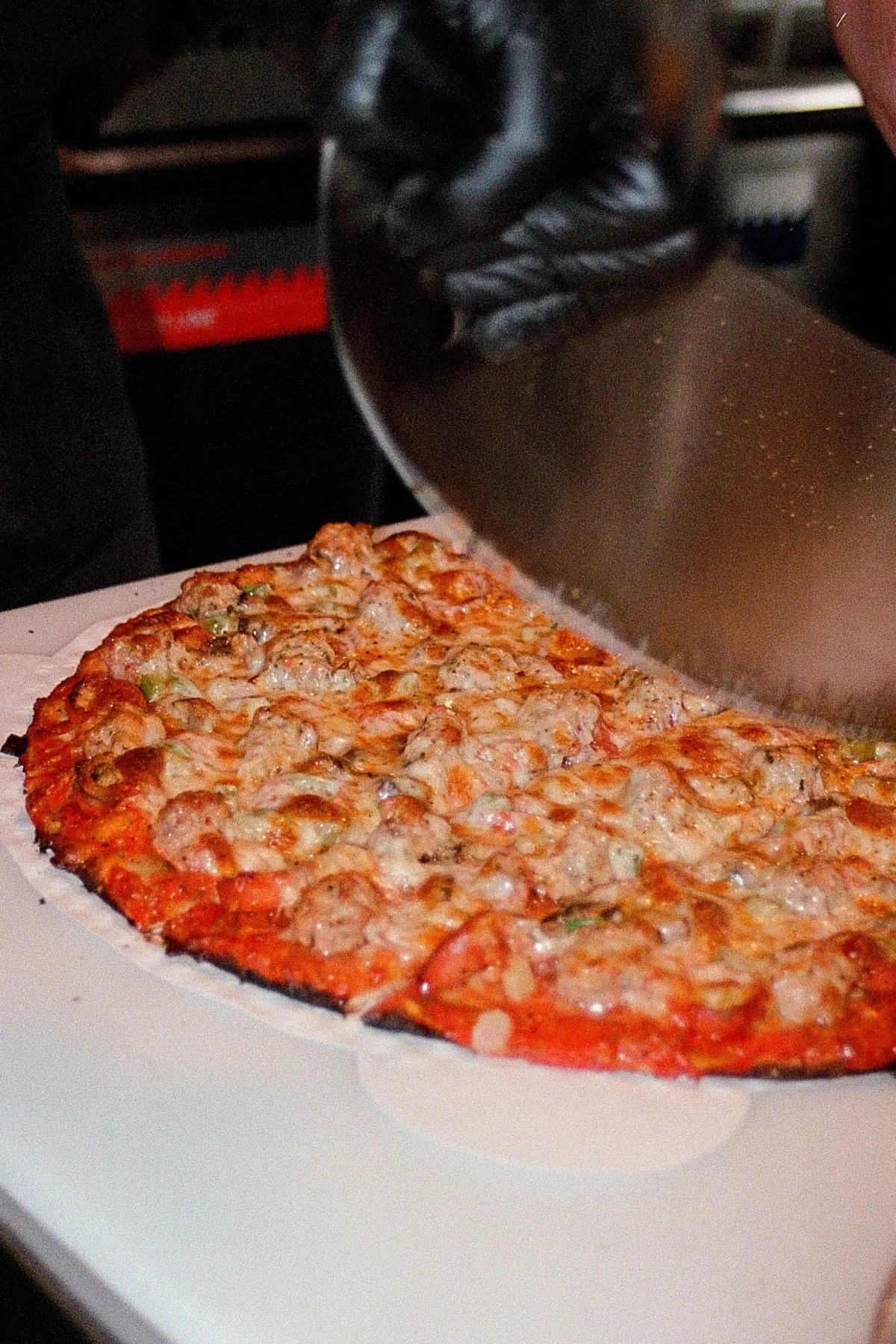
On the West Coast, the trend is finding a home in the burgeoning cocktail scene. In Los Angeles, the cocktail destination Bar Next Door recently celebrated its third anniversary by introducing a food menu centered on tavern-style pies. Previously, the bar allowed guests to bring in pizza from the neighboring Prince Street Pizza, but owner and bar director Brynn Smith noticed a recurring problem. After eating a heavy, thick slice of Prince Street’s famous Sicilian-style pizza, customers often felt too full to continue drinking.

"After having a slice, sometimes you get a little full and you’re like, ‘I want to go to bed,’" Smith says. "That’s the whole goal for us: for people to stay a little longer, drink more. We thought the tavern-style pizza would be perfect." By branding them as "bar pies" on the menu, Smith emphasizes their role as a companion to the drinks. The pizzas are made exclusively for the bar by Prince Street, providing a unique draw that encourages patrons to linger in the dark, atmospheric space.
This connection between the food and the environment is perhaps the most vital component of the tavern-style’s success. The idea of the tavern as a social, convivial space is inseparable from the pizza itself. When Bradley Shorten and his wife, Meg Schmitt, designed La Merna in D.C., they aimed to replicate the specific "feel" of a Chicago dive bar or a Wisconsin supper club. They filled the space with wood-paneled walls, checkered floors, and red leather booths—elements that beckon diners to sprawl out and stay for a while.
In an era where many dining experiences feel increasingly transactional or optimized for social media, the tavern offers a return to something more grounded. It taps into a collective nostalgia for a simpler era, even for those who didn’t grow up in the Midwest. The archetype of the hometown pizza shop, with its pitchers of beer and shareable squares, represents a form of hospitality that is welcoming precisely because it is familiar and unpretentious.
Back in Oregon, the Grosvenors are leaning even further into this Midwestern nostalgia. At Proof, they have expanded their menu beyond pizza to include other regional staples like Bosco sticks—the cheese-stuffed breadsticks ubiquitous in Midwestern school cafeterias—and Italian beef sandwiches served with spicy giardiniera. For years, they felt the frustration of being able to find certain Midwestern hits in Portland but never all in one place.
As Brennan Grosvenor puts it, the mission is about more than just the recipe; it’s about capturing a specific cultural essence. "We’re just trying to embody the feeling," he says. "If you went into a tavern in Chicago, what could you order there?" By answering that question, they and other pizzerias across the country are proving that the "party cut" isn’t just a way to slice a pizza—it’s a way to bring people together.