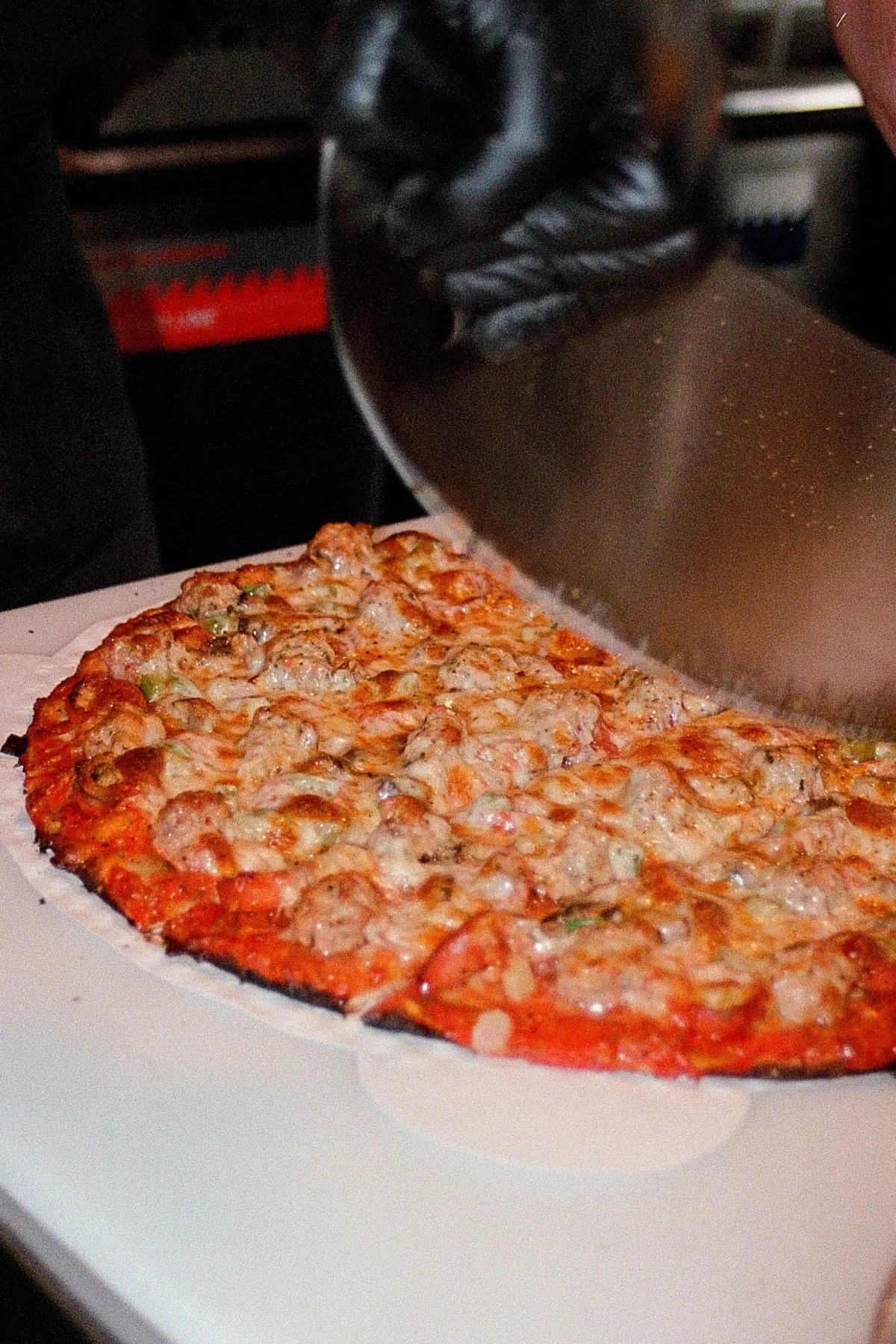

The beauty of the tavern-style pie lies in its inherent shareability. Bradley Shorten, a Chicago-area native and the mind behind Kim’s Uncle Pizza in Westmont, Illinois, as well as the newly opened La Merna in Washington, D.C., explains that the geometry of the grid is essential to the experience. A pizza cut into small squares simply yields more individual pieces, making it the ultimate food for a crowd. Furthermore, its size is practical; a small square of pizza fits perfectly onto a cocktail napkin, making it the ideal accompaniment for a standing-room-only bar or a crowded booth.
According to Shorten, a truly successful tavern-style pie requires a meticulous approach to toppings. Because the pieces are small, every square must contain a balanced ratio of every ingredient. There is no room for a "naked" crust; the toppings must reach the perimeter to ensure the outer pieces are as flavorful as the center. Interestingly, while the four tiny corner slices might seem like an afterthought to the uninitiated, Shorten notes they are often the most coveted pieces on the tray. "Everybody goes for them," he says, particularly those who grew up in the Chicago pizza tradition.
This shift toward the tavern-style aesthetic is part of a larger movement in the restaurant industry. In recent years, "taverns" have become a fixation for a new generation of restaurateurs looking to move away from the sterile minimalism of the 2010s. The goal is to create spaces that feel homey, lived-in, and unpretentious. This has led to a wave of tavern-style openings across the country, including Keepers in New York City, One Trick Pony in Fort Worth, Texas, and Tillie’s Tavern Pizza in Wheat Ridge, Colorado. Even in Chicago, the style is seeing a resurgence with new spots like Zarella and Dimmi Dimmi Corner Italian, where operators are leaning into the heritage of the "party cut" to reclaim the narrative of their city’s food culture.
For some Midwesterners, this national expansion is an opportunity to finally "correct the record" regarding Chicago’s pizza reputation. For others, it is a chance to claim their own stake in a regional tradition. Mike Fadem, the owner of the popular Brooklyn pizzeria Ops, recently decided to explore this territory when opening his second location. While Ops is famous for its wood-fired, Neapolitan-esque pies with pliant, sourdough crusts, Fadem—a St. Louis native—wanted to pay homage to the super-thin pizzas of his youth.
Fadem admits that the St. Louis style can be polarizing, largely due to its use of Provel, a processed cheese blend of cheddar, Swiss, and provolone that has a distinct, gooey consistency. "It’s maybe not the best version of tavern pizza," Fadem says with a laugh, acknowledging the style’s many critics. He views the evolution of tavern-style pizza as a long game of telephone: the St. Louis style was derived from Chicago’s thin-crust, which itself was an Americanized evolution of the original Neapolitan pies brought over by Italian immigrants. At each stage of the journey, the style diverged, picking up local quirks and ingredients.
Fadem’s take on the style, which he calls the "Tavernetta," is a regionally agnostic tribute. It incorporates the whole-grain sourdough flavors Ops is known for but focuses on the extreme crispness that New Yorkers crave. During his research, Fadem found that his favorite version of the style wasn’t actually in Chicago or St. Louis, but in Milwaukee. The Tavernetta has become a hit in Brooklyn, often ordered as an "extra" pie for the table—a testament to its lightness and addictive crunch.