ALLENTOWN, Pa. — “Una sola cosa. Just one thing.”
That was the simple, pointed challenge Victor Martinez issued to the listeners of his Spanish-language radio station. In a region where the political winds are as unpredictable as the seasonal shifts of the Northeast, Martinez wanted to hear just one positive development regarding the administration of President Donald Trump. He waited, his hands hovering over the control board of his fourth-floor studio in downtown Allentown, ready to facilitate a conversation that has become increasingly fraught with tension.
The responses began to trickle in, reflecting a community grappling with the complexities of a second Trump term. One caller brought up the $5,000 payout Trump had promised to American families—a pledge contingent on Republicans maintaining their grip on Congress. To Martinez, the idea felt more like a punchline than a policy. He met the suggestion with a sharp press of a button, filling the airwaves with a pre-recorded laugh track that echoed through the studio’s hardwood floors and out into the bustling streets of the Lehigh Valley.
However, the humor quickly gave way to the sobering reality of the current economic climate. A local trucker called in, not with a joke, but with a grim silver lining born of necessity. He told Martinez that because diesel prices had climbed to such astronomical heights, he could no longer afford to keep his rig on the road. His "positive" news was an unplanned, forced vacation—a break from the grind only because the cost of working had exceeded the profit of the haul.
Martinez has occupied this seat for nearly a decade, serving as a vital bridge for a Latino population that has grown from a fifth to nearly a quarter of the Lehigh Valley’s demographic over the same period. His show is more than just entertainment; it is a barometer for the frustrations of a community that feels increasingly squeezed by the gears of national politics. Toward the end of Trump’s first term, Martinez added a dedicated hour of political discussion to his morning talk show, responding to a flood of calls regarding the January 6 attack on the U.S. Capitol and deep-seated anxieties over inflation and the aging leadership of the Democratic Party.
Now, at the halfway mark of Trump’s second term, the atmosphere has shifted from shock to a weary, simmering anger. The concerns about democratic institutions have been largely eclipsed by the immediate, daily struggle of the checkbook. According to Martinez, the frustration today is just as palpable as it was during the height of the previous administration’s controversies, but the focus has narrowed significantly to the cost of living.
“It’s the economy, stupid. That’s what it is,” Martinez said, invoking the famous political mantra of the 1990s. “I mean, things have gotten so bad. People didn’t think Biden did a good job. Everything was expensive and now it’s worse.”
Latinos make up a key part of a winning coalition
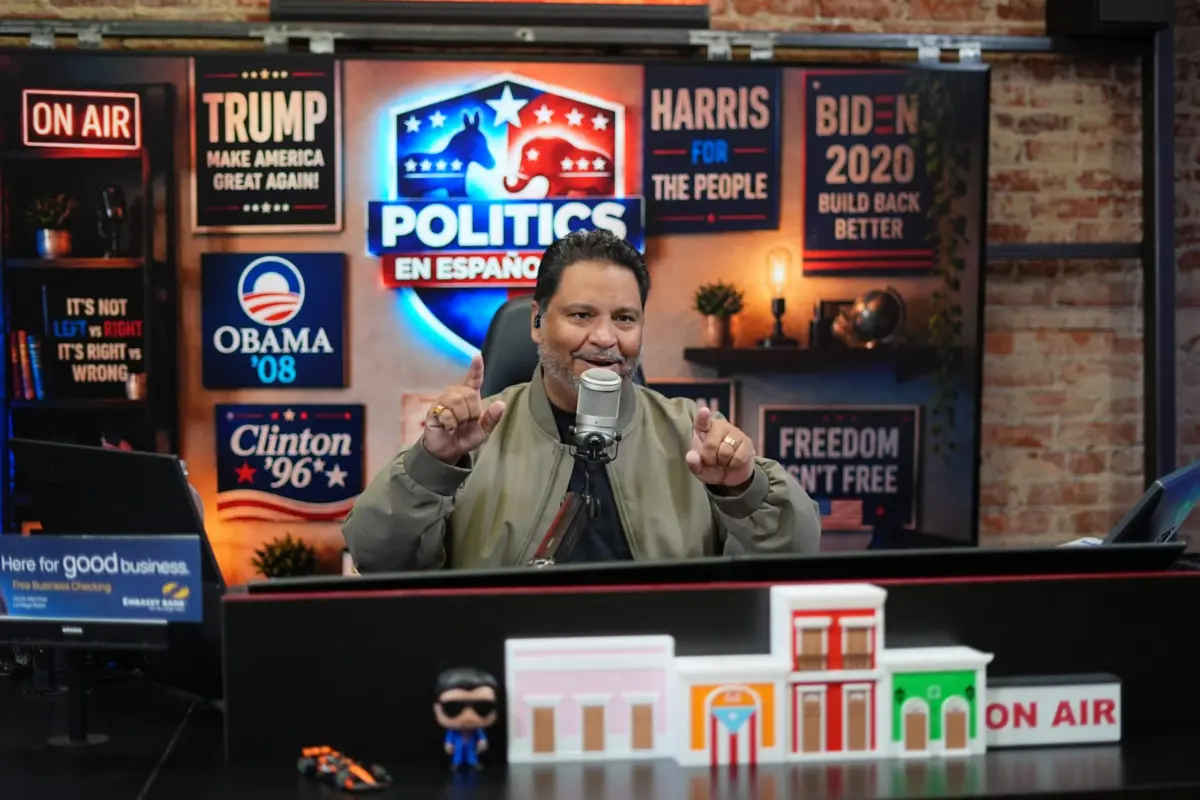
The studio where Martinez broadcasts offers a sweeping view of an old church, a symbol of the deep-rooted community ties in Allentown. Martinez operates the station with the precision of an orchestra conductor, balanced by the visual clutter of a modern political battlefield. Behind him, a poster is plastered with campaign signs for both Democrats and Republicans, reflecting the purple nature of the district he serves.
This is Pennsylvania’s 7th Congressional District, a perennial swing territory and a focal point for national political strategists. The race here is among the most closely watched in the country, featuring a high-stakes showdown between freshman Republican incumbent Ryan Mackenzie and his Democratic challenger, Bob Brooks. Brooks, a retired firefighter and former union official, is attempting to reclaim the seat for his party by leaning into his blue-collar roots.
The stakes could not be higher. Latinos now comprise approximately 25% of the district’s population, and their shift toward the GOP was a cornerstone of Trump’s successful coalition two years ago. For Republicans, holding this demographic is essential to maintaining their majority; for Democrats, winning them back is the only viable path to power.