ALLENTOWN, Pa. — “Una sola cosa. Just one thing.”
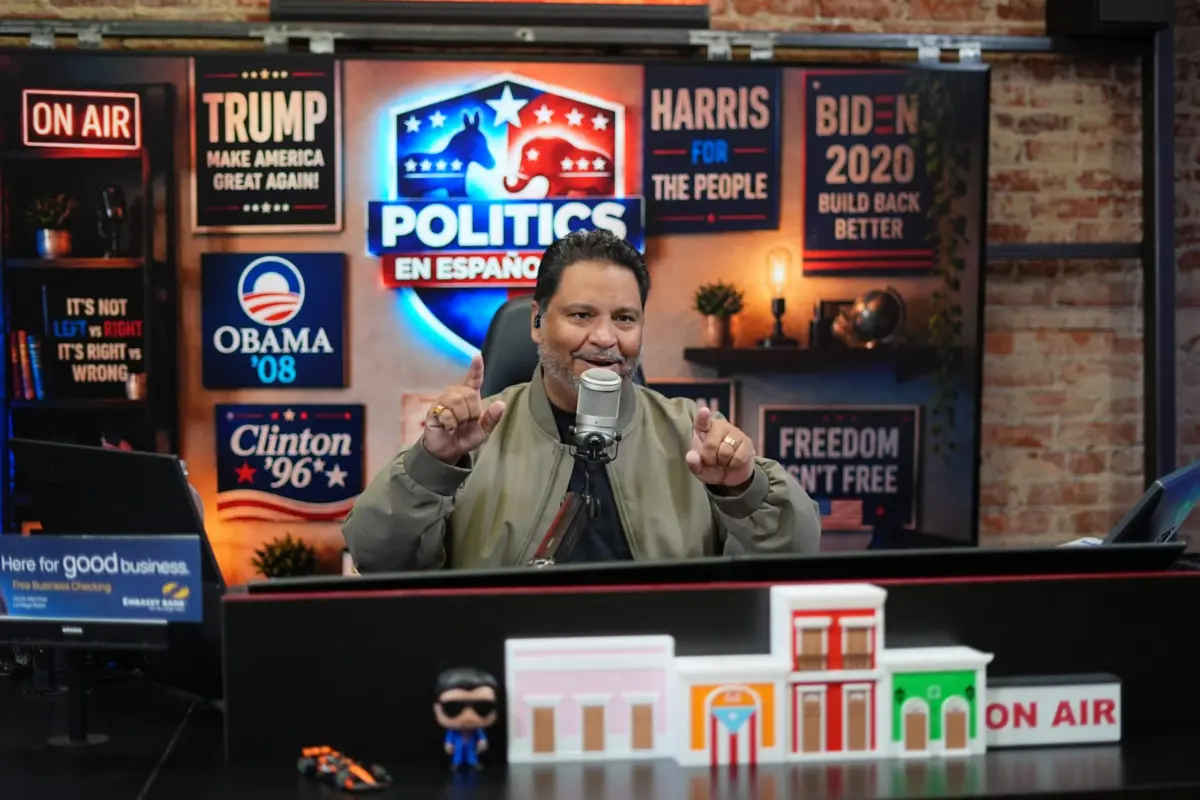
That was the simple, pointed challenge Victor Martinez issued to the listeners of his Spanish-language radio station. In a region where the political winds are as unpredictable as the seasonal shifts of the Northeast, Martinez wanted to hear just one positive development regarding the administration of President Donald Trump. He waited, his hands hovering over the control board of his fourth-floor studio in downtown Allentown, ready to facilitate a conversation that has become increasingly fraught with tension.
The responses began to trickle in, reflecting a community grappling with the complexities of a second Trump term. One caller brought up the $5,000 payout Trump had promised to American families—a pledge contingent on Republicans maintaining their grip on Congress. To Martinez, the idea felt more like a punchline than a policy. He met the suggestion with a sharp press of a button, filling the airwaves with a pre-recorded laugh track that echoed through the studio’s hardwood floors and out into the bustling streets of the Lehigh Valley.
However, the humor quickly gave way to the sobering reality of the current economic climate. A local trucker called in, not with a joke, but with a grim silver lining born of necessity. He told Martinez that because diesel prices had climbed to such astronomical heights, he could no longer afford to keep his rig on the road. His "positive" news was an unplanned, forced vacation—a break from the grind only because the cost of working had exceeded the profit of the haul.
Martinez has occupied this seat for nearly a decade, serving as a vital bridge for a Latino population that has grown from a fifth to nearly a quarter of the Lehigh Valley’s demographic over the same period. His show is more than just entertainment; it is a barometer for the frustrations of a community that feels increasingly squeezed by the gears of national politics. Toward the end of Trump’s first term, Martinez added a dedicated hour of political discussion to his morning talk show, responding to a flood of calls regarding the January 6 attack on the U.S. Capitol and deep-seated anxieties over inflation and the aging leadership of the Democratic Party.
Now, at the halfway mark of Trump’s second term, the atmosphere has shifted from shock to a weary, simmering anger. The concerns about democratic institutions have been largely eclipsed by the immediate, daily struggle of the checkbook. According to Martinez, the frustration today is just as palpable as it was during the height of the previous administration’s controversies, but the focus has narrowed significantly to the cost of living.
“It’s the economy, stupid. That’s what it is,” Martinez said, invoking the famous political mantra of the 1990s. “I mean, things have gotten so bad. People didn’t think Biden did a good job. Everything was expensive and now it’s worse.”
Latinos make up a key part of a winning coalition
The studio where Martinez broadcasts offers a sweeping view of an old church, a symbol of the deep-rooted community ties in Allentown. Martinez operates the station with the precision of an orchestra conductor, balanced by the visual clutter of a modern political battlefield. Behind him, a poster is plastered with campaign signs for both Democrats and Republicans, reflecting the purple nature of the district he serves.
This is Pennsylvania’s 7th Congressional District, a perennial swing territory and a focal point for national political strategists. The race here is among the most closely watched in the country, featuring a high-stakes showdown between freshman Republican incumbent Ryan Mackenzie and his Democratic challenger, Bob Brooks. Brooks, a retired firefighter and former union official, is attempting to reclaim the seat for his party by leaning into his blue-collar roots.
The stakes could not be higher. Latinos now comprise approximately 25% of the district’s population, and their shift toward the GOP was a cornerstone of Trump’s successful coalition two years ago. For Republicans, holding this demographic is essential to maintaining their majority; for Democrats, winning them back is the only viable path to power.
Recognizing the gravity of the situation, both campaigns have launched aggressive, culturally specific outreach efforts. Brooks has embraced the moniker “Bombero Bob”—Spanish for “firefighter Bob.” He has been a frequent sight in the community, recently stopping by a local Mexican restaurant and a barber shop where a Dominican flag hangs prominently in the window. His strategy is one of presence and shared labor values, aiming to convince voters that his background as a first responder makes him a more authentic advocate for their safety and economic stability.
On the other side, Mackenzie’s campaign has not ceded any ground. The incumbent has touted his endorsements from Latino business owners and local officials, framing the Republican platform as the one most aligned with the entrepreneurial spirit of the community. To solidify this connection, Mackenzie opened a district office in the heart of downtown Allentown, specifically staffing it with Spanish-speaking representatives to ensure that constituent services are accessible to the city’s largest demographic.
Despite his background, Martinez remains a vocal critic of the current president. This year, he is putting his support behind Brooks, though he is quick to note that his own political journey began in the Republican Party. He once supported figures like Marco Rubio and Jeb Bush, seeing in them a version of conservatism that felt inclusive. His break with the Democrats was also notable; he had publicly opposed Joe Biden’s decision to seek reelection, citing concerns over the former president’s age and ability to lead.
For Martinez, the radio show is a tool to combat the growing sense of political nihilism. He sees his role as keeping the electorate engaged at a time when many feel that their vote no longer influences the price of eggs or the cost of a gallon of gas.
“I got a call yesterday from a guy that said that he was just not going to vote,” Martinez said. “I understand that feeling of frustration, but not doing nothing is not the answer.”
Economic stress looms over the campaign
The Republican Party is acutely aware of the influence Martinez wields. Despite his personal leanings, the GOP continues to purchase significant advertising time on his station, recognizing it as the most direct pipeline to the voters they need.
Jackie Rivera, the vice chair of the Lehigh County Republicans, is at the forefront of this effort. She acknowledges that the party cannot simply rely on the momentum of the last election. To maintain the support of Latino voters, she believes the GOP must pivot toward issues of “faith and family,” while remaining transparent about the current economic hardships.
While President Trump frequently uses his platform to boast about the strength of the economy under his leadership, Rivera suggests a more nuanced approach on the ground. She notes that the party is careful not to repeat what they viewed as the mistakes of the Democrats during the Biden years—appearing out of touch with the reality of working-class struggles.
“We’re not pretending everything is great right now,” Rivera said. “You have to be honest with them so that they can believe in you and actually trust in what you’re stating to them.”
This sentiment is echoed, albeit from a different perspective, by Allentown’s Democratic Mayor, Matt Tuerk. He observes that the current election cycle carries the “same vibes” as the one two years ago, when the Democratic establishment was struggling to convince a skeptical public that the economy was on the mend.
“People on the street were like, ‘Yeah, but my monthly childcare bill is higher and then my monthly mortgage, the price of groceries is ridiculously high,’” Tuerk said. “That’s the same story that you hear right now. There’s been no improvement.”
The disconnect between macroeconomic indicators and the "kitchen table" reality remains the primary obstacle for both parties. In the Lehigh Valley, where many families live paycheck to paycheck, the abstract numbers of the stock market or GDP growth matter far less than the immediate cost of a trip to the supermarket.
Gas and grocery prices contribute to living ‘day by day’
For the listeners who tune in every morning, the radio station serves as a communal space to process these pressures. Claudia Parrales-DeLeon, a Democrat from Allentown, says that Martinez’s show provides a sense of solidarity. In an era where many feel isolated by economic hardship and the fear of Trump’s intensified immigration crackdowns, the airwaves offer a place to be heard.
“I don’t know if it makes people less afraid, as much as it makes people more informed,” she said.
Parrales-DeLeon recalled a specific moment on the air that highlighted the desperation many are facing. A caller had dialed in to share that he had recently lost his job and was unable to find new work. The man spoke of the crushing uncertainty of not knowing where his next meal would come from, or how he would feed his children.
“It brought tears to my eyes,” she said, noting that such stories have become increasingly common as the "day by day" struggle intensifies.
This sentiment is shared by Alberto Pena, even though he isn’t a regular listener of the show. For nearly twenty years, Pena and his wife have operated a Dominican restaurant in Allentown. On any given afternoon, the dining room is filled with the rich, savory aroma of rice and crispy pastelillos, but the atmosphere behind the counter is heavy with worry.
Pena originally voted for Trump, hoping that the businessman-turned-politician would be able to reverse the high inflation that characterized the Biden years. He wanted a change that would stabilize his business and provide a more secure future for his family. Two years into the second Trump term, however, that hope has curdled into disappointment.
“This is not what we expected,” Pena said, looking around his restaurant. “The economy is completely on the ground.”
Despite his previous support for the Republican ticket, Pena says he is now leaning toward “Bombero Bob” Brooks. For him, the decision isn’t about grand ideology; it’s about survival. Like many in the Lehigh Valley, he is looking for a sign—any sign—that the political process can offer more than just talk and laugh tracks, but a genuine path toward relief.