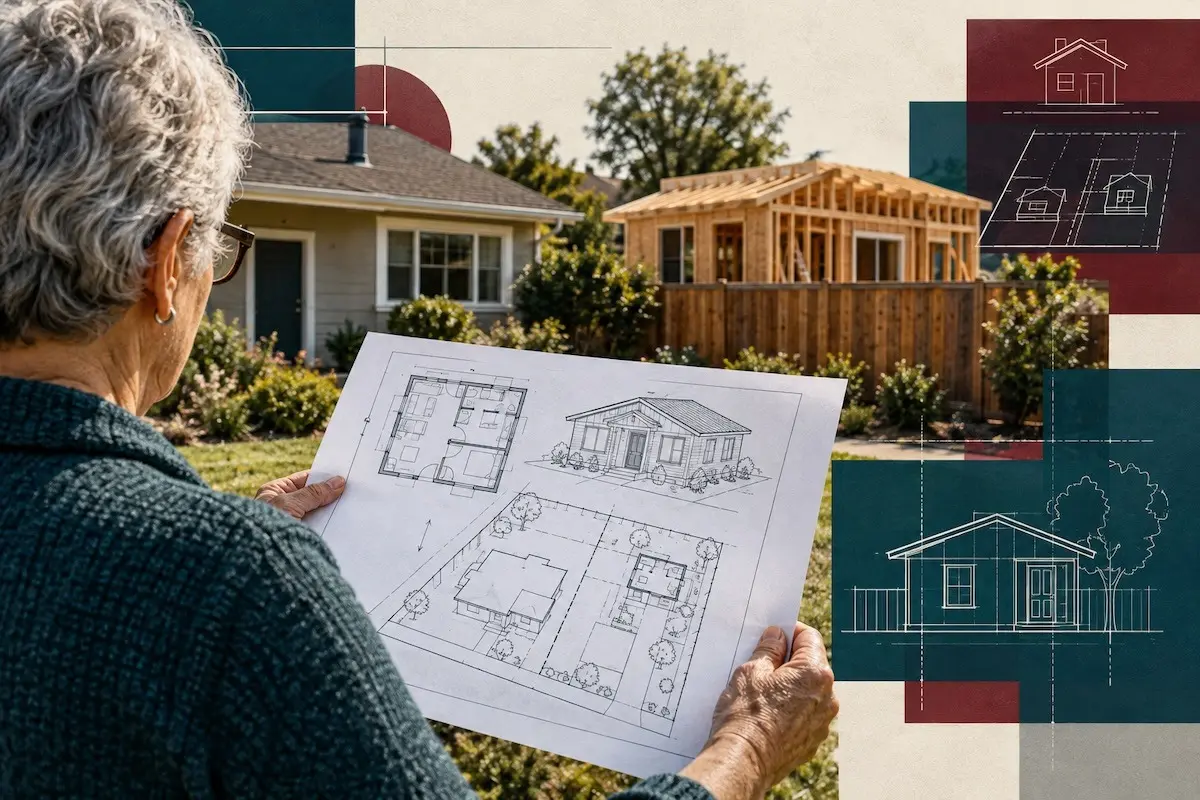
In an effort to address the dual crises of senior financial instability and a chronic shortage of family housing, Alameda County, California, is developing a first-of-its-kind initiative. The program seeks to empower older homeowners on fixed incomes to leverage their property’s value by building accessory dwelling units (ADUs), subdividing their lots, and selling their original family homes. This strategic move is designed to provide seniors with modern, accessible living spaces while simultaneously creating new homeownership opportunities for families in one of the nation’s most expensive real estate markets.
The initiative, currently being refined by the Alameda County Housing Department, offers a specialized pathway for seniors who are often described as "house rich but cash poor." Many long-term residents in the East Bay own properties that have appreciated significantly over decades, yet they struggle to cover rising property taxes, healthcare costs, and daily living expenses on stagnant retirement incomes. By utilizing a combination of recent state laws, the county hopes to provide a structural solution that allows these residents to remain in their neighborhoods while gaining financial independence.
A Strategic Framework Built on State Legislation
The proposed program does not exist in a vacuum; rather, it is a sophisticated integration of several landmark California housing laws passed in recent years. To make the "build, split, and sell" model viable, Alameda County is drawing on the combined power of Assembly Bill 68, Senate Bill 9, and Proposition 19.
Assembly Bill 68, which significantly eased the restrictions on ADU construction across the state, serves as the foundation for the physical expansion of housing on existing lots. By streamlining the permitting process and reducing requirements for parking and setbacks, the law made it feasible for homeowners to add secondary units even on smaller suburban lots. However, building an ADU is only the first step in the Alameda County model.
The critical mechanism for financial liberation comes from Senate Bill 9 (SB 9), the California Homebuild Act. This legislation allows qualifying property owners to split a single-family residential lot into two separate parcels. Under the county’s proposed program, a senior would build a high-quality ADU on their property, legally subdivide the lot so the ADU sits on its own parcel, and then sell the original primary residence. This allows the homeowner to retain ownership of the new, smaller unit while generating a significant windfall from the sale of the larger home.
Furthermore, the program utilizes Proposition 19, a constitutional amendment approved by California voters in 2020. Prop 19 allows homeowners who are over 55, severely disabled, or victims of wildfires or natural disasters to transfer the taxable value of their primary residence to a replacement residence. In the context of the Alameda County program, this is vital; it ensures that a senior moving from a large family home into a newly built ADU on the same subdivided lot does not face a massive, unaffordable spike in property taxes based on current market valuations.
The Vision of ‘Right-Sizing’ and Community Stability
Michelle Starratt, the director of the Alameda County Housing Department, views the initiative as a way to facilitate "right-sizing" for a demographic that is often overlooked in traditional housing development. For many seniors, the large multi-bedroom homes where they raised their families have become a physical and financial burden. Maintaining a large structure and yard can be grueling, and many older homes lack the accessibility features—such as single-floor layouts or walk-in showers—necessary for aging in place safely.
“That senior is then walking away with a smaller unit, a right-sized unit that they then can live in, hopefully more accessible, and we have created an opportunity for a new family to have a home,” Starratt told the San Francisco Chronicle.