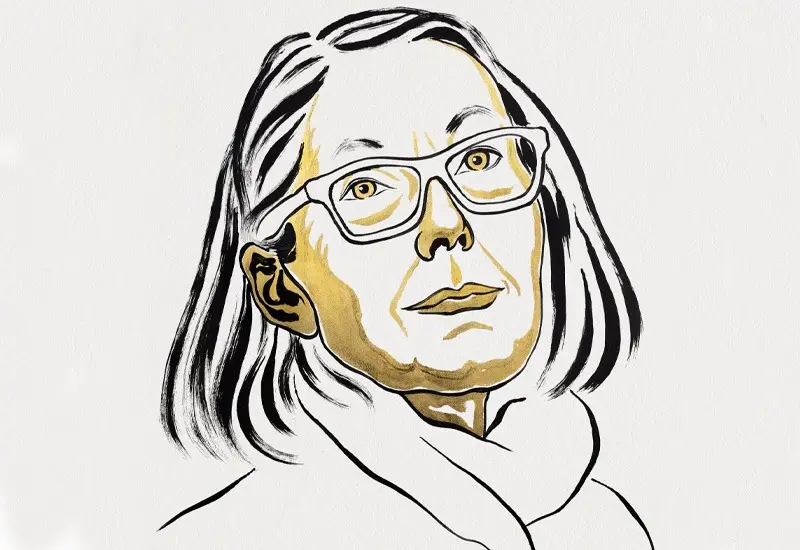
The news reached Carson in a setting that many of her readers would find characteristically atmospheric. When the Academy’s permanent secretary placed the traditional call to notify the laureate, Carson was in Iceland. When asked what she was doing at the moment the world’s most prestigious literary honor was bestowed upon her, she replied simply that she was "listening to the wind." The response, at once grounded and ethereal, underscores the temperament of a writer who has spent her career navigating the spaces between the physical world and the echoes of the past.
Born in Toronto in 1950, Carson has long maintained a public persona defined by a blend of academic rigor and creative mystery. For decades, her biographical notes have famously and succinctly stated that she "teaches ancient Greek for a living," a nod to her career as a classicist that informs every facet of her creative output. This foundation in the languages and literatures of antiquity—Homer, Sappho, Euripides, and Stesichorus—serves as the bedrock upon which she builds her experimental structures. Rather than merely translating the classics, Carson engages in a living conversation with them, treating the ancient world not as a relic, but as a vibrant, ongoing presence.
The Swedish Academy’s decision highlights Carson’s ability to dismantle the boundaries between genres. Throughout her career, she has consistently defied the traditional categories of poetry, essay, novel, and drama. Her work is often described as "form-bending," a term that barely captures the physical and intellectual variety of her publications. Perhaps the most striking example of this is "Nox," published in 2010. Rather than a standard bound volume, "Nox" is presented as a sturdy box containing a single, continuous accordion-folded sheet. This physical object serves as an epitaph for her estranged brother, Michael, who died in Copenhagen in 2005. The work combines photographs, letters, sketches, and a word-by-word breakdown of Catullus’s Poem 101, a Roman elegy for a brother. By turning a book into a sculptural object, Carson forced readers to engage with the tactile reality of grief and the fragmented nature of memory.
Carson’s breakthrough into wider public consciousness came with the 1998 publication of "Autobiography of Red." Nominally a "novel in verse," the book is a reimagining of the myth of Geryon, a red winged monster who was slain by Herakles in classical mythology. In Carson’s hands, Geryon becomes a sensitive, red-skinned young boy coming of age in the modern world, navigating a difficult romance with a charismatic youth named Herakles and finding solace in photography. The work was praised not only for its lyrical beauty but for its unexpected humor and its ability to make the mythological feel urgently contemporary. It remains one of her most accessible and beloved works, serving as a gateway for readers into her more challenging later experiments.
The 2026 Nobel win also brings renewed attention to her more recent successes, particularly "Wrong Norma," published by New Directions in 2024. This collection, which was a finalist for the National Book Award and won the National Book Critics Circle Award, exemplifies Carson’s late-career vitality. Like much of her work, "Wrong Norma" resists easy summary, blending prose, poetry, and visual elements to explore themes of identity, language, and the surreal nature of daily life. Its critical success signaled that Carson remained at the height of her creative powers, continuing to push the envelope of what literature can achieve.
Her bibliography is a testament to a restless intellectual curiosity. In 2001, she released "The Beauty of the Husband: A Fictional Essay in 29 Tangos," which won the T.S. Eliot Prize for Poetry. The book explores the dissolution of a marriage, using the structure of the tango to mirror the back-and-forth movement of a relationship defined by both desire and betrayal. Each "tango" is prefaced by a quote from John Keats, further illustrating her habit of weaving historical literary voices into her personal narratives.
Carson’s work often revisits its own themes and characters, creating a self-referential universe. In 2013, she published "Red Doc>," a sequel of sorts to "Autobiography of Red." In this volume, the characters Geryon and Herakles (now "G" and "Sad") return as older, more weathered versions of themselves, navigating a landscape that is both mythological and mundane. The book’s layout—narrow columns of text centered on the page—demonstrates her continued interest in how the visual presentation of words affects the reader’s experience of time and meaning. This was followed in 2016 by "Float," another experimental package consisting of twenty-two individual chapbooks contained within a transparent case. The format allows readers to encounter the poems and essays in any order, reflecting Carson’s belief in the fluidity of thought and the "floating" nature of artistic inspiration.
Beyond her original creative work, Carson is revered as one of the preeminent translators of our time. Her 2002 volume "If Not, Winter: Fragments of Sappho" is considered a landmark in the field. Rather than attempting to "fill in the blanks" of Sappho’s ravaged papyri, Carson used brackets and white space to represent the missing portions of the ancient texts. This approach allowed the silence of history to speak as loudly as the surviving words, creating a hauntingly beautiful reading experience that respected the fragmentary nature of the original material. Her scholarly background also produced "Eros the Bittersweet," an influential long essay that examines the nature of desire in ancient Greek literature. Originally published in 1986, the work argues that "eros" is defined by the gap between the lover and the beloved—a space of lack that Carson has spent her entire career exploring through various literary lenses.
The Academy’s recognition of Carson is also a recognition of her unique brand of irony and playfulness. Despite the heavy weight of her classical influences and the often-tragic themes of her work, Carson’s writing is frequently shot through with a dry, sharp wit. She has a penchant for the unexpected, whether it is inserting a "fictional essay" into a poem or describing a red monster’s mother as a woman who "liked to smoke and look at the kitchen clock." This playfulness is what prevents her work from ever feeling academic in a dry or inaccessible sense; instead, it feels like an invitation to join her in a sophisticated game of intellectual and emotional discovery.
As a Canadian author, Carson joins the ranks of Alice Munro as a Nobel laureate from her home country, further cementing Canada’s significant contribution to global literature. Her win is likely to spark a renewed interest in the "classical tradition" the Academy mentioned, as readers look to understand the foundations upon which she has built her revolutionary contemporary forms.
Throughout the afternoon following the announcement, tributes began to pour in from the literary community. Peers and critics alike noted that Carson’s win feels like a validation of the "difficult" and the "experimental" at a time when the literary market often favors more conventional narratives. By awarding the prize to a writer who listens to the wind and translates the silence of Sappho, the Swedish Academy has signaled a deep appreciation for the enduring power of the avant-garde.
Carson has spent her life teaching Greek and writing books that refuse to stay within their margins. Today, that lifelong dedication to the "bittersweet" nature of language and the "playful dialogue" with the past has earned her the highest honor in the world of letters. As she remains in Iceland, perhaps still listening to the wind, the rest of the world is once again turning to the pages of "Autobiography of Red," "Nox," and "Wrong Norma" to rediscover the "new forms" she has so masterfully created. The 2026 Nobel Prize in Literature does not just honor a career; it honors a unique way of seeing the world—one where the ancient and the modern are in constant, beautiful, and restless motion.