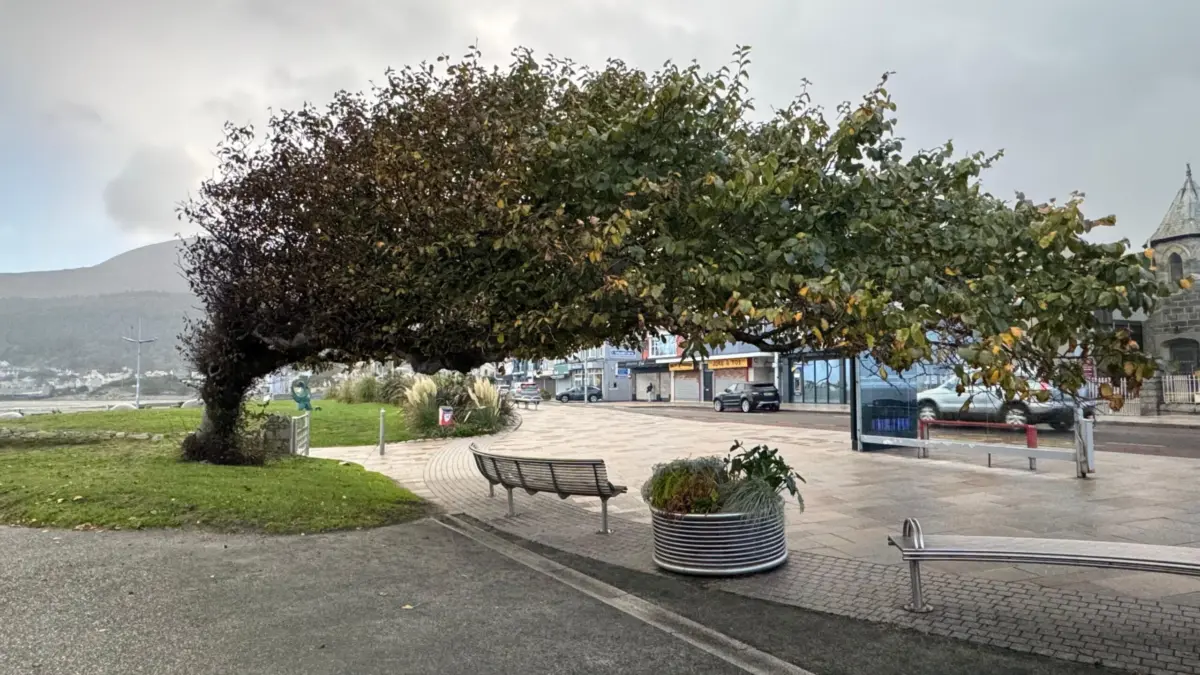
The Last Tree Leaning: A Century and a Half of Survival
The history of the Bendy Tree is intimately linked with the development of Newcastle as a popular seaside destination. Planted approximately 150 years ago during the 19th century, the wych elm was not originally a solitary landmark. Instead, it was part of a formal row of trees planted along the town’s original seaside promenade. The purpose of the row was highly practical: to provide a physical shelter for Victorian strollers, protecting them from the fierce, salty sea breezes blowing in from the Irish Sea.
Over the decades, the environment shaped the trees, but human activity eventually proved to be a more immediate threat. During a major redevelopment of the Newcastle promenade in the 1980s, the decision was made to fell the historic row of trees. Through a combination of luck, local appreciation, and sheer physical placement, the bendy wych elm was spared, making it the last remaining survivor of the original Victorian planting.
The relentless coastal winds that the tree was planted to block have left a permanent mark on its physical form. Decades of strong onshore gales forced the trunk to grow at an extreme angle, leaving it running almost parallel to the ground. Today, the tree forms a dramatic, leafy archway over the public path, resembling a green rainbow. While it no longer stands as part of a protective row, its sweeping canopy continues to offer shelter and character to the promenade, albeit in a highly unusual and striking way.
A Double Survivor of Wind and Disease
The Newcastle wych elm’s survival is even more remarkable when considered against the wider ecological challenges faced by its species. In addition to weathering coastal storms and escaping the chainsaws of 1980s developers, the tree successfully resisted one of the most devastating ecological events in modern British history: the Dutch elm disease epidemic.
During the 1960s and 1970s, Dutch elm disease—a highly contagious fungal pathogen spread by bark beetles—swept across the United Kingdom. The disease caused near-total devastation, destroying an estimated 30 million native elm trees and permanently altering the landscape of the British countryside. Wych elms, which are native to the UK, were particularly hard hit.

The fact that this coastal specimen survived the epidemic intact is a biological marvel. John Martin emphasized that the tree has demonstrated remarkable resilience to live as long as it has, and he expressed his delight at seeing a tree of this advanced age and historical significance receive such high-profile national recognition.
May Chemais, the Ancient Tree inventory lead at the Woodland Trust, also spoke warmly of the Newcastle winner, describing it as an astonishing and bizarre tree that has endured a great deal of hardship over its long life. She noted that the Bendy Tree has been blasted by extreme winds, over and over again, for well over a century, yet it has continued to exist, remain firmly rooted, and adapt to its challenging environment.