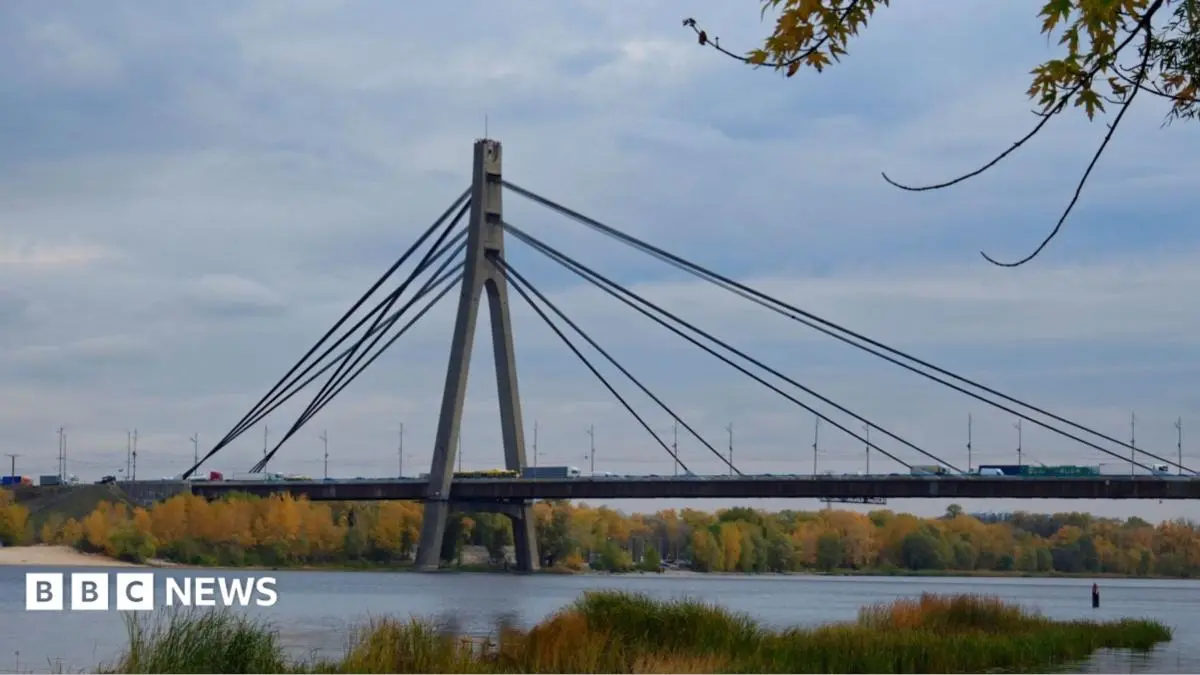
In a significant escalation of the ongoing aerial campaign targeting the Ukrainian capital, a critical transit route has been struck, causing severe disruption and prompting an immediate emergency response. Kyiv Mayor Vitali Klitschko confirmed on Saturday morning that the city’s North Bridge had been hit in a fresh wave of strikes. Writing on the social media platform Telegram, Klitschko provided a swift update to the public, stating, "Hitting the North Bridge. Emergency services are on their way." The strike has instantly paralyzed movement across one of the city’s most critical geographic barriers, further complicating the daily lives of residents and the logistical operations of the capital’s defense forces.
The physical and logistical consequences of the strike on the North Bridge were immediate and profound. Klitschko announced that traffic across the bridge, specifically moving from the left bank of the Dnipro River to the right bank, had been completely blocked. The Dnipro River serves as a massive geographical divide within Kyiv, separating the heavily populated residential areas of the left bank from the administrative, commercial, and historical heart of the city on the right bank. By halting traffic from east to west, the strike has effectively severed a primary commuter and supply corridor. The blockage has created massive vehicular bottlenecks and forced emergency services to quickly establish detours and secure the perimeter, while structural engineers assess the extent of the damage inflicted on the bridge’s physical infrastructure.
As Klitschko indicated, emergency services were dispatched to the site of the North Bridge strike without delay. These first responders face the hazardous task of securing the blast site, extinguishing any fires that may have erupted, and searching for potential casualties among the commuters who use the span daily. Additionally, specialized technical teams must conduct rigorous structural integrity assessments to determine whether the bridge can safely support the resumption of vehicular traffic in the future, or if the damage is severe enough to require long-term closure and extensive repairs. The suspension of traffic on such a vital artery places an immense burden on the city’s remaining bridges, which must now absorb the redirected flow of vehicles under the constant threat of further aerial bombardment.
Saturday’s strike on the North Bridge is not an isolated incident but rather the latest development in a systematic targeting of Kyiv’s river crossings. Just days earlier, the Southern Bridge—another crucial conduit spanning the Dnipro River—was subjected to intense attacks. The repeated targeting of these key transport links has created a cumulative crisis for the city’s municipal government and defense planners. The Southern Bridge serves a dual purpose, carrying both vehicular traffic and a vital line of the Kyiv Metro system, making any disruption to its structure a major blow to the city’s public transportation network.
The earlier attacks on the Southern Bridge were deemed so severe that they prompted an immediate administrative response from the capital’s leadership. On Friday, Kyiv’s defense council convened for an urgent crisis meeting to address the growing threat to the city’s transport infrastructure and coordinate a unified response. The defense council, which comprises key military commanders, municipal officials, and emergency service heads, gathered to evaluate the vulnerability of the city’s bridges and devise strategies to maintain civil order, ensure the continuity of public services, and protect civilians who rely on these transit routes for their daily survival.
Following the conclusion of Friday’s crisis meeting, Mayor Klitschko delivered a sobering assessment of the challenges facing the Ukrainian capital. He characterized the current state of affairs as a "very dramatic situation," reflecting the high level of concern among city officials. Klitschko explained that the municipal government is grappling with a coordinated campaign of destruction, noting that Moscow is systematically battering the city’s "critical infrastructure, logistics, housing," and other key facilities. This multi-pronged assault is designed not only to disrupt military operations but also to undermine the daily functionality of the city and erode the resilience of its civilian population.
The categories of targets highlighted by Klitschko—critical infrastructure, logistics, and housing—underscore the comprehensive nature of the ongoing bombardment. Critical infrastructure refers to the essential systems that keep the city livable, including electricity grids, heating plants, and water treatment facilities. When these systems are battered, hundreds of thousands of residents are left without power, clean water, or warmth. Logistics, which encompasses the transport networks, roads, and bridges like the North and Southern Bridges, are targeted to prevent the efficient movement of goods, emergency services, and defensive forces. Meanwhile, the targeting of housing directly threatens the safety of families in their own homes, creating a climate of fear and forcing many to seek shelter underground.
The strategic rationale behind these systematic strikes has been the subject of sharp rhetorical exchanges between Kyiv and Moscow. Russian President Vladimir Putin has publicly sought to justify the targeting of Ukrainian infrastructure, claiming that Russia’s actions are a direct response to Ukrainian strikes on Russian energy facilities. Putin’s framing of the campaign as a retaliatory measure is designed to project a sense of strategic equivalence and place the responsibility for the escalation on Ukraine. However, this narrative is strongly contested by Ukrainian officials and international observers, who point out that it was Moscow that first launched systematic attacks on energy and civilian infrastructure early in the conflict, establishing a precedent of targeting non-military utility networks.
The assertion that Moscow initiated the attacks on energy facilities is supported by the historical timeline of the conflict. Well before Ukraine began targeting facilities within Russian territory, the Russian military had launched sustained missile and drone campaigns aimed at dismantling Ukraine’s power grid, particularly during the winter months. These early strikes were widely condemned as attempts to weaponize the weather and inflict maximum suffering on the civilian population by cutting off heating and electricity. The current cycle of strikes and counterstrikes represents a continuation of this high-stakes infrastructure war, with both sides recognizing the critical role that energy and