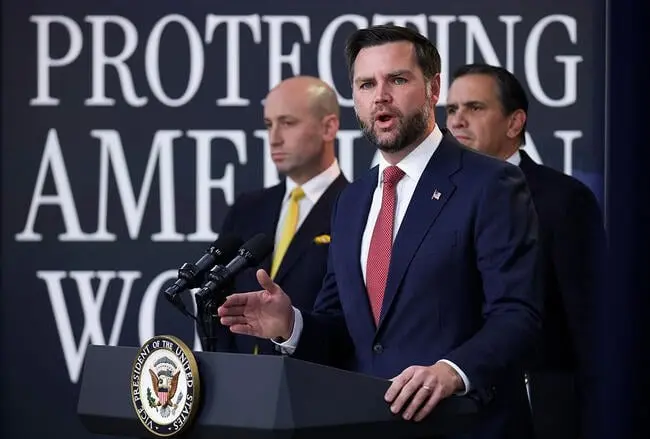
D’Esposito, a former New York Police Department detective, adopted a remarkably aggressive tone for a federal oversight official, signaling that the administration views this not merely as a regulatory oversight, but as a potential criminal enterprise.
“I don’t care how prestigious a university thinks it is,” D’Esposito said. “Break the law and screw the American people, and I will personally cuff you in the university square. I don’t care how large your endowment is, how powerful your alumni are, or how many politicians you have on speed dial. We are going to follow the money and uncover the schemes.”
The Inspector General further noted that the investigation would scrutinize whether these visa arrangements have opened the door to improper foreign influence or compromised the integrity of federally funded research. He specifically highlighted concerns regarding the influence of foreign actors, including China, suggesting that the misuse of visa programs could have implications for national security and the protection of American intellectual property.

In the hours following the announcement, several of the named universities issued statements defending their practices and the contributions of their international communities. The responses generally emphasized a commitment to legal compliance and the role of global talent in maintaining American leadership in science and technology.
A spokesperson for Brown University confirmed that the institution had received a subpoena and intended to cooperate fully with the government’s request for records. However, the university also mounted a firm defense of its international scholars. “Brown’s international scholars, students, and employees make essential contributions on our campus, including to teaching and research that advances American innovation, competitiveness, and economic vitality,” the spokesperson said, emphasizing that these individuals are integral to the university’s mission.
Arizona State University (ASU) also pushed back against the implication of wrongdoing. A spokesperson for ASU highlighted the university’s role as a primary engine for the American workforce, noting that it educates more STEM (science, technology, engineering, and mathematics) majors than any other university in the country. The spokesperson stated that ASU employs one of the largest technical and scientific workforces in the United States to support this mission. “This benefits both the Arizona and the United States economies and in doing so, ASU has hired the talent needed to perform these functions and done so in complete compliance with existing United States policy and law,” the statement read.
At MIT, Kimberly Allen, the executive director of media relations, described the Labor Department’s subpoena as “very broad” and noted that the university is currently in the process of reviewing the document. Allen pointed out that the federal government itself plays a central role in the J-1 process, vetting each visa holder before they arrive on campus. She echoed the sentiment that attracting global talent is a strategic advantage for the country. “America’s ability to attract top talent from around the world while protecting U.S. economic and security interests is a national strength, and that competitive advantage should be supported,” she said.