In a significant escalation of the administration’s efforts to overhaul federal labor and immigration oversight, Vice President JD Vance announced on Thursday that the Department of Labor has initiated a high-stakes investigation into nine of the nation’s most prestigious higher education institutions. The probe centers on allegations that these universities have systematically abused the J-1 visa program to recruit foreign labor at the expense of American graduate students and researchers, effectively depressing wages in the academic sector.
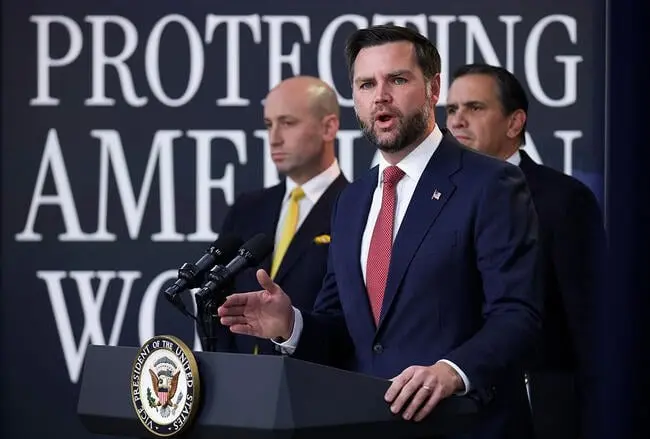
Speaking from a podium flanked by senior advisors Stephen Miller and Todd Blanche, the Vice President characterized the findings of a preliminary data review as a troubling departure from the intended purpose of the J-1 exchange visitor program. Under the banner of "Protecting American Workers," Vance presented a case that suggests a pattern of behavior among elite institutions where international recruitment is being leveraged not for cultural or academic exchange, but as a mechanism for cost-cutting on federally funded research projects.
The J-1 visa program is traditionally designed to foster global exchange, allowing noncitizens to temporarily enter the United States to teach, study, conduct research, or receive specialized medical training. However, the administration’s newly formed fraud task force, which Vance chairs, claims to have uncovered data suggesting that certain universities are using the program to create a tiered labor market.
“Something weird is going on at these universities,” Vance said during the press conference, pointing to a stark disparity in how J-1 visas are utilized across different sectors of higher education. “These universities are employing J-1 visas for federally funded grants at a rate of about 61 percent. The national average is 38 percent. They’re using these visas way too much. They’re using them to undercut the wages of American grad students and American researchers.”
The investigation has specifically targeted a list of institutions that represent the pinnacle of American research and academia: Arizona State University, Brown University, Harvard University, Yale University, Stanford University, the California Institute of Technology (Caltech), the Massachusetts Institute of Technology (MIT), the University of California, Davis, and the University of Pittsburgh.
The core of the administration’s allegation rests on a significant wage gap. According to the Vice President, internal data suggests that American graduate students and researchers are being bypassed for roles that are instead filled by J-1 visa holders who are paid approximately $20,000 less annually. By utilizing foreign labor at these lower rates, Vance argued, universities are able to stretch federal grant dollars further while simultaneously making it more difficult for domestic talent to secure living-wage positions in their chosen fields.
The Department of Labor’s Office of Inspector General is spearheading the inquiry. Anthony D’Esposito, the Inspector General, confirmed during the briefing that the investigation has already moved into a formal legal phase. Subpoenas have been served to the institutions in question, demanding comprehensive records related to their foreign labor programs and payroll structures.
D’Esposito, a former New York Police Department detective, adopted a remarkably aggressive tone for a federal oversight official, signaling that the administration views this not merely as a regulatory oversight, but as a potential criminal enterprise.
“I don’t care how prestigious a university thinks it is,” D’Esposito said. “Break the law and screw the American people, and I will personally cuff you in the university square. I don’t care how large your endowment is, how powerful your alumni are, or how many politicians you have on speed dial. We are going to follow the money and uncover the schemes.”
The Inspector General further noted that the investigation would scrutinize whether these visa arrangements have opened the door to improper foreign influence or compromised the integrity of federally funded research. He specifically highlighted concerns regarding the influence of foreign actors, including China, suggesting that the misuse of visa programs could have implications for national security and the protection of American intellectual property.

In the hours following the announcement, several of the named universities issued statements defending their practices and the contributions of their international communities. The responses generally emphasized a commitment to legal compliance and the role of global talent in maintaining American leadership in science and technology.
A spokesperson for Brown University confirmed that the institution had received a subpoena and intended to cooperate fully with the government’s request for records. However, the university also mounted a firm defense of its international scholars. “Brown’s international scholars, students, and employees make essential contributions on our campus, including to teaching and research that advances American innovation, competitiveness, and economic vitality,” the spokesperson said, emphasizing that these individuals are integral to the university’s mission.
Arizona State University (ASU) also pushed back against the implication of wrongdoing. A spokesperson for ASU highlighted the university’s role as a primary engine for the American workforce, noting that it educates more STEM (science, technology, engineering, and mathematics) majors than any other university in the country. The spokesperson stated that ASU employs one of the largest technical and scientific workforces in the United States to support this mission. “This benefits both the Arizona and the United States economies and in doing so, ASU has hired the talent needed to perform these functions and done so in complete compliance with existing United States policy and law,” the statement read.
At MIT, Kimberly Allen, the executive director of media relations, described the Labor Department’s subpoena as “very broad” and noted that the university is currently in the process of reviewing the document. Allen pointed out that the federal government itself plays a central role in the J-1 process, vetting each visa holder before they arrive on campus. She echoed the sentiment that attracting global talent is a strategic advantage for the country. “America’s ability to attract top talent from around the world while protecting U.S. economic and security interests is a national strength, and that competitive advantage should be supported,” she said.
Stanford University also issued a brief statement, asserting that it complies with all applicable visa laws and will cooperate with the Labor Department’s investigation.
The clash between the administration and the nation’s top research universities highlights a fundamental debate over the future of the American academic labor market. For decades, the influx of international talent has been viewed by the higher education sector as a cornerstone of American soft power and scientific dominance. Universities argue that the J-1 program allows them to bring in the "best and brightest" from around the world, many of whom stay in the U.S. to start companies and lead research labs.
However, the administration’s fraud task force is reframing this narrative, viewing the high concentration of J-1 holders as a sign of systemic labor exploitation. By focusing on the 61 percent utilization rate at these specific schools—compared to the 38 percent national average—Vance is suggesting that these institutions have become overly reliant on a visa category that lacks the robust labor protections found in other programs, such as the H-1B visa.
The $20,000 wage gap cited by the Vice President is likely to become a central point of contention in the investigation. If the Labor Department can prove that universities are intentionally selecting J-1 candidates over qualified Americans specifically to save money on grant-funded salaries, the institutions could face severe penalties, including the clawback of federal funds or restrictions on their future ability to sponsor international scholars.
The investigation also touches on the broader "Protecting American Workers" agenda, which seeks to prioritize domestic labor in every sector of the economy. By targeting the "prestige" of the Ivy League and elite technical institutes like MIT and Caltech, the administration is signaling that no institution is exempt from scrutiny.
As the Labor Department begins the process of reviewing the subpoenaed records, the higher education community is bracing for what could be a lengthy and adversarial process. The outcome of this investigation may not only result in legal consequences for the nine universities named but could also lead to a fundamental restructuring of how international researchers are integrated into the American university system.
For now, the administration remains firm in its position. The investigation is not just about administrative compliance, according to D’Esposito, but about ensuring that federal research dollars—provided by American taxpayers—are used to support the American workforce rather than to subsidize a system that favors cheaper, temporary foreign labor. The "historic" nature of this investigation, as described by the Inspector General, suggests that the government is prepared for a prolonged battle with the nation’s most powerful educational entities.