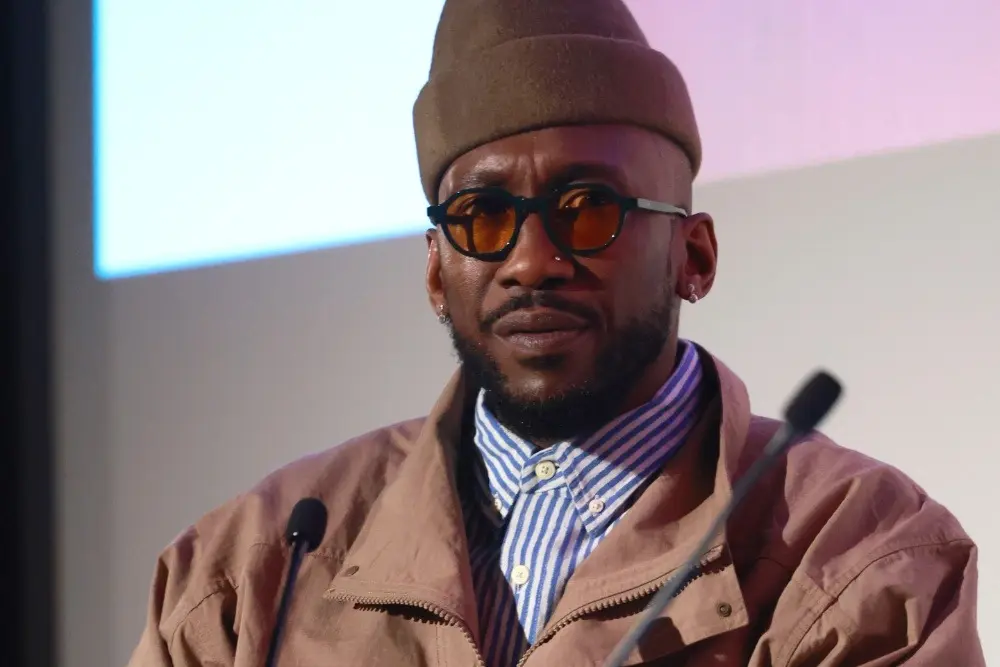
The atmosphere at the BFI London Film Festival turned profoundly somber and reflective on Saturday as two-time Academy Award winner Mahershala Ali took the stage for a career-spanning Screen Talk. In a moment of raw vulnerability that resonated throughout the packed theater, Ali broke down in tears while revisiting the foundational role that catapulted him to international stardom: the compassionate drug dealer Juan in Barry Jenkins’ 2016 masterpiece, “Moonlight.”
The discussion, moderated by film critic and journalist Amon Warmann, served as both a celebration of Ali’s decorated career and a deep dive into the psychological and emotional labor that defines his craft. As the conversation turned toward “Moonlight,” which recently celebrated its 10th anniversary, the weight of the film’s impact seemed to catch Ali off guard. The actor was discussing one of the film’s most pivotal and quietest moments—the dinner-table scene where the young protagonist, Chiron (nicknamed “Little”), looks across the table at Juan and asks with heartbreaking innocence whether he sells drugs.
“You see this like crisis for this young boy who’s already in crisis,” Ali said, his voice thickening with emotion. “It’s really heartbreaking.”
As Warmann probed further into why “Moonlight” continues to hold such an enduring, visceral power over audiences a decade later, Ali found himself unable to speak for a moment. He paused, visibly overcome, and reached to wipe away tears as the audience sat in a supportive silence. “Sorry, just need a second,” he whispered, taking a moment to compose himself before articulating the philosophy that drives his work.
“Any time people put flesh on the bones of those who haven’t been seen or had their moment, I think it’s important,” Ali explained once he had regained his composure. He suggested that the film’s strength lay in its ability to strip away the archetypes of the "inner city" and replace them with something deeply intimate. “I think ‘Moonlight’ was able to make those characters people… make it personal.”
For Ali, the role of Juan was never a caricature. He revealed that his performance was anchored in the memory of a real person from his own life—an uncle-like figure he had known since childhood. This man, a substitute teacher who also spent time playing basketball with a young Ali, represented the complexity of the human experience that Ali sought to bring to the screen. The actor recalled the profound shock he felt when he learned, while away at college, that this man had been arrested and sent to prison.
“I thought of him a lot in the making of the film because of how human everyone was in my environment and in my upbringing,” Ali said. By channeling this real-world complexity, Ali was able to portray Juan not merely as a criminal, but as a paternal figure providing a necessary, if fleeting, sanctuary for a lost child. It was this nuanced portrayal that earned Ali his first Oscar for Best Supporting Actor, making him the first Muslim actor to win an Academy Award for acting.
However, the path following his initial success was not without its complications. Ali spoke with striking candor about the period surrounding his second Oscar win for “Green Book,” in which he portrayed the world-class pianist Don Shirley. While the film was a massive commercial success and a major awards contender, it was also lightning rod for controversy. Critics and members of Don Shirley’s own family raised concerns regarding the historical accuracy of the film and the way Shirley’s life was framed through the perspective of his white driver, played by Viggo Mortensen.
Ali did not shy away from the "backlash" that followed the film’s release. He admitted that the transition from being the industry’s "golden boy" during the “Moonlight” era to being at the center of a cultural debate was a jarring experience. “I think I’m just sensitive in general, you know what I mean? So it definitely like had its impact, like for sure,” he admitted.
Despite the noise, Ali remains steadfast in his commitment to the project. “I still stand by it. I stand by the work,” he told the audience, adding that he values the “experience as a whole, and what it taught me.” He used a vivid metaphor to describe the growth that comes through public scrutiny and professional pressure, noting that “swords are folded in the fire.” For Ali, the controversy was a refining process that forced him to examine his role as an artist and a public figure.
Reflecting on the rare feat of winning two Academy Awards within a three-year span, Ali offered a grounded perspective on the nature of accolades. While many would view two Oscars as the pinnacle of a career, Ali views them with a degree of healthy detachment. “I felt a sense of accomplishment, which is not fulfillment,” he remarked. This distinction is evident in his daily life; he revealed that he keeps his statuettes tucked away in a cabinet, out of his direct line of sight. This choice, he explained, allows him to remain hungry and focused on the next challenge rather than resting on his past achievements. “I need to get back to work,” he said simply.
That work has recently seen Ali expanding his range into the world of animation and high-octane action. He currently voices the character of Aaron Davis (and his various multiversal iterations) in the acclaimed “Spider-Verse” franchise. The actor teased the upcoming “Beyond the Spider-Verse,” though he remained playfully tight-lipped about the specifics of the plot. When asked about the progress of the film and how he distinguishes between the different versions of his character, Ali joked, “I might not even be in it, man! I don’t know, man! I don’t know!”
Beyond the jokes, Ali spoke highly of the animation process, noting that the medium allows for a level of spontaneity often missing in live-action. Actors are filmed while recording their lines, and their physical improvisations often inspire the animators to rewrite scenes or adjust the character’s movements. “I think that’s why, honestly, the animation films will hold up better than live-action films,” he mused, citing the iterative and collaborative nature of the medium.
The physical and mental demands of his live-action roles, however, remain a significant part of his narrative. Ali recalled the grueling production of the third season of HBO’s “True Detective,” which he began filming just a week or two after finishing “Green Book.” Playing detective Wayne Hays across three distinct time periods required him to endure 80-hour work weeks and four hours in the makeup chair starting at 3:30 a.m. each morning. At the time, his daughter was only a year old, adding the strain of new fatherhood to an already punishing schedule.
“I just think about how I almost went crazy doing that part,” he admitted, reflecting on the seven-month shoot that pushed him to his absolute limits.
The BFI London Film Festival also showcased Ali’s current projects, highlighting his continued versatility. He provides the voice for Brendan, a bandit leader, in the stop-motion animated film “Wildwood.” Simultaneously, he is appearing in the action thriller “Your Mother, Your Mother, Your Mother,” where he plays Latif, a character who embodies a stark duality: a devout Muslim father who also happens to be a contract killer.
Ali noted the physical challenges of the latter role, mentioning he had only a few days to master complex fight choreography. He compared the experience to another discipline entirely. “It’s really more like dance than what people realize,” he said, emphasizing the rhythm and precision required for screen combat.
Crucially, the role of Latif allowed Ali to address a personal mission in his acting career: the representation of Black fatherhood. “I don’t feel like Black fathers have the dimensionality that I would love for them to have,” Ali said. By playing a character who is a father, a man of faith, and a man involved in a violent profession, Ali continues his career-long habit of "putting flesh on the bones" of characters who might otherwise be relegated to one-dimensional tropes.
As the Screen Talk drew to a close, Ali looked toward the future. He is currently working on the new HBO series “Task” alongside Mark Ruffalo. Despite the years of grueling schedules and the emotional toll of his more intense roles, the actor seems to have found a sustainable rhythm. He described himself as feeling “exhausted for the right reasons” and “tired in the right way.”
Far from looking toward retirement or a slower pace, Mahershala Ali concluded the session with a sentiment that suggested his best work may still be ahead of him. “So that’s why I feel like I’m just getting started,” he told the audience, leaving them with the impression of an artist who has processed his past successes and struggles to emerge more focused than ever.