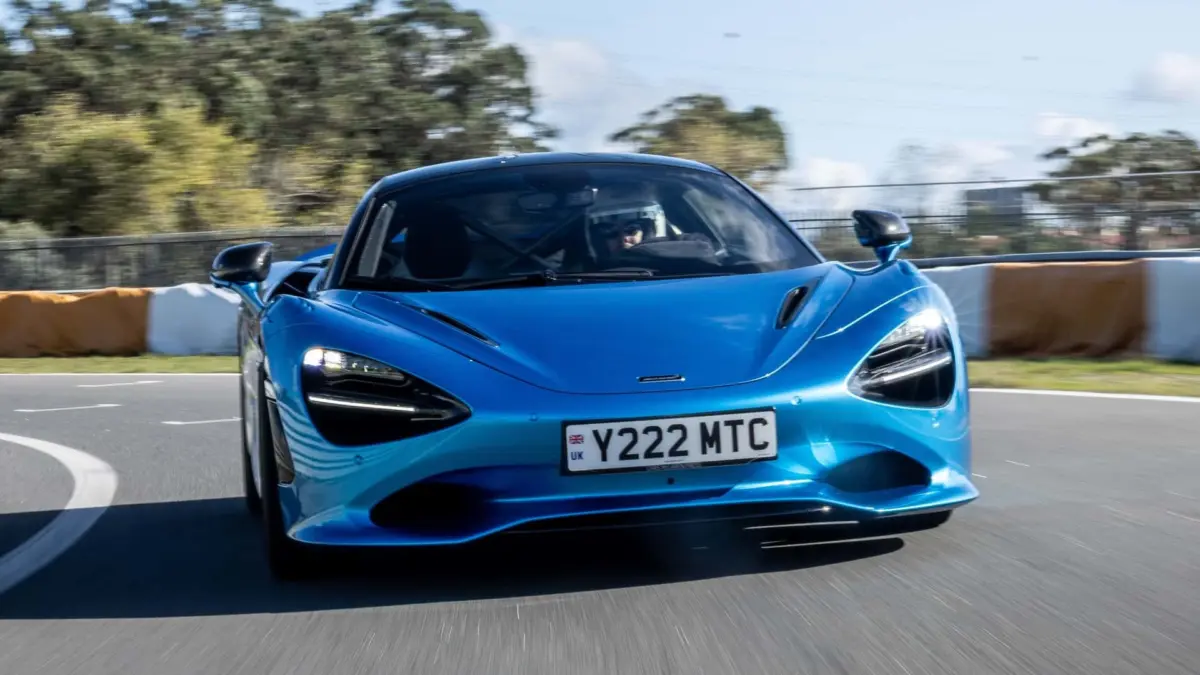
The automotive landscape is preparing to bid farewell to one of the most accomplished supercar platforms of the modern era. McLaren Automotive has officially confirmed that production of the 750S will come to a definitive end in 2027. This announcement marks the beginning of the final chapter for a lineage that has defined the Woking-based manufacturer’s core supercar offering for nearly a decade, starting with the introduction of the 720S in 2017. With the clock now ticking, McLaren has formally opened the final order books, offering enthusiasts and collectors a dwindling window of opportunity to secure a brand-new example of what many consider to be the benchmark for mid-engine performance.
The decision to sunset the 750S is not entirely unexpected, yet it carries significant weight within the industry. The 750S was never intended to be a revolutionary departure from its predecessor, but rather a surgical refinement of an already class-leading formula. By the time the final 750S rolls off the assembly line in 2027, the underlying architecture will have served as the backbone of McLaren’s supercar sales for ten years, a testament to the forward-thinking engineering that went into the original 720S project.
McLaren’s Supercar Era Is Coming To An End
The McLaren 750S occupies a unique space in the company’s history. When it debuted in 2023, it was tasked with the difficult job of improving upon the 720S—a car that had already redefined expectations for power, weight, and usable performance. McLaren’s engineers did not settle for a simple facelift; instead, they overhauled approximately 30 percent of the vehicle’s components. This extensive update ensured that the 750S remained at the sharp end of a segment increasingly populated by hybrid competitors and high-output rivals from Maranello and Sant’Agata Bolognese.
At the heart of the 750S lies the M840T 4.0-liter twin-turbocharged V8 engine, a masterclass in internal combustion engineering. In this final iteration, the powerplant produces a staggering 740 horsepower (750 PS, hence the name) and 590 lb-ft of torque. When combined with a relentless focus on weight reduction—resulting in a claimed dry weight of just 2,815 pounds in its lightest specification—the 750S delivers a power-to-weight ratio that remains difficult for many modern supercars to match.
Beyond the raw numbers, the 750S introduced several key dynamic improvements. The suspension system was revised with a new generation of McLaren’s Proactive Chassis Control, featuring lighter springs and dampers that improved both ride quality and track-day composure. The transmission calibration was shortened to provide more urgent in-gear acceleration, and the aerodynamics were tweaked with a larger active rear wing to increase downforce and improve high-speed stability.
Inside, the cabin was redesigned to be more driver-centric. The instrument cluster was moved to the steering column, a design choice borrowed from the Artura, allowing the displays to move in tandem with the wheel. This focus on ergonomics underscored McLaren’s philosophy that a supercar should be as intuitive to drive on a winding road as it is capable on a circuit.
The 750S is the latest evolution of a platform that has proven to be incredibly versatile. Since the 720S first broke cover at the Geneva Motor Show in 2017, the architecture has supported a variety of high-performance variants. This includes the track-honed 765LT, which pushed the boundaries of lightweight construction and aerodynamic aggression, and the more recent, ultra-exclusive 788HS. Each iteration has squeezed more performance and engagement out of the carbon-fiber Monocage II chassis, cementing the platform’s reputation as one of the most capable in the history of the supercar.

Reflecting on the impact of the model, McLaren Chief Commercial Officer Henrik Wilhelmsmeyer emphasized the car’s role in defining the brand’s identity. "The 750S represents everything that defines a McLaren supercar: benchmark performance, thrilling driver engagement, technical innovation, expressive design, and defined personalization," Wilhelmsmeyer stated. "It will leave behind an extraordinary legacy."
What’s Next For McLaren?
The conclusion of 750S production in 2027 is more than just the end of a model cycle; it is a clear signal that McLaren is entering a period of profound transformation. The company is currently navigating a pivotal moment in its history, characterized by a shift in leadership, a rebranding effort that recently included the introduction of a modernized logo, and a strategic pivot toward a more diversified product portfolio.
For years, McLaren focused almost exclusively on two-seat, mid-engine supercars. However, the market is changing, and McLaren is changing with it. The company is widely reported to be developing its first-ever SUV—or "performance vehicle" in McLaren parlance—aimed directly at the burgeoning super-SUV segment currently dominated by the Ferrari Purosangue and the Lamborghini Urus. This move, while controversial among some purists, is seen as a financial necessity to fund the development of next-generation electric and hybrid technologies.
The 750S is not the only model in the current lineup facing an uncertain future. Industry reports have recently suggested that the Artura, McLaren’s first series-production high-performance hybrid, may also be nearing the end of its projected lifespan by 2028. If these reports prove accurate, McLaren could be looking at a near-total refresh of its lineup within the next three to four years. This overhaul would likely see the introduction of entirely new platforms designed from the ground up to accommodate advanced electrification, as the brand looks to balance its heritage of lightweight performance with increasingly stringent global emissions regulations.
Furthermore, McLaren has been active in the trademark office, filing names such as "Remuera" and "Muriwai." These names, which pay homage to the New Zealand roots of founder Bruce McLaren, suggest that a new naming convention may be on the horizon. This would mark a departure from the numerical designations (720, 750, 765) that have defined the brand’s core models for the last decade, potentially signaling a fresh start for the company’s design language and market positioning.
As McLaren prepares for this new era, the 750S serves as a bridge between the pure internal combustion past and the electrified, diversified future. It remains one of the last "analog" feeling supercars in terms of its hydraulic steering and its commitment to a non-hybridized V8 powertrain in its primary segment. For many enthusiasts, the end of 750S production represents the closing of a door on a specific type of driving experience that is becoming increasingly rare.
For prospective buyers, the window to act is closing. While 2027 may seem distant, the bespoke nature of McLaren production and the high demand for the final units of a celebrated platform mean that build slots are expected to fill rapidly. The company has made it clear that final orders are being accepted now, allowing customers to dive into the extensive MSO (McLaren Special Operations) catalog to create highly personalized versions of the 750S before the curtain finally falls.
When the last 750S leaves the McLaren Production Centre in Woking, it will conclude a ten-year run for a chassis and engine combination that forced every other supercar manufacturer to go back to the drawing board. Whether it is replaced by a hybrid successor or a radically different type of performance vehicle, the legacy of the 720S and 750S is secure as a high-water mark for the mid-engine supercar. For now, the 750S enters its twilight years, not by fading away, but by offering one last opportunity for drivers to experience the pinnacle of McLaren’s traditional supercar expertise.