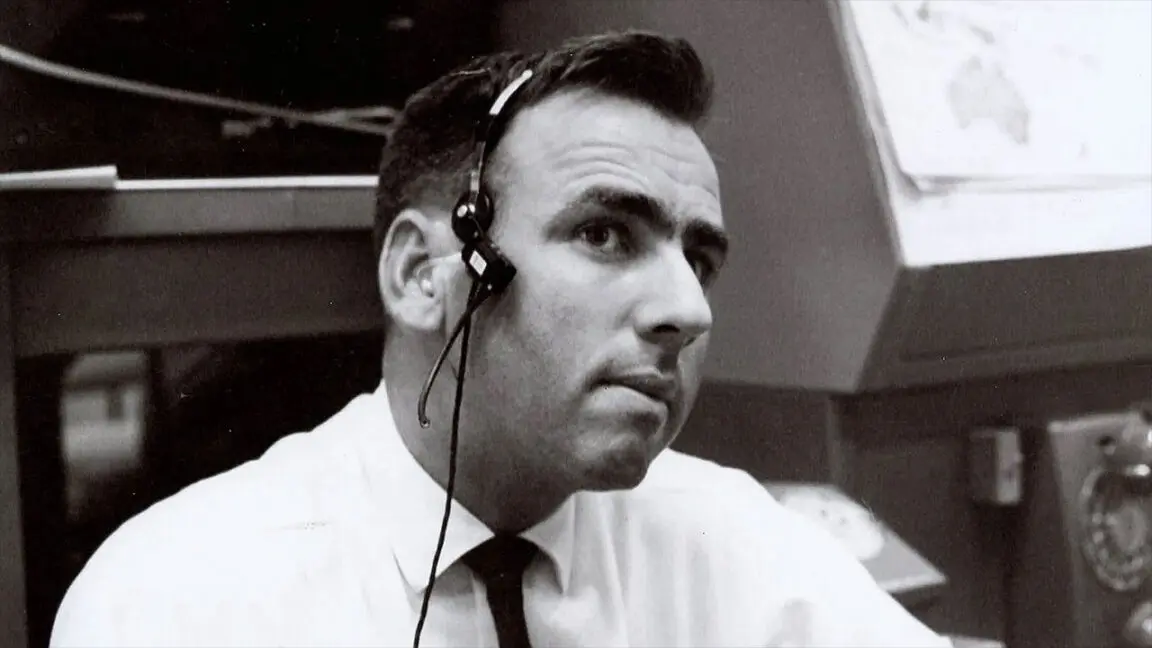
Milton “Milt” Windler, a key figure in the golden age of American human spaceflight whose leadership in NASA’s Mission Control helped safely guide the endangered Apollo 13 crew back to Earth, has died. Over a career that spanned the dawn of the space race through the assembly of the International Space Station, Windler played a pivotal role in establishing the operational discipline and flexible planning protocols that define modern space operations.
As one of NASA’s elite flight directors during the Apollo program, Windler shared the nation’s highest civilian honor—the Presidential Medal of Freedom—for his decisive role during the 1970 Apollo 13 emergency. Beyond the dramatic rescue of Apollo 13, Windler was instrumental in transforming how mission controllers operated during the Skylab program, helped integrate Canadian robotics into the Space Shuttle fleet, and later served as a consultant ensuring the complex systems of the International Space Station were ready for orbit.
His passing marks the loss of another pioneer from the historic cadre of mission controllers who built human spaceflight operations from the ground up at NASA’s Manned Spacecraft Center in Houston, Texas.
The Crisis of Apollo 13 and the Medal of Freedom
Windler’s most public legacy came in April 1970 during the flight of Apollo 13. Intended to be NASA’s third crewed lunar landing mission, Apollo 13 turned into a fight for survival when an oxygen tank exploded inside the Service Module nearly 200,000 miles from Earth. The explosion crippled the primary spacecraft command module, forcing astronauts Jim Lovell, Jack Swigert, and Fred Haise to convert the Lunar Module into an orbital lifeboat.
To bring the three astronauts home, NASA relied on round-the-clock coordination among four flight directors who managed alternating teams of controllers in Mission Control: Gene Kranz, Glynn Lunney, Gerry Griffin, and Milton Windler, who led the Maroon Team. Facing unprecedented technical hurdles—ranging from strict power conservation and carbon dioxide filtration to trajectory recalculations that required firing engines never intended for deep-space maneuvers—the flight directors oversaw a grueling multi-day effort that safely returned the crew to Earth on April 17, 1970.
The operational feat garnered international acclaim. Just one day after the crew safely splashed down in the Pacific Ocean, President Richard Nixon traveled to Hawaii and Texas to honor those responsible. On April 18, 1970, President Nixon presented the Presidential Medal of Freedom to the Apollo 13 mission operations team, represented by Windler, Lunney, Kranz, and Griffin. The award recognized the team’s exceptional coolness under pressure, operational excellence, and unwavering dedication to preserving human life in space.
In addition to the Presidential Medal of Freedom, Windler was honored with NASA’s Exceptional Service Medal, recognizing his broader contributions to the Apollo program and the advancement of mission management protocols.
Innovating Space Science aboard Skylab
Following the conclusion of the Apollo lunar landing missions, Windler transitioned into leadership roles for Skylab, America’s first orbital space station. Launched in 1973, Skylab presented a completely different set of operational challenges than the brief, highly scripted missions to the Moon. Instead of following a rigid, predetermined flight plan, Skylab crew members spent months in orbit conducting extensive scientific research, Earth observations, and solar physics experiments.
This shift required a radical rethink of how flight controllers planned daily astronaut schedules. Central to Skylab’s scientific mission was the Apollo Telescope Mount (ATM), a specialized solar observatory that allowed astronauts to study the Sun in wavelengths obscured by Earth’s atmosphere. Solar activity, however, is inherently unpredictable. If a solar flare or major event occurred on the Sun, controllers needed to react immediately so the astronauts could point the ATM’s instruments at the phenomenon.
“We had to come up with a system that would allow us to plan in real time and accommodate the science people,” Windler recalled in a 2006 interview. “If something interesting happened on the sun, which it did several times, then we needed to be able to schedule the ATM work.”
To solve this problem, Windler and his team overhauled mission planning techniques, moving away from months-long pre-flight scheduling to short, dynamic operational cycles that adapted to real-time scientific opportunities.
“We invented a way of flight planning in real time, or cycles,” Windler explained. Under this framework, controllers and scientists engaged in a continuous daily dialogue. “One day the science people talked about what they wanted to do, and the ‘Science Czar’ got with them and said, ‘All right, then, we need these particular objectives for tomorrow.’”
This agile planning approach proved revolutionary. It allowed NASA to bridge the gap between traditional engineering-focused mission control operations and the dynamic needs of the scientific community. The real-time cycle system developed under Windler’s leadership laid the groundwork for how operational science would be conducted on future space platforms for decades to come.
The Shuttle Era, the Canadarm, and Private Industry
After the completion of the Skylab program in 1974, Windler brought his operational expertise to NASA’s next major endeavor: the Space Shuttle program. As NASA transitioned toward reusable winged orbiters, payload deployment and orbital construction became central mission goals.
Windler contributed significantly to the development and integration of the shuttle’s Remote Manipulator System (RMS), universally known as the "Canadarm." Contributed to the shuttle program by Canada through the Canadian Space Agency and built by Spar Aerospace, the mechanical arm allowed shuttle crews to deploy, capture, and maneuver heavy satellites in orbit. Windler worked to establish operational procedures for operating the robotic arm safely from the shuttle’s aft flight deck, establishing practices that would later become essential for satellite repair missions—such as those servicing the Hubble Space Telescope—and the assembly of large orbital structures.
Following a distinguished career at NASA, Windler retired from the space agency, but his involvement in human spaceflight was far from over. He joined the private aerospace industry, bringing decades of flight operations knowledge to the initial development phases of what would become the International Space Station (ISS).
Working as a private contractor and consultant, Windler advised on the complex operational frameworks needed to manage a permanently crewed, multi-module space station built by an international partnership. As physical hardware for the ISS was produced across various manufacturing facilities, Windler focused on verification procedures, helping ensure that individual modules, electrical architectures, and environmental systems were thoroughly tested and operationally ready before being launched and mated together in low Earth orbit.
‘Pay more attention’
Milton Windler was born on Jan. 10, 1932, in Hampton, Virginia. Growing up near the coast, he developed an early interest in aviation and engineering. He attended Virginia Tech (Virginia Polytechnic Institute and State University), earning his degree in aeronautical engineering in 1954.
While pursuing his degree at Virginia Tech, Windler joined the U.S. Air Force’s Reserve Officers’ Training Corps (ROTC). After graduation, he began working for the National Advisory Committee for Aeronautics (NACA), the federal agency dedicated to aeronautical research that served as the predecessor to NASA. He then spent four years fulfilling his active-duty service commitment in the U.S. Air Force before returning to civil service at NACA’s Langley Research Center in Hampton, Virginia.
Windler was present at Langley during a historic turning point in aviation history: the formal transition of NACA into the National Aeronautics and Space Administration (NASA) in October 1958, spurred by the dawn of the Space Age. As NASA established its human spaceflight effort, Windler relocated to Houston, Texas, taking up residence and duty just as the Manned Spacecraft Center—later renamed the Lyndon B. Johnson Space Center—was being established. There, he joined the initial cohort of flight controllers who would define the mechanics of controlling human missions to space.
Outside of his aerospace career, Milton was a devoted family man. He and his wife, Betty (née Selby), raised three children and were later blessed with eight grandchildren. A memorial service honoring Windler’s life and accomplishments will take place in the coming weeks at the family’s longtime former church in Friendswood, Texas, located near the Johnson Space Center where he spent so many years of his professional life.
Looking back on his remarkable career in late-life interviews, Windler offered a poignant reflection on the relentless, intense pace of early spaceflight operations. During the height of the space race, mission controllers worked grueling hours under immense national pressure, moving rapidly from one historic mission to the next with little time to pause.
“If I did it again, I’d probably try to do something more about trying to pay more attention,” Windler admitted in a quiet reflection on his storied career. “Apollo was — well, all of [the missions] were … bang-bang-bang. You couldn’t enjoy, really, in a way you couldn’t savor it, like maybe it would have been better to have done.”