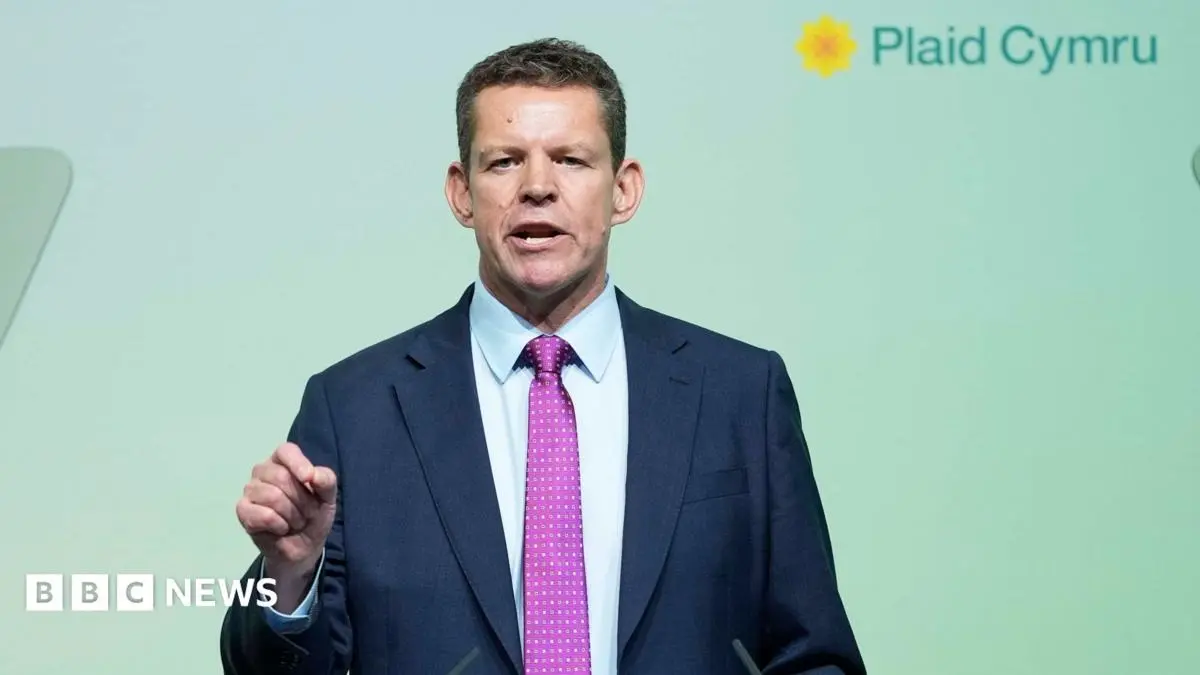
In a landmark address that marks a significant shift in Welsh political dynamics, First Minister Rhun ap Iorwerth has formally demanded a "new deal" for Wales from the UK government. Speaking at Plaid Cymru’s autumn conference, the First Minister argued that Wales must be placed on an equal constitutional and fiscal footing with Scotland as a "bare minimum." The bold declaration sets up a crucial constitutional test for the UK government, led by Prime Minister Andy Burnham, as Wales seeks to expand its devolved authority into areas historically controlled by Westminster.
Addressing party activists and delegates gathered in Llandudno, ap Iorwerth outlined a comprehensive transfer of powers that he believes is necessary to correct decades of constitutional imbalance. At the heart of his proposal is the devolution of policing and justice, control over the Welsh railway network, and administration of the Crown Estate’s assets within Wales. Currently, these crucial policy areas remain largely under the jurisdiction of the UK government in Westminster, whereas Scotland enjoys a far higher degree of self-governance in these domains. The First Minister’s speech framed this discrepancy as a historic unfairness that must be resolved if the UK government is serious about its commitment to a respectful partnership with the devolved nations.
The backdrop for this demand could not be more significant for Plaid Cymru. The party is currently gathering at Llandudno’s Venue Cymru for its first major conference since securing a historic victory in the Senedd elections held in May. That electoral triumph has transformed the political landscape of Wales, elevating Plaid Cymru to the position of the largest party in the Welsh Parliament and placing ap Iorwerth at the helm of the Welsh government. Reflecting on this political shift, the First Minister described the election result as a "new dawn" for the nation, signaling a mandate for substantial change in how Wales is governed and how it interacts with the broader United Kingdom.
However, despite the historic nature of the May election, the realities of governing without an outright majority have quickly come to the fore. Plaid Cymru currently holds 44 seats in the Welsh Parliament chamber. This total includes the significant addition of Sarah Cooper-Lessad, who recently defected to the party, bolstering their numbers but still leaving them five seats short of an absolute majority. To successfully govern and, crucially, to pass the Welsh government’s spending plans and budget next year, Plaid Cymru will need to secure the cooperation of at least one other political group in the Senedd. This delicate arithmetic has already led to preliminary discussions and negotiations, with ap Iorwerth’s administration engaging in talks with representatives from the Labour Party, the Welsh Conservatives, and Reform UK.
The challenge of passing a budget is compounded by a highly challenging economic environment. In his wide-ranging speech, ap Iorwerth did not shy away from the financial difficulties facing the Welsh government. He acknowledged that the upcoming Welsh government budget process would be exceptionally "tight" and "tough," shaped by a "difficult economic and fiscal backdrop." To navigate these financial headwinds, the First Minister emphasized that his administration would have to be highly disciplined and resourceful. He signaled that the government would actively seek to identify savings wherever possible, focusing on driving public sector efficiency, improving overall productivity, and eliminating redundancies.
"There will be difficult decisions," ap Iorwerth told the audience, stressing that the current budget arithmetic demands a highly disciplined approach to public finances. He explained that the Welsh government would look to find savings by consolidating and streamlining public services, avoiding unnecessary duplication, and focusing strictly on delivering positive outcomes for the public. However, the First Minister drew a sharp ideological line between his administration’s approach to fiscal discipline and that of his political opponents on the right. He insisted that any efforts to streamline services must remain free of the damaging approach of the parties on the right, whom he accused of defining savings and waste through a narrow ideological lens rather than a practical commitment to public service delivery. This cooperative but firm stance underscores the tightrope ap Iorwerth must walk: negotiating with rival parties to pass his budget while maintaining Plaid Cymru’s core progressive values.
A central theme of ap Iorwerth’s address was the nature of the relationship between Cardiff and London. He revealed details of his personal interactions with Prime Minister Andy Burnham, expressing a cautious optimism about the potential for constructive collaboration, while simultaneously issuing a firm warning. The First Minister recalled a direct conversation with the Prime Minister, stating that he had looked him in the eyes and explicitly warned him not to undermine Wales as a nation or bypass the democratically elected Senedd. According to ap Iorwerth, the Prime Minister returned his gaze and promised that he would not take such actions—a commitment that the First Minister intends to hold him to. "I will hold him to that," ap Iorwerth declared to the conference hall, adding, "Wales will hold him to that."
The demand for parity with Scotland highlights the long-standing differences in how devolution has developed across the nations of the United Kingdom. In Scotland, the devolved parliament in Holyrood has long held extensive control over policing, civil and criminal justice, and a vast array of domestic policies. In contrast, the Welsh Senedd’s powers have developed more incrementally. Policing and justice in Wales remain under the direct control of the Home Office and the Ministry of Justice in Westminster, creating a complex administrative split where Welsh laws are passed by the Senedd but enforced by a system answerable to London. Similarly, while Scotland enjoys substantial control over its rail infrastructure, the Welsh rail network is only partially devolved and remains heavily dependent on decisions made in London.
The First Minister also highlighted the Crown Estate as a key area where Wales is being left behind. In Scotland, the management and revenues of the Crown Estate’s land and coastal assets have been devolved, providing a direct source of income for the Scottish government, particularly from offshore renewable energy projects. In Wales, the Crown Estate’s vast holdings—including the seabed out to the 12-nautical-mile limit—remain under the control of London, with the revenues generated flowing back to the UK Treasury rather than being reinvested directly into Welsh communities. Ap Iorwerth argued that his proposed "new deal" is essential to "redress the historic unfairness of our fiscal and constitutional settlement." He insisted that putting Wales on an equal footing with Scotland must be viewed as a "bare minimum" for any future relationship between Cardiff and London.
The First Minister emphasized that the "respect agenda" promised by the new UK government must be a genuine, reciprocal arrangement. "It remains my hope that the prime minister will listen in a shared spirit, and that he’ll see that the respect agenda between the Welsh and UK governments must work both ways," he told the audience. But ap Iorwerth also issued a sharp ultimatum, warning that a failure by Westminster to engage in good faith would only strengthen the case for Welsh self-determination. "If he fails, Wales will know again that our best interests will never be served by Westminster, and that it matters little whether who lives in Number 10 Downing Street is an Evertonian or an Old Etonian," he said, referencing the social backgrounds of various UK political figures.
The constitutional debate is set to intensify at the end of the month, when ap Iorwerth is scheduled to meet directly with Prime Minister Burnham. The meeting, which will also include the First Ministers of Scotland and Northern Ireland, will provide the first major forum to test the Prime Minister’s willingness to engage with the Welsh government’s demands. There are some early indications that the UK government may not be entirely closed to the idea of further devolution. Prime Minister Burnham has previously indicated that he is "open" to discussing the transfer of control over policing to the Welsh government. He has also publicly committed to respecting the individual governments of the UK’s nations, promising to give a "fair hearing" to any proposals submitted to him by the devolved administrations.
In response to the First Minister’s speech, the UK government released a statement emphasizing its commitment to collaboration, though it stopped short of endorsing any specific transfer of powers. A UK government spokesperson stated that the administration remains "committed to building a stronger and fairer Wales in a stronger and fairer United Kingdom." The spokesperson added that the UK government’s primary focus is on working constructively with the Welsh government to empower local leaders and communities, with the goal of delivering economic growth and creating high-quality jobs across every postcode in Wales.
As the end-of-month summit approaches, the political tension between Cardiff and London is set to rise. With Plaid Cymru riding high on its historic election victory but facing a delicate legislative balancing act in the Senedd, Rhun ap Iorwerth’s demand for a "new deal" represents a high-stakes gamble. Whether Prime Minister Burnham’s promised "respect agenda" will translate into a genuine transfer of powers over policing, justice, rail, and the Crown Estate remains to be seen, but the outcome will undoubtedly shape the future of the union for years to come.