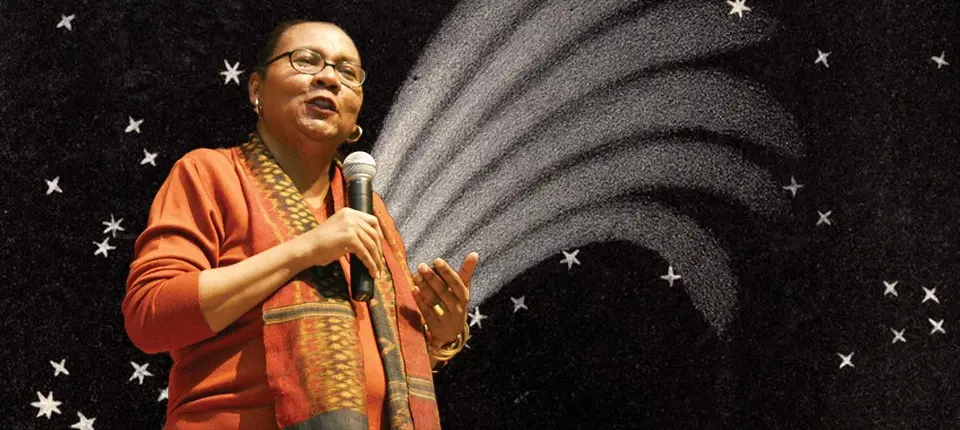
On this day in 1952, the world welcomed Gloria Jean Watkins, the visionary thinker, prolific author, and social activist who would eventually become known to millions by her pen name, bell hooks. As we mark the anniversary of her birth on September 25, the literary community continues to reflect on a legacy that fundamentally reshaped the landscape of contemporary thought, feminism, and cultural criticism. From her early days in the segregated South to her emergence as a global intellectual powerhouse, the trajectory of bell hooks remains a cornerstone of the "literary internet" and a guiding light for those navigating the complexities of race, gender, and class in the 21st century.
Born in Hopkinsville, Kentucky, Watkins grew up in a working-class Black community that would serve as the foundational site for her later theories on homeplace and the "margins" of society. One of seven children, she was raised in a household where the power of language was both a tool for survival and a means of transformation. Her father worked as a janitor for the local postal service, and her mother was a homemaker; together, they provided a domestic environment that Watkins would later describe as a site of resistance against the dehumanizing forces of the outside world. This early upbringing in the rural South informed her unique perspective on the intersection of domesticity and radical politics, a theme that would recur throughout her more than 30 published works.
The decision to adopt the pseudonym "bell hooks" was a deliberate act of ancestral reclamation and intellectual humility. Borrowing the name of her maternal great-grandmother, Bell Blair Hooks, she chose to write the name in lowercase letters to shift the focus away from her individual identity and toward the substance of her ideas. This stylistic choice was more than a mere quirk of formatting; it was a profound statement on the nature of authorship and the collective struggle for liberation. By de-emphasizing the "I," she invited readers to engage with the work as a communal resource rather than a personal ego project.
Her academic journey led her from the hills of Kentucky to the prestigious halls of Stanford University, and later to the University of Wisconsin-Madison and the University of California, Santa Cruz. It was during her time as an undergraduate that she began writing her seminal work, Ain’t I a Woman? Black Women and Feminism. Though the book was not published until 1981, its genesis in the early 1970s marked a pivotal moment in the development of Black feminist thought. In it, hooks challenged the mainstream feminist movement for its exclusionary focus on white, middle-class experiences, arguing that any movement for gender equality that did not address the specific struggles of Black women was inherently flawed and incomplete.
Throughout the 1980s and 1990s, hooks established herself as a critic who refused to be confined by the traditional boundaries of academia. She coined the phrase "imperialist white-supremacist capitalist patriarchy" to describe the interlocking systems of oppression that define modern life. While the term was intentionally provocative, it provided a precise vocabulary for activists and scholars to discuss the ways in which various forms of domination reinforce one another. Her work in Feminist Theory: From Margin to Center further expanded these ideas, suggesting that the most profound critiques of society often come from those living on the edges, as they possess a "dual vision" of both the center and the periphery.