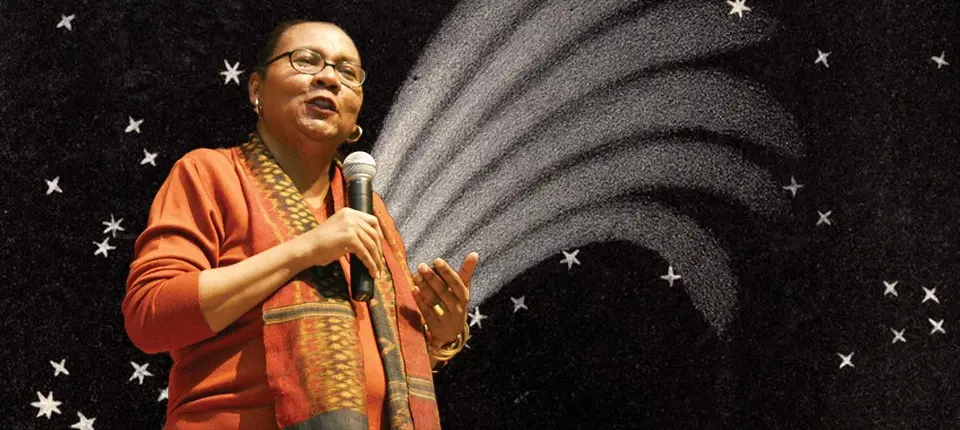
On this day in 1952, the world welcomed Gloria Jean Watkins, the visionary thinker, prolific author, and social activist who would eventually become known to millions by her pen name, bell hooks. As we mark the anniversary of her birth on September 25, the literary community continues to reflect on a legacy that fundamentally reshaped the landscape of contemporary thought, feminism, and cultural criticism. From her early days in the segregated South to her emergence as a global intellectual powerhouse, the trajectory of bell hooks remains a cornerstone of the "literary internet" and a guiding light for those navigating the complexities of race, gender, and class in the 21st century.
Born in Hopkinsville, Kentucky, Watkins grew up in a working-class Black community that would serve as the foundational site for her later theories on homeplace and the "margins" of society. One of seven children, she was raised in a household where the power of language was both a tool for survival and a means of transformation. Her father worked as a janitor for the local postal service, and her mother was a homemaker; together, they provided a domestic environment that Watkins would later describe as a site of resistance against the dehumanizing forces of the outside world. This early upbringing in the rural South informed her unique perspective on the intersection of domesticity and radical politics, a theme that would recur throughout her more than 30 published works.
The decision to adopt the pseudonym "bell hooks" was a deliberate act of ancestral reclamation and intellectual humility. Borrowing the name of her maternal great-grandmother, Bell Blair Hooks, she chose to write the name in lowercase letters to shift the focus away from her individual identity and toward the substance of her ideas. This stylistic choice was more than a mere quirk of formatting; it was a profound statement on the nature of authorship and the collective struggle for liberation. By de-emphasizing the "I," she invited readers to engage with the work as a communal resource rather than a personal ego project.
Her academic journey led her from the hills of Kentucky to the prestigious halls of Stanford University, and later to the University of Wisconsin-Madison and the University of California, Santa Cruz. It was during her time as an undergraduate that she began writing her seminal work, Ain’t I a Woman? Black Women and Feminism. Though the book was not published until 1981, its genesis in the early 1970s marked a pivotal moment in the development of Black feminist thought. In it, hooks challenged the mainstream feminist movement for its exclusionary focus on white, middle-class experiences, arguing that any movement for gender equality that did not address the specific struggles of Black women was inherently flawed and incomplete.
Throughout the 1980s and 1990s, hooks established herself as a critic who refused to be confined by the traditional boundaries of academia. She coined the phrase "imperialist white-supremacist capitalist patriarchy" to describe the interlocking systems of oppression that define modern life. While the term was intentionally provocative, it provided a precise vocabulary for activists and scholars to discuss the ways in which various forms of domination reinforce one another. Her work in Feminist Theory: From Margin to Center further expanded these ideas, suggesting that the most profound critiques of society often come from those living on the edges, as they possess a "dual vision" of both the center and the periphery.
Beyond her contributions to feminist theory, bell hooks was a dedicated educator who viewed the classroom as a radical space for transformation. In her 1994 book, Teaching to Transgress: Education as the Practice of Freedom, she drew on the theories of Paulo Freire and her own experiences as a teacher to advocate for a pedagogy that engaged the whole person—mind, body, and spirit. She believed that education should not be a process of indoctrination but an "ecstatic" experience where students and teachers work together to challenge the status quo. This commitment to "engaged pedagogy" made her a beloved figure among students and fellow educators, fostering a legacy of critical thinking that transcends the ivory tower.
In the latter part of her career, hooks turned her attention to the concept of love, not as a sentimental emotion, but as a political and spiritual force. Her "Love Trilogy"—comprising All About Love: New Visions, Salvation: Black People and Love, and Communion: The Female Search for Love—remains some of her most widely read and quoted work. In these texts, she argued that the absence of love in public life is the root cause of many social ills. By redefining love as an "active verb" and a commitment to spiritual and personal growth, she offered a roadmap for healing in a world increasingly characterized by cynicism and division.
The enduring relevance of bell hooks is perhaps most evident in the way her work continues to circulate in the digital age. On platforms like Lit Hub and across the broader "literary internet," her essays and quotes are frequently revisited as a means of making sense of current events. Whether discussing the representation of Blackness in film, the nuances of class struggle, or the necessity of community, her voice remains as sharp and necessary as ever. In 2026, as we navigate a world of rapid technological change and shifting social paradigms, her insistence on the "politics of the heart" serves as a vital reminder of the human element at the center of all intellectual inquiry.
Returning to her roots in Kentucky later in life, hooks joined the faculty at Berea College, where the bell hooks center was established to preserve her archives and continue her work. Her homecoming was a full-circle moment, bridging the gap between her global influence and the local community that first shaped her. She passed away in December 2021, but the "Today in History" reminders of her birth serve as more than just a chronological marker; they are a call to action to continue the work of critical consciousness and compassionate activism.
As Lit Hub Daily notes the anniversary of her birth, it is a moment to recognize that bell hooks was not just a writer, but a cultural architect. She built frameworks of understanding that allowed people to see themselves and their society with greater clarity. Her work taught us that to be a critic is not to be a hater, but to be a lover of truth and a seeker of justice. She challenged us to look at the world "from the margin to the center" and to find the courage to speak our truths, even when our voices shake.
The literary internet today is filled with tributes, reading lists, and reflections on her impact. Scholars discuss her influence on intersectional theory, while activists cite her work as the foundation for modern social justice movements. Yet, perhaps the greatest tribute to bell hooks is the way her words have found a home in the hearts of everyday readers who seek to live more authentically and lovingly. She bridged the gap between the complex theories of the university and the practical needs of the community, making radical thought accessible without ever diluting its power.
In a media landscape often dominated by fleeting trends and superficial discourse, the work of bell hooks offers a profound depth. Her bibliography serves as a vast library of resistance, a collection of insights that demand we look closer at the world around us. As we celebrate what would have been her 74th year, we are reminded that her birth was a gift to the world of letters and a catalyst for a more thoughtful, inclusive, and loving society.
The legacy of Gloria Jean Watkins—the girl from Hopkinsville who became the world’s bell hooks—is a testament to the power of a single voice to challenge an entire system. On this September 25, the literary world pauses to honor a woman who taught us that "feminism is for everybody" and that the pursuit of justice is, at its core, an act of love. As her work continues to be shared, studied, and celebrated, it remains clear that the conversation she started is far from over; it is a living, breathing dialogue that continues to evolve with each new generation of readers who discover her transformative words.