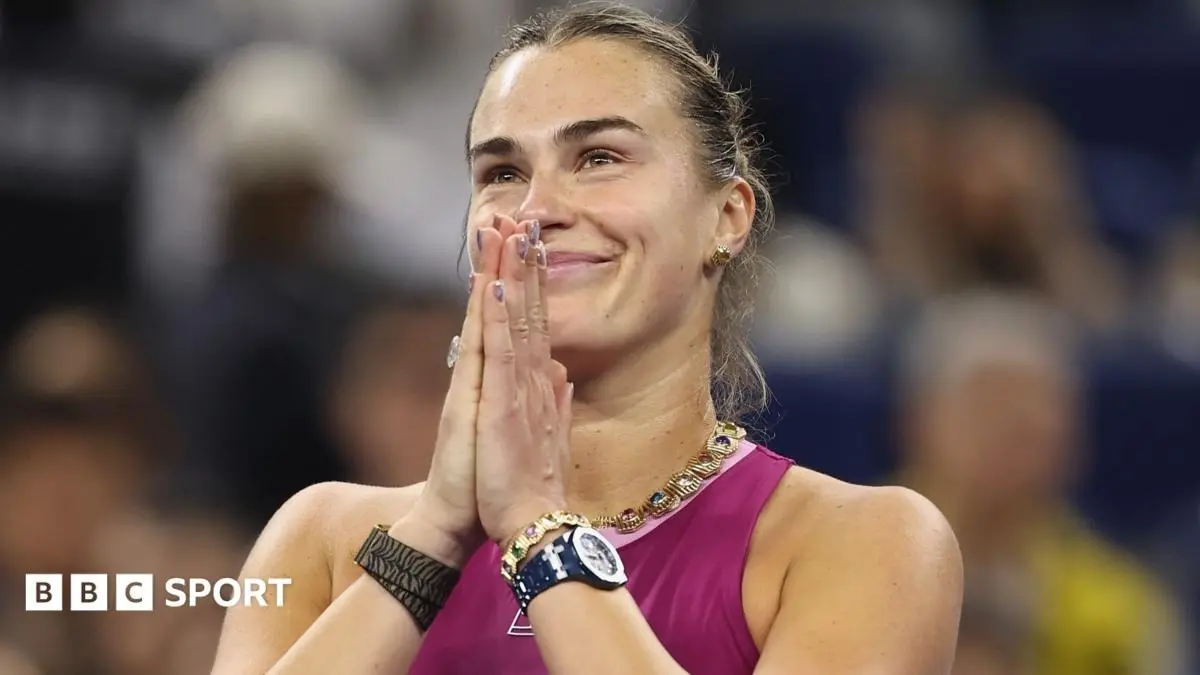
The match itself was a showcase of the raw athleticism and serving prowess that have become Sabalenka’s trademarks. From the opening point, she established a rhythm that Zarazua simply could not disrupt. Sabalenka fired 11 aces throughout the contest, a statistic that underscored her dominance on serve. Perhaps more impressively, she did not face a single break point during the entire match, a rarity in the modern women’s game that speaks to her focus and clinical execution. For Zarazua, the challenge proved insurmountable; the Mexican player struggled to find answers for the depth and velocity of Sabalenka’s groundstrokes, which consistently pushed her behind the baseline and forced errors.
Despite the efficiency of the win, the context surrounding Sabalenka’s return to the court is complex. This was her first competitive appearance since a disappointing stretch in September, where she saw both her world number one ranking and her US Open crown slip away to Elena Rybakina. The loss of the top spot and the failure to defend her title in New York were significant blows for a player who had started the year with such momentum. For Sabalenka, the China Open represents not just another WTA 1000 event, but a crucial opportunity to recalibrate and reclaim the form that saw her dominate the early stages of the season.
The 28-year-old’s 2024 campaign has been a narrative of two halves. In March, she achieved the rare and prestigious ‘Sunshine Double,’ winning the Indian Wells and Miami Open titles back-to-back. At that moment, she appeared nearly invincible, combining her natural power with a newfound tactical maturity. However, the months following that peak have been uncharacteristically mixed by her own lofty standards. For the first time since 2022, Sabalenka will finish a calendar year without a Grand Slam trophy, a reality that clearly weighs on her. Throughout the season, spectators have often seen her struggle to contain her frustrations on the court, with visible displays of anger and self-reproach following missed shots or lost momentum.
When questioned about this self-critical nature in Beijing, Sabalenka provided a candid assessment of her personality. She acknowledged that her tendency to demand perfection is a double-edged sword. On one hand, it is the engine that has driven her to multiple major titles and the top of the rankings. On the other, it can become a self-defeating cycle of negativity. She described this as both a "good and a bad side" of her character, noting that while it can drive her forward and push her to improve, it can also "really drain my energy." The admission that she is "trying so hard" to be kinder to herself suggests a player in a state of transition, recognizing that her greatest opponent is often the voice in her own head.
This journey toward a more balanced mental approach will be tested in the coming days. In the third round, Sabalenka is set to face Nikola Bartunkova, a 20-year-old prospect from the Czech Republic. While Sabalenka will be the heavy favorite, she is well aware of the threat the young Czech poses. The two met previously at the Berlin Open in June, a match in which Bartunkova pushed Sabalenka to the limit and came remarkably close to an upset. For Sabalenka, the upcoming encounter will be a test of whether she can maintain the composure she spoke about, especially if the match becomes a tightly contested affair.
While Sabalenka’s narrative dominated the early headlines in Beijing, she is far from the only high-profile figure in the draw. Elena Rybakina, the tournament’s top seed and the player who recently usurped Sabalenka’s ranking, is scheduled to begin her campaign on Saturday. The presence of Rybakina adds a layer of competitive tension to the event, as the two players continue their season-long battle for supremacy at the top of the WTA rankings. Rybakina’s consistency has been the foil to Sabalenka’s explosive power this year, and their potential collision later in the tournament is already a major talking point among fans and analysts.
The tournament also saw mixed fortunes for the British contingent. Katie Boulter, who has enjoyed a career-best season, faced a daunting task against Karolina Muchova. Muchova, a former Wimbledon runner-up known for her variety and court craft, proved to be too strong for the British number one. The first set was a tightly contested affair that went to a tiebreak, with Boulter showing flashes of the aggressive tennis that has seen her rise up the rankings. However, Muchova’s experience shone through in the pressure moments, as she claimed the tiebreak 7-3. Once the first set was secured, the momentum shifted entirely in Muchova’s favor. She dominated the second set, winning 6-1 and leaving Boulter with few opportunities to claw her way back into the match.
In another significant WTA result, Mirra Andreeva demonstrated the resilience that has made her one of the most talked-about teenagers in the sport. The French Open champion faced a difficult start against Chinese wildcard Yuan Yue, losing the opening set 3-6 as the home crowd rallied behind their player. However, Andreeva’s response was nothing short of spectacular. She completely shut out her opponent in the final two sets, producing a "double bagel" of 6-0 6-0 to secure her place in the next round. The turnaround was a testament to Andreeva’s tactical adjustments and her ability to remain unfazed by an early deficit, further cementing her reputation as a future cornerstone of the women’s tour.
The men’s side of the event also provided its share of high-quality tennis, with sixth seed Daniil Medvedev making a statement in his opening match. Facing the experienced Spaniard Pablo Carreno Busta, Medvedev relied on his trademark consistency and an exceptionally potent serve. The Russian hit 12 aces during the match, mirroring Sabalenka’s dominance from the service line. Medvedev’s ability to neutralize Carreno Busta’s baseline game was evident throughout the 6-4 6-2 victory. For Medvedev, who has often excelled during the late-season swing in Asia, the win was a perfect start to his bid for the title in Beijing.
There was better news for British fans in the doubles draw, where Julian Cash and Lloyd Glasspool secured a notable victory. The British pair faced the formidable Russian duo of Andrey Rublev and Karen Khachanov. While Rublev and Khachanov are primarily known for their singles success, they are dangerous competitors in any format. However, Cash and Glasspool showed superior doubles chemistry and tactical awareness, breaking the Russian pair at crucial moments to secure a 6-3 6-4 win. The victory allows them to advance in the tournament and provides a boost for British doubles tennis on the international stage.
As the China Open progresses, the focus will undoubtedly remain on Sabalenka and her quest for both a title and a sense of internal peace. Her victory over Zarazua was the first step in what she hopes will be a restorative week in Beijing. The 63 minutes she spent on court on Friday were a display of a player who possesses all the physical tools to dominate the sport. Yet, as she herself admitted, the real challenge lies in the moments between the points, in the way she handles the pressure of her own expectations. If she can successfully "be easier" on herself, the rest of the field may find it even harder to stop her. For now, Sabalenka moves forward, her eyes on the trophy and her mind focused on the difficult task of self-forgiveness in a sport that demands nothing less than perfection.