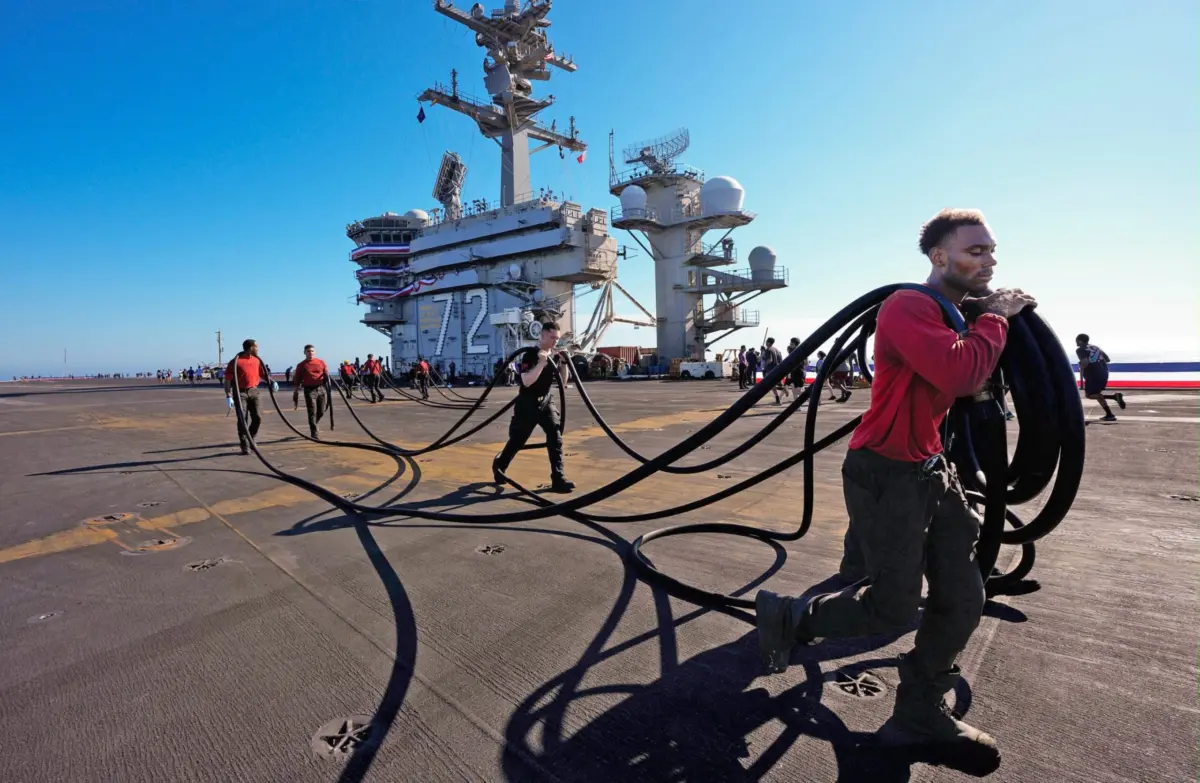
In a high-profile display of military recognition and political defense, Defense Secretary Pete Hegseth traveled to the USS Abraham Lincoln on Wednesday to personally deliver one of the military’s most prestigious honors. Hegseth presented the crew of the aircraft carrier with the Presidential Unit Citation, an award reserved for units that demonstrate extraordinary heroism and significant achievement in the face of armed conflict. The ceremony marked a pivotal moment for the ship’s company, coming on the heels of a grueling, record-setting deployment in the Middle East that saw the carrier at the center of intense combat operations against Iranian forces.
The visit was not only an opportunity to honor the sailors but also served as a forceful rebuttal to a mounting narrative of internal struggle aboard the vessel. Throughout the carrier’s ten-month mission, reports had surfaced regarding plummeting morale, supply chain failures, and a mental health crisis among the thousands of service members stationed on the ship. Addressing the crew directly, Hegseth sought to dismantle these criticisms, framing the Lincoln’s journey not as a story of hardship, but as a testament to American military endurance.
Hegseth explicitly pushed back against what he described as a concerted effort by critics and observers to turn the carrier "into some sort of a symbol, a symbol of dysfunction or a symbol of low morale or a symbol of a failed mission." Instead, he argued that the challenges faced by the crew were the very things that defined their success.
"What makes the U.S. military and the U.S. Navy and all these sailors different is that you adapt and that you’re resilient and you overcome," Hegseth told the assembled sailors. "You finish the mission nonetheless."
The Defense Secretary also conveyed a personal message from the commander-in-chief, noting that President Donald Trump had been closely monitoring the carrier’s movements and engagements since the deployment began. According to Hegseth, the President "tracked your activities from day one and couldn’t be more proud of what you executed."
The Presidential Unit Citation is the highest honor a military unit can receive, roughly equivalent to an individual’s Navy Cross or Distinguished Service Cross. For the Lincoln, the award recognizes a mission that was as historically significant as it was physically demanding. The carrier and its associated strike group were a primary instrument of American power during a period of escalating tensions with Tehran, providing a constant presence and a potent strike capability in the region.
The Navy initially downplayed problems on the carrier
While the Lincoln’s combat record is now being celebrated, the path to this recognition was paved with domestic controversy. Over the summer, the carrier became a focal point of national attention as reports leaked regarding the deteriorating quality of life for the sailors on board. These reports detailed significant stress, a spike in mental health concerns, and severe shortages of basic necessities, including food and hygiene products.
In the early stages of these reports, the Navy’s leadership largely downplayed the severity of the issues. This official stance was mirrored by political rhetoric; in August, President Trump commented that the Lincoln’s deployment, which was already stretching well beyond typical durations, was "not nearly long enough." This sentiment stood in stark contrast to the lived experience of the crew, who had been operating at a high tempo since leaving San Diego the previous November.
The carrier arrived in the Middle East in January, and by February 28, it was actively engaged in hostilities. U.S. and Israeli forces launched coordinated airstrikes against Iranian targets on that date, a major escalation that required the Lincoln to remain on high alert for months afterward.
As the deployment dragged on, Navy leaders were eventually forced to acknowledge that conditions on the ship had indeed been strained. In August, acting Navy Secretary Hung Cao addressed the growing concerns in response to inquiries from Democratic lawmakers who were seeking information on the welfare of the crew. In a letter, Cao maintained that the Lincoln had kept adequate food supplies on hand, but he admitted that the intensity of combat operations had created logistical bottlenecks.
Because the ship was frequently in a high-threat environment, opportunities for resupply were limited. This led to a period where meal options were significantly reduced—at one point dropping from the standard two main options to just one for a short time. Despite these admissions, Cao defended the Navy’s management, stating that the ship continued to serve four nutritionally balanced meals daily throughout the mission.
The physical and psychological relief for the crew did not arrive until early last month, when the Lincoln finally departed the Middle East. After more than ten months at sea, the ship made a port call in Pattaya, Thailand, providing the sailors with their first significant break in nearly a year.
Long deployments can tax service members
The Lincoln’s mission highlighted the immense strain that extended naval deployments place on both personnel and hardware. Modern aircraft carriers are designed for endurance, but the human element remains the most vulnerable component of the strike group. When ships are kept at sea for periods exceeding the standard six-to-seven-month rotation, the cumulative effects of isolation, high-stress combat environments, and limited resources begin to take a measurable toll.
Data provided by the Navy to lawmakers revealed the depth of the mental health struggle aboard the Lincoln. During the ten-month deployment, eight sailors attempted suicide. While experts in military health noted that this number is statistically low for a strike group consisting of roughly 6,000 sailors over such a long period, the figure nevertheless served as a sobering indicator of the internal pressures facing the crew.
Despite these internal challenges, the Lincoln’s operational output was staggering. The citation read by Hegseth provided a detailed account of the strike group’s lethality and efficiency. During its time in the Middle East, the Lincoln and its aircraft executed 3,693 combat missions. The strike group delivered 1.37 million pounds of ordnance and launched 450 Tomahawk cruise missiles against various targets.
The defensive statistics were equally notable. The Lincoln’s defenses shot down 77 one-way attack drones and successfully neutralized 21 anti-ship cruise missiles. In direct naval engagements, the strike group was credited with sinking 64 Iranian warships and defending against four separate attacks involving fast-attack craft and explosive-carrying ships.
The Lincoln now holds a record for the most days spent at sea between ports of call, a distinction that underscores the intensity of the Iran-focused mission. It is the second carrier in recent years to endure such an unusually long deployment and receive the Presidential Unit Citation upon its conclusion.
Hegseth’s visit to the Lincoln follows a similar event in May, when he met with the crew of the USS Gerald R. Ford. That carrier returned from a 326-day deployment—the longest for an American aircraft carrier in the last half-century and a record for the post-Vietnam War era. The Ford had also been deployed to the region to deter Iranian aggression and support regional stability.
The cycle of extended deployments continues to be a central theme for the Navy’s carrier fleet. As the Lincoln began its journey home, the USS George Washington—a carrier typically based in Asia—was moved into the Middle East in August to relieve the Lincoln. This strategic reshuffling highlights the ongoing demand for a carrier presence in multiple theaters, often at the expense of traditional deployment schedules and crew welfare.
As the USS Abraham Lincoln continues its transit back to its home port, the Presidential Unit Citation serves as a formal acknowledgment of the crew’s historic role in the conflict with Iran. While the debate over the "dysfunction" and "low morale" mentioned by Hegseth may continue in policy circles, for the 6,000 sailors on board, the award represents a definitive, if hard-won, validation of their ten months on the front lines.