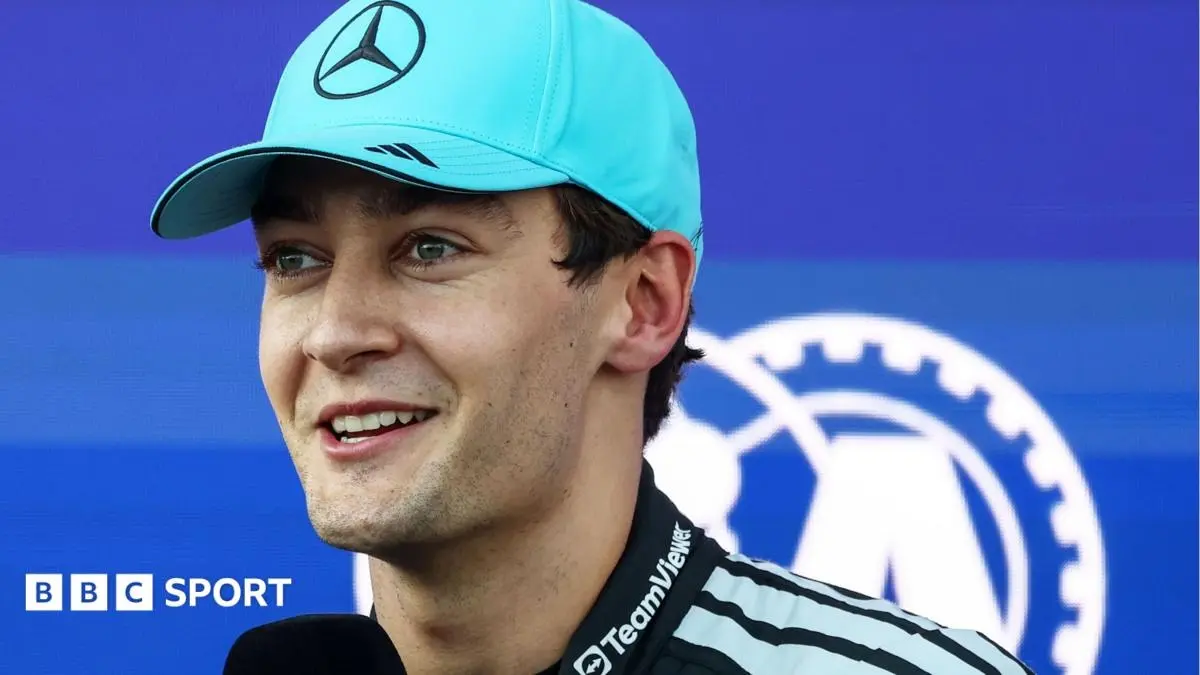
George Russell delivered a masterclass in precision and speed on Saturday, securing an imperious pole position for Mercedes at the Azerbaijan Grand Prix. On a day defined by high-speed drama and tactical complexity, the British driver showcased the sheer potential of the W15, leaving his rivals trailing by a margin rarely seen in the modern era of Formula 1. However, the jubilant atmosphere in one half of the Mercedes garage was sharply contrasted by the frustration in the other, as Russell’s teammate and current championship leader, Kimi Antonelli, saw his qualifying session end in the barriers during the opening segment.
Russell’s performance was nothing short of a statement. Navigating the treacherous, high-speed corridors of the Baku City Circuit, he clocked a lap time that left Ferrari’s Charles Leclerc—a noted specialist on this track—stunned. The gap was a staggering 0.837 seconds, a margin that felt like a lifetime in a sport often decided by thousandths. While Russell celebrated his first pole position since the Austrian Grand Prix in late June, Antonelli was left to contemplate a difficult Sunday from 16th on the grid, his championship lead of 81 points suddenly feeling more vulnerable.
The session underscored the unique challenges of the Baku circuit, where the combination of 90-degree turns and a monstrous 2.2-kilometer main straight demands a car that is both agile in the technical sectors and efficient in a straight line. Throughout the weekend, Russell had appeared at ease with the car’s balance, consistently hovering near the top of the timing charts. When it mattered most in the final shootout of Q3, he extracted every ounce of performance from the Mercedes, describing the car as feeling "great all weekend."
The Gap That Stunned the Paddock
The sheer scale of Russell’s advantage was the primary talking point in the paddock following the session. Even Charles Leclerc, who has secured pole position in Baku on multiple occasions in the past, admitted to being caught off guard by the Mercedes’ superiority. While Leclerc felt that a front-row start was a realistic target for Ferrari, the nearly nine-tenths of a second deficit to Russell was a sobering realization of the pace Mercedes had found.
"That’s probably the biggest margin I’ve had in my whole career," Russell remarked after climbing out of the cockpit. "The lap felt really sweet. We’ve been building up to this all weekend, and the car has just been in the window from the first session. To do it here, on a track that is so unforgiving, feels incredible."
Behind the leading duo, the grid took on a somewhat unconventional look. McLaren’s Oscar Piastri secured a solid third place, continuing his consistent form. He was followed by Red Bull’s Isack Hadjar, who produced a standout performance to claim fourth, and the second McLaren of Lando Norris in fifth.
For the championship protagonists and the established veterans, the session was fraught with complications. Lewis Hamilton, usually a threat for the top spots, found himself relegated to sixth. His qualifying effort was hampered by the lack of a tow—a critical aerodynamic advantage on the long Baku straight. Without a slipstream from a leading car, Hamilton was unable to match the straight-line speeds of those who timed their runs to perfection.
Tactical Turmoil and Verstappen’s Frustration
The importance of the slipstream, or "tow," cannot be overstated in Azerbaijan. Engineers estimate that a well-executed tow can be worth as much as half a second per lap. This tactical necessity led to a cat-and-mouse game on track, as drivers slowed down to find a gap or waited for a rival to provide a hole in the air.
Max Verstappen, the four-time world champion, found himself on the wrong end of this tactical gamble. The Red Bull driver was following Lando Norris on their final flying laps, positioned perfectly to benefit from the McLaren’s slipstream. However, the plan disintegrated when Norris made a mistake, running off the track and forcing Verstappen to abandon the benefit of the tow.
The incident left Verstappen in eighth place, behind the Alpine of Pierre Gasly. Despite the disappointment, Verstappen was realistic about his prospects. While he believed a front-row start was within reach had the lap gone according to plan, he conceded that Russell’s time was likely untouchable. The Red Bull driver will now have to navigate a crowded midfield to make his way toward the podium on Sunday.
A Nightmare Afternoon for the Championship Leader
While Russell thrived, Kimi Antonelli’s weekend continued its downward trajectory. The young Italian, who arrived in Baku with a commanding lead in the standings, had been on the back foot since the start of the event. His Friday was plagued by reliability issues, specifically a hydraulic problem that brought his car to a halt during the first practice session. The subsequent repairs meant he missed half of the second practice, leaving him with limited data and a lack of rhythm heading into qualifying.
The lack of track time proved costly in the first segment of qualifying (Q1). On his second flying lap, Antonelli misjudged his entry into Turn One. He turned in marginally too early, causing the left front wheel to strike the inside wall. The impact was enough to shatter the suspension, effectively ending his session.
In a moment of desperate optimism, Antonelli attempted to limp the damaged Mercedes back to the pit lane. However, his race engineer, Peter Bonnington, was quick to intervene. "Let me try," Antonelli pleaded over the radio, hoping against hope that the car was still functional enough to reach the garage for repairs.
Bonnington’s response was firm and final. He informed the driver that either the track rod or the upright was broken, and there was no possibility of fixing the damage in the short window before the start of the next session. "Park the car," was the instruction. It was a significant blow for the championship leader, marking his first major unforced error since a heavy crash during final practice at the season opener in Australia. Starting from 16th, Antonelli faces a steep climb to salvage points and protect his lead.
Williams Finds a Breakthrough
Amid the drama at the front and the back of the grid, there was a significant success story for the Williams team. For the first time this season, Carlos Sainz managed to secure a top-10 qualifying position for the Grove-based outfit. The achievement was the result of a concerted technical effort to address the primary weakness of the FW46: its weight.
Williams arrived in Baku with a new, lighter chassis, finally bringing the car down to the FIA’s minimum weight limit. At the beginning of the season, the car was reportedly as much as 25 kilograms overweight—a massive handicap in a sport where every gram counts. The weight reduction, combined with a suite of aerodynamic developments, appeared to transform the car’s competitiveness.
While the team acknowledged that the low-drag characteristics of the Baku circuit played to the car’s strengths, Sainz’s performance was a clear indication of progress. His teammate, Alex Albon, was less fortunate. Albon struggled with straight-line speed throughout the session and missed out on a crucial tow during Q2. He ended the session in 13th, nearly four-tenths of a second behind Sainz, highlighting how tight the midfield battle remains.
Looking Ahead to Race Day
As the sun set over the Caspian Sea, the stage was set for a fascinating Azerbaijan Grand Prix. George Russell enters the race as the clear favorite, backed by a car that has shown no signs of weakness thus far. However, Baku is a circuit famous for its unpredictability. The close proximity of the walls, the high risk of Safety Car interventions, and the extreme speeds on the main straight mean that no lead is ever truly safe.
For Charles Leclerc and Oscar Piastri, the goal will be to apply pressure on Russell from the start, hoping to capitalize on any strategic openings. Meanwhile, all eyes will be on the recovery drives of Max Verstappen and Kimi Antonelli. Verstappen’s ability to slice through the field is well-documented, but Antonelli’s task is perhaps more daunting. Starting 16th on a street circuit requires a delicate balance of aggression and patience, especially for a driver looking to maintain a championship advantage.
Mercedes finds itself in a position of both strength and vulnerability. They possess the fastest car on the grid, but they also face the challenge of managing a split-fortune weekend. As the teams prepare for the 51 laps of the Baku City Circuit, the narrative remains centered on whether Russell can convert his massive qualifying advantage into a dominant victory, or if the chaos of Baku will once again rewrite the script.