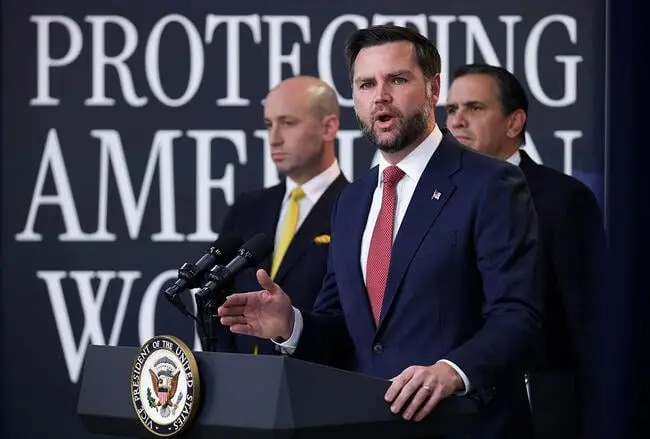
Vice President JD Vance announced on Thursday that the federal government has launched a high-priority investigation into nine of the nation’s most prestigious higher education institutions, alleging a systemic abuse of the J-1 visa program. The investigation, spearheaded by the Department of Labor, seeks to determine whether these universities have intentionally utilized foreign labor to undercut the wages of American graduate students and researchers. Standing at a podium emblazoned with the words "Protecting American Workers," and flanked by senior administration officials including Stephen Miller and Todd Blanche, Vance characterized the situation as a significant breach of the trust placed in American academic institutions.
The J-1 visa program is traditionally designed as an exchange visitor program, intended to foster global cultural and educational exchange by allowing noncitizens to temporarily teach, lecture, conduct research, or receive graduate medical education in the United States. However, the Vice President alleged that several elite universities have transformed this tool for diplomacy into a mechanism for economic exploitation. By citing specific usage data, Vance argued that these institutions are using the program at rates that far exceed the national average, suggesting that the primary motivation is no longer academic exchange, but rather the acquisition of lower-cost labor at the expense of the domestic workforce.
The investigation is being conducted under the auspices of the administration’s Task Force to Eliminate Fraud, which Vance chairs. During a press conference held to address visa fraud, Labor Department officials confirmed that the inquiry has already moved into an active enforcement phase. Subpoenas have officially been served to the targeted institutions, which include some of the most famous names in global education: Harvard University, Yale University, Brown University, Stanford University, and the University of Pennsylvania’s peer institutions like the Massachusetts Institute of Technology (MIT) and the California Institute of Technology (Caltech). Also named in the probe are Arizona State University, the University of California, Davis, and the University of Pittsburgh.
The core of the administration’s case rests on a disparity in how these universities utilize J-1 visas in relation to federally funded research grants. According to data presented by Vance, the nine universities under investigation are employing J-1 visa holders for federally funded projects at a rate of approximately 61 percent. This stands in stark contrast to the national average for such programs, which currently sits at 38 percent. The Vice President described this 23-point gap as a red flag that indicates an institutional reliance on foreign labor that is out of step with the rest of the country’s research landscape.
"Something weird is going on at these universities," Vance stated during the briefing. "They’re using these visas way too much. They’re using them to undercut the wages of American grad students and American researchers." To illustrate the economic impact of this alleged practice, Vance provided a specific figure, asserting that an American graduate student or researcher typically earns roughly $20,000 more than a colleague performing similar work under a J-1 visa. This wage gap, the administration argues, creates a perverse incentive for universities to bypass qualified American citizens in favor of foreign nationals who can be paid significantly less, all while utilizing taxpayer-funded federal grants to subsidize the operations.
The Department of Labor’s Inspector General, Anthony D’Esposito, provided further details on the scope of the inquiry, which he characterized as a "historic investigation into J-1 visa fraud." D’Esposito, a former detective with the New York Police Department, brought a tone of aggressive law enforcement to the announcement. He pledged that his office would "follow the money and uncover the schemes" that allow these institutions to potentially bypass labor laws. He emphasized that the investigation is not merely looking at administrative errors, but is instead focused on whether there are deeper issues of "foreign influence, improper financial relationships, or visa abuse" that might be compromising the integrity of federally funded research.
D’Esposito specifically pointed toward concerns regarding foreign influence from China as a factor in the investigation’s broader context. He argued that the American public has a right to know how and where their tax dollars are being spent, particularly when those dollars are intended to drive American innovation and secure the nation’s technological future. His rhetoric toward the universities was notably blunt, signaling a departure from the traditionally deferential relationship between the federal government and elite academia.

"I don’t care how prestigious a university thinks it is," D’Esposito said, addressing the heads of the named institutions. "Break the law and screw the American people, and I will personally cuff you in the university square. I don’t care how large your endowment is, how powerful your alumni are, or how many politicians you have on speed dial."
In the wake of the announcement, several of the named universities issued statements defending their practices and the contributions of their international staff. The institutions generally maintained that they are in full compliance with federal laws and emphasized that the presence of international scholars is a cornerstone of American scientific and economic leadership.
A spokesperson for Brown University confirmed that the institution had received a subpoena and intended to cooperate fully with the government’s request for records. However, the university also defended the necessity of the J-1 program. "Brown’s international scholars, students, and employees make essential contributions on our campus, including to teaching and research that advances American innovation, competitiveness, and economic vitality," the spokesperson said. The university’s response suggested that any attempt to curtail these programs could have a detrimental effect on the very "economic vitality" the administration claims to be protecting.
Arizona State University (ASU) also pushed back against the implications of the investigation. A spokesperson for ASU highlighted the university’s massive scale, noting that it educates more Science, Technology, Engineering, and Math (STEM) majors than any other university in the country. The university maintains one of the largest technical and scientific workforces in the United States, a feat that ASU argues is only possible by hiring the best available talent from around the globe. "This benefits both the Arizona and the United States economies," the ASU spokesperson stated, adding that all hiring has been done in "complete compliance with existing United States policy and law."
Similarly, Stanford University and MIT expressed their commitment to following visa regulations while stressing the importance of global talent. A Stanford spokesperson stated that the university complies with all applicable laws and would cooperate with the Labor Department. Kimberly Allen, the executive director of media relations at MIT, noted that the university is currently reviewing what she described as a "very broad" subpoena from the Department of Labor. Allen pointed out that the J-1 visa process is already a rigorous one, with the U.S. government itself vetting every individual holder before they arrive on campus.
"We value international students and scholars on our campus," Allen said. "America’s ability to attract top talent from around the world while protecting U.S. economic and security interests is a national strength, and that competitive advantage should be supported."
The tension between the administration and the universities reflects a broader debate over the "global race for talent" versus the protection of domestic labor markets. While universities argue that the J-1 program is a vital conduit for the "brain drain" that brings the world’s smartest researchers to American shores, the Vice President and the Labor Department frame it as a loophole that allows wealthy institutions to pad their bottom lines by suppressing wages. By highlighting the $20,000 pay discrepancy, the administration is positioning the investigation as a populist defense of the American middle class and the next generation of domestic scientists who may feel squeezed out of a competitive academic job market.
The investigation is expected to be a lengthy and complex process, as investigators sift through thousands of payroll records, grant applications, and visa filings. The Labor Department has indicated that it will look closely at the financial relationships between the universities and the foreign entities that often sponsor or facilitate these exchanges. As the task force moves forward, the focus remains on whether these nine institutions have prioritized their endowments and research output over the economic well-being of the American workers they are tasked with educating and employing. With subpoenas already served and a "follow the money" mandate in place, the conflict between the federal government and the upper echelons of American academia appears set for a significant legal and political showdown.