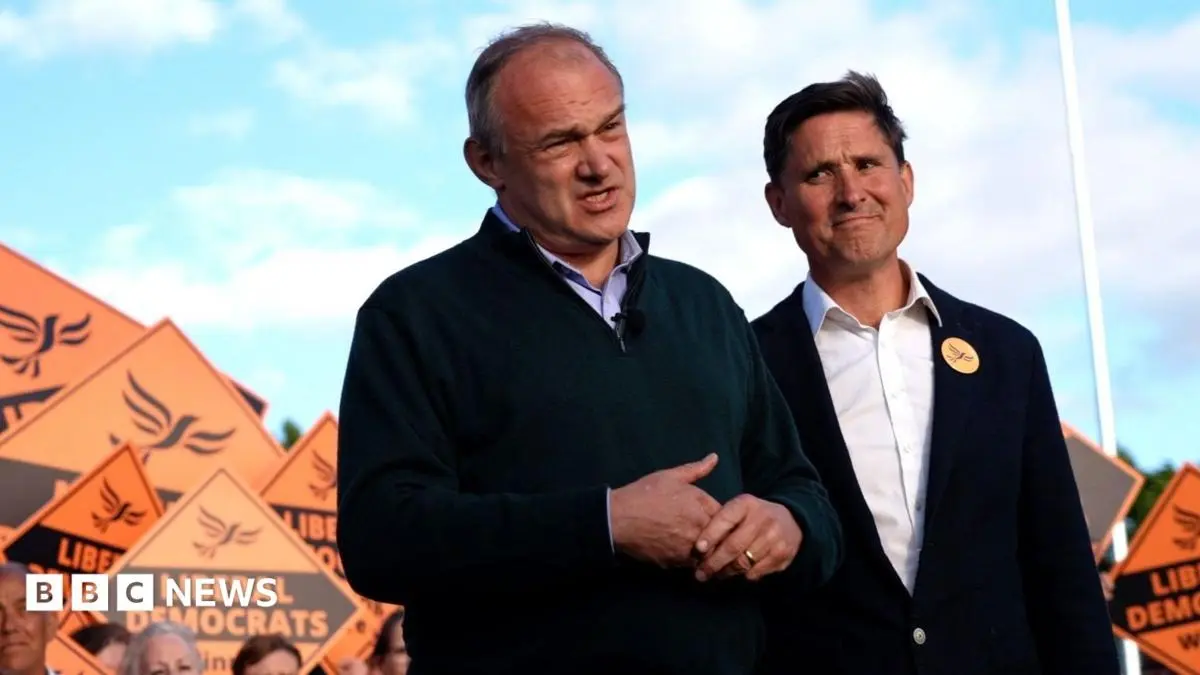
The Liberal Democrats have been thrust into a period of internal uncertainty following the resignation of Charlie Maynard from the party’s frontbench. Maynard, the Member of Parliament for Witney, stepped down from his role as Treasury spokesman on Friday and has openly called for Sir Ed Davey to be replaced as the leader of the party. The sudden departure of a frontbench spokesperson represents a significant challenge to Sir Ed’s authority, exposing simmering tensions within the parliamentary party despite its historic electoral performance earlier this year.
The resignation, which was first reported by the Financial Times, highlights a growing divide within the Liberal Democrat ranks. While the party achieved a historic breakthrough in the 2024 general election, winning dozens of new seats, some backbenchers and party figures are reportedly growing increasingly restless over its current political direction and national strategy. Those close to Sir Ed have privately acknowledged the existence of what they describe as a "small group" of Liberal Democrat MPs who are dissatisfied with his leadership, with Maynard identified as one of the prominent voices within this dissenting faction.
In response to the resignation, the party’s leadership has moved swiftly to contain the damage and project an image of overwhelming unity. Daisy Cooper, the deputy leader of the Liberal Democrats, issued a strong defense of Sir Ed, seeking to downplay the significance of Maynard’s departure. Cooper stated that the vast majority of their MPs support Ed, want him to lead the party into the next election, and are furious at this distraction. The sharp language from the deputy leader underscores the frustration within the party hierarchy over the public airing of internal divisions, which they view as an unnecessary self-inflicted wound at a time when they believe the party should be focusing its fire on the government. The BBC has approached Maynard for further comment regarding his decision to step down and his vision for the party’s future leadership.
Maynard’s resignation carries particular weight due to his background and the nature of the constituency he represents. He was first elected to Parliament in the 2024 general election, capturing the Oxfordshire constituency of Witney. The seat is highly symbolic, having been a traditionally safe Conservative stronghold famously held by former Prime Minister David Cameron. Maynard won the constituency with a majority of more than 4,000 votes, a victory that was seen as a key prize in the Liberal Democrats’ successful campaign to dismantle the Conservative "Blue Wall" across southern England. Before entering Westminster, Maynard built a career in the private sector, running an international mergers and acquisitions advisory firm. His professional background in finance and business made him a natural fit for the high-profile role of Treasury spokesman, making his decision to abandon the frontbench portfolio a notable loss of expertise for the party’s parliamentary team.
The prospect of a formal challenge to Sir Ed’s leadership remains a complex hurdle under the Liberal Democrats’ internal rules. According to the party’s constitution, a leadership contest cannot be triggered easily. It first requires a vote of no confidence in the leader to be passed by a majority of all the party’s sitting MPs. With the Liberal Democrats currently holding 72 seats in the House of Commons, a challenger would need to secure the support of at least 37 MPs to force Sir Ed from office. Furthermore, even if a vacancy occurs or a contest is triggered, any MP wishing to enter the leadership race must meet strict nomination criteria. A candidate must secure nominations from at least 10% of the parliamentary party, excluding themselves, which currently translates to at least seven other MPs. Additionally, they must obtain the backing of at least 200 party members spread across a minimum of 20 different local government parties. This high threshold is designed to prevent frivolous challenges and ensure that any potential leader has broad, demonstrable support across both the Westminster group and the wider grassroots membership.
Sir Ed has served as the leader of the Liberal Democrats for six years, navigating the party through a period of rebuilding following the difficult legacy of the post-coalition years. His tenure reached its high-water mark in the 2024 general election, where he led the party to its most successful electoral result in its history, securing 72 seats. The campaign was characterized by Sir Ed’s highly publicized and often eccentric stunts, ranging from paddleboarding to bungee jumping, which were designed to attract media attention to local issues such as water quality, sewage dumping, and social care.
However, despite this unprecedented parliamentary success, some within the party argue that the Liberal Democrats have struggled to capitalize on their expanded presence in the House of Commons. National opinion polling for the party has remained stuck at relatively low levels, failing to show a significant post-election bounce or a sustained rise in public support. This lack of upward movement has generated anxiety among some MPs who worry that the party is failing to establish a distinct national identity and is struggling to make its voice heard in a political landscape dominated by the Labour government and the Conservative opposition.
This anxiety has recently been exacerbated by public disagreements over key policy areas, most notably the future of the state pension triple lock. The triple lock is a highly sensitive political mechanism that guarantees the state pension increases each year in line with either inflation, average wage growth, or 2.5%, whichever of the three figures is the highest. While popular among older voters, the policy has faced growing criticism from economists and younger generations who argue it is financially unsustainable in the long term and exacerbates intergenerational inequality.
The issue became a point of contention last week when Sir Ed strongly criticized an announcement by Andy Burnham, the Labour Mayor of Greater Manchester, who suggested that the triple lock should be adjusted. Sir Ed argued that any move to modify or weaken the triple lock would put more pensioners into poverty. He sought to defend the policy by framing it as a long-term benefit for younger people, arguing that this would mean people who are working hard now—the millennials—when they retire would have a very poor pension.
This defense of the triple lock did not sit well with several of Sir Ed’s own MPs, who publicly and privately challenged his reasoning. One Liberal Democrat MP went so far as to describe the leader’s argument as nonsense. Another backbencher highlighted the disconnect between the leadership’s messaging and the economic reality perceived by younger voters, pointing out that most millennials do not think there will be a state pension when they retire, so this is not being done with them in mind. The internal backlash suggests a deeper philosophical divide within the party over how to balance the interests of the older, affluent voters who helped them win seats in the Blue Wall with those of younger generations who face high housing costs and stagnant real wages.
The criticism from the parliamentary party follows earlier warnings from local government figures who have expressed concern about the party’s overall trajectory. Last month, Julian Brazil, the Liberal Democrat leader of Devon County Council, went public with his frustrations, warning that the party was sleepwalking into irrelevance and openly questioning whether Sir Ed was the right person to lead them forward. Speaking to the BBC, Brazil argued that the Liberal Democrats were lacking ambition and had allowed other parties to go steaming past them in terms of setting the national political agenda and presenting a bold vision for the country.
The resignation of Charlie Maynard from the frontbench indicates that these concerns are no longer confined to local government or private grumbles among backbenchers. By stepping down from the Treasury portfolio and calling for a change in leadership, Maynard has brought the debate over Sir Ed’s future directly to the fore. While the party leadership insists that the vast majority of MPs remain firmly behind Sir Ed, the public emergence of a dissenting faction suggests that the post-election unity the party enjoyed during the summer is facing its most significant test yet.