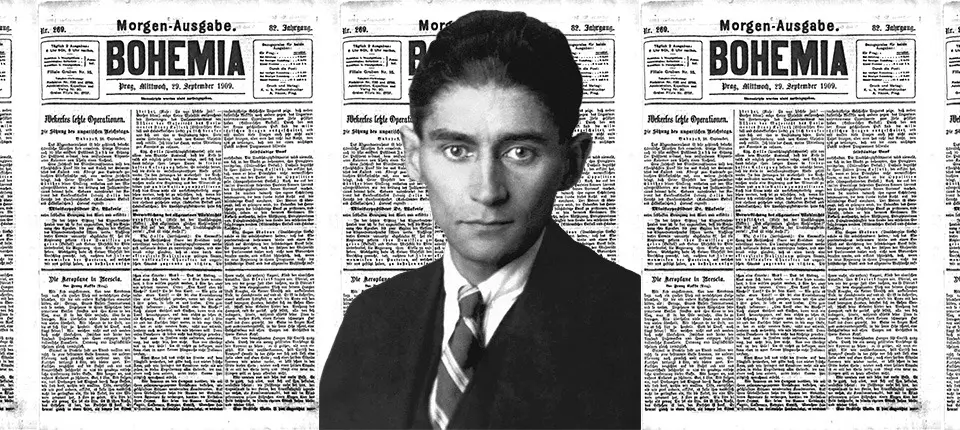
On September 29, 1909, the Prague-based German-language newspaper Bohemia published a piece of reportage that would, in retrospect, capture a pivotal moment in both technological history and the evolution of modern literature. The article, titled "The Aeroplanes at Brescia" (Die Aeroplane in Brescia), was written by a twenty-six-year-old insurance lawyer and aspiring author named Franz Kafka. While Kafka is today synonymous with the labyrinthine bureaucracies and existential anxieties of the twentieth century, this early work offers a rare glimpse into his engagement with the burgeoning world of high technology and the spectacle of the modern age.
The publication of "The Aeroplanes at Brescia" represents one of the earliest examples of a major literary figure grappling with the phenomenon of flight. In September 1909, the world was still reeling from the shock of the new; it had been less than six years since the Wright brothers first took to the air at Kitty Hawk, and only two months since Louis Blériot had successfully crossed the English Channel. When Kafka, accompanied by his close friend Max Brod and Max’s brother Otto, traveled to northern Italy to witness the "Circuito Aereo di Brescia," he was not merely a tourist but a witness to a transformation in the human experience of space and time.
The "Best of the Literary Internet" frequently looks back at these milestones to understand how the giants of literature were shaped by their contemporary surroundings. For Kafka, the Brescia air show was more than a display of mechanical prowess; it was a sensory assault that demanded a new kind of descriptive language. At the time, Kafka was employed at the Workers’ Accident Insurance Institute in Prague, a position that required him to document industrial injuries and the failings of machinery. In Brescia, however, he saw the machine in its most aspirational and aestheticized form.
The trip to Italy was intended as a brief holiday for the young men from Prague. They arrived in Brescia during a period of intense international excitement. The air show was the first of its kind in Italy, attracting an estimated 50,000 spectators, including members of the European aristocracy, socialites, and intellectuals. Among the crowd were figures such as the composer Giacomo Puccini and the flamboyant poet Gabriele D’Annunzio, the latter of whom actually secured a flight as a passenger—an event Kafka noted with his characteristic eye for detail.
In "The Aeroplanes at Brescia," Kafka’s prose deviates from the dense, metaphorical style that would later define masterpieces like The Trial or The Metamorphosis. Instead, he adopts the persona of a journalist, yet one who cannot help but infuse his reportage with a sense of wonder and alienation. He describes the airfield not as a place of triumph, but as a dusty, chaotic landscape where the human form seems dwarfed by the scale of the sky and the fragility of the wooden-and-canvas flying machines.
The article provides a vivid account of the pilots who were the celebrities of their day. Kafka writes of Louis Blériot, describing him as a man of modest appearance who, despite his fame, seemed burdened by the weight of his achievements. He also observes Glenn Curtiss, the American aviator, noting the precision and almost clinical efficiency of his flight. Kafka’s focus is often on the physical reality of the event—the "trembling" of the engines, the "whirring" of the propellers, and the way the planes seemed to struggle against the very air they were meant to conquer.
One of the most striking aspects of the piece is Kafka’s attention to the crowd. He describes the collective gasp of the spectators as a plane lifts off the ground, capturing the shared psychological experience of witnessing the impossible. To the onlookers in 1909, flight was not yet a mundane reality of travel; it was a miraculous rupture in the laws of nature. Kafka’s ability to translate this collective awe into prose is what makes the article a landmark in early twentieth-century writing.
The publication in Bohemia was a significant moment for Kafka’s burgeoning career. The newspaper was a staple of the German-speaking minority in Prague, a city then part of the Austro-Hungarian Empire. Bohemia served as a cultural bridge, and for Kafka, seeing his name in its pages was a validation of his literary ambitions. Max Brod, who would later become Kafka’s literary executor and biographer, also wrote an account of the Brescia trip, but it is Kafka’s version that has endured as a classic of travel literature and early modernist observation.
Scholars often point to "The Aeroplanes at Brescia" as a precursor to the themes of technology and the body that would pervade Kafka’s later work. In the article, he notes the "unnatural" posture of the pilots, who must contort themselves to fit into the cramped cockpits of their biplanes. This fascination with the intersection of the human body and the mechanical apparatus would later find a much darker expression in "In the Penal Colony," where a complex machine is designed to carve a prisoner’s sentence into their flesh. In 1909, however, the tone is one of cautious fascination rather than horror.
The context of the Brescia air show also highlights the rapid pace of change during the Edwardian era. The event was held just five years before the outbreak of the First World War, a conflict that would see these same "miraculous" machines repurposed for unprecedented destruction. Kafka’s reportage captures a moment of innocence in aviation, where the focus was on speed records and the sheer novelty of being airborne. Yet, even in his descriptions, there is a sense of the precariousness of the endeavor. He writes of the "falling" sensation that accompanies a landing and the constant threat of mechanical failure.
For the modern reader, the 1909 article serves as a reminder of Kafka’s versatility. He was not always the hermit of Prague, locked in a room and writing about nightmarish bureaucracies. He was a man of his time, interested in the cinema, the telephone, and, as evidenced by his trip to Brescia, the aeroplane. These technologies informed his understanding of the "modern" world—a world where old certainties were being replaced by a sense of speed, fragmentation, and the dissolution of traditional boundaries.
The "Lit Hub Daily" feature on this anniversary underscores the importance of archival discovery in literary studies. By revisiting the date of September 29, 1909, we are reminded that literature does not exist in a vacuum. It is shaped by the newspapers authors read, the events they attend, and the technological shifts they witness. Kafka’s report on the aeroplanes at Brescia is a testament to the writer’s role as a chronicler of his age, even when that writer is someone as uniquely inward-looking as Franz Kafka.
The prose in the Bohemia article also reveals Kafka’s emerging talent for finding the "extraordinary in the ordinary." He describes the way a plane, once it has landed and its engine has stopped, becomes a "lifeless heap of wood and fabric." This transition from the sublime to the mundane is a hallmark of Kafka’s later fiction. In Brescia, he saw the future taking flight, but he also saw the dust on the ground and the exhaustion of the men trying to keep those machines in the air.
As we look back at this moment from the perspective of 2026, the significance of Kafka’s journalism remains undiminished. It serves as a bridge between the nineteenth-century tradition of the "man of letters" and the twentieth-century reality of the "technological observer." Kafka’s trip to Brescia was a formative experience that allowed him to practice the kind of detached, precise observation that would eventually make him one of the most influential writers in history.
The legacy of "The Aeroplanes at Brescia" continues to be explored by biographers and literary critics who seek to understand the "Prague Circle" and the cultural environment of the early 1900s. The article remains a vibrant piece of writing, as fresh today as it was when it first appeared in the columns of Bohemia over a century ago. It reminds us that before he was the architect of the "Kafkaesque," Franz Kafka was a young man standing in an Italian field, looking up at the sky in wonder as the first aeroplanes roared overhead.