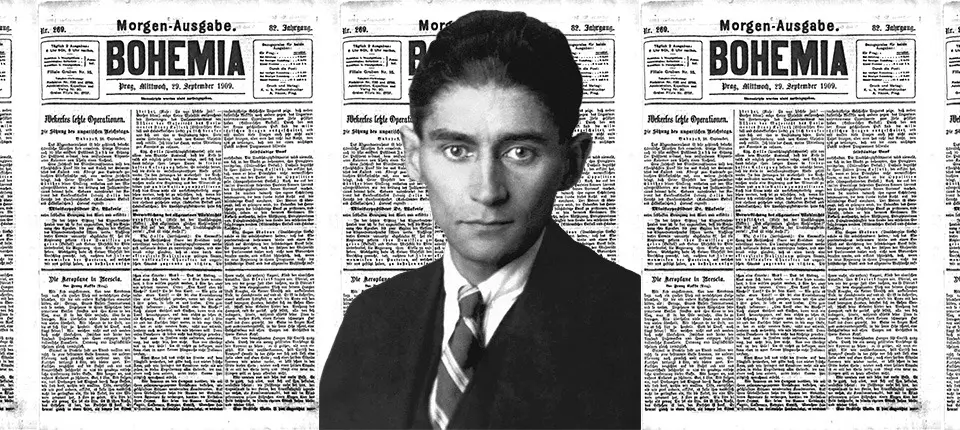
The article provides a vivid account of the pilots who were the celebrities of their day. Kafka writes of Louis Blériot, describing him as a man of modest appearance who, despite his fame, seemed burdened by the weight of his achievements. He also observes Glenn Curtiss, the American aviator, noting the precision and almost clinical efficiency of his flight. Kafka’s focus is often on the physical reality of the event—the "trembling" of the engines, the "whirring" of the propellers, and the way the planes seemed to struggle against the very air they were meant to conquer.
One of the most striking aspects of the piece is Kafka’s attention to the crowd. He describes the collective gasp of the spectators as a plane lifts off the ground, capturing the shared psychological experience of witnessing the impossible. To the onlookers in 1909, flight was not yet a mundane reality of travel; it was a miraculous rupture in the laws of nature. Kafka’s ability to translate this collective awe into prose is what makes the article a landmark in early twentieth-century writing.
The publication in Bohemia was a significant moment for Kafka’s burgeoning career. The newspaper was a staple of the German-speaking minority in Prague, a city then part of the Austro-Hungarian Empire. Bohemia served as a cultural bridge, and for Kafka, seeing his name in its pages was a validation of his literary ambitions. Max Brod, who would later become Kafka’s literary executor and biographer, also wrote an account of the Brescia trip, but it is Kafka’s version that has endured as a classic of travel literature and early modernist observation.
Scholars often point to "The Aeroplanes at Brescia" as a precursor to the themes of technology and the body that would pervade Kafka’s later work. In the article, he notes the "unnatural" posture of the pilots, who must contort themselves to fit into the cramped cockpits of their biplanes. This fascination with the intersection of the human body and the mechanical apparatus would later find a much darker expression in "In the Penal Colony," where a complex machine is designed to carve a prisoner’s sentence into their flesh. In 1909, however, the tone is one of cautious fascination rather than horror.
The context of the Brescia air show also highlights the rapid pace of change during the Edwardian era. The event was held just five years before the outbreak of the First World War, a conflict that would see these same "miraculous" machines repurposed for unprecedented destruction. Kafka’s reportage captures a moment of innocence in aviation, where the focus was on speed records and the sheer novelty of being airborne. Yet, even in his descriptions, there is a sense of the precariousness of the endeavor. He writes of the "falling" sensation that accompanies a landing and the constant threat of mechanical failure.