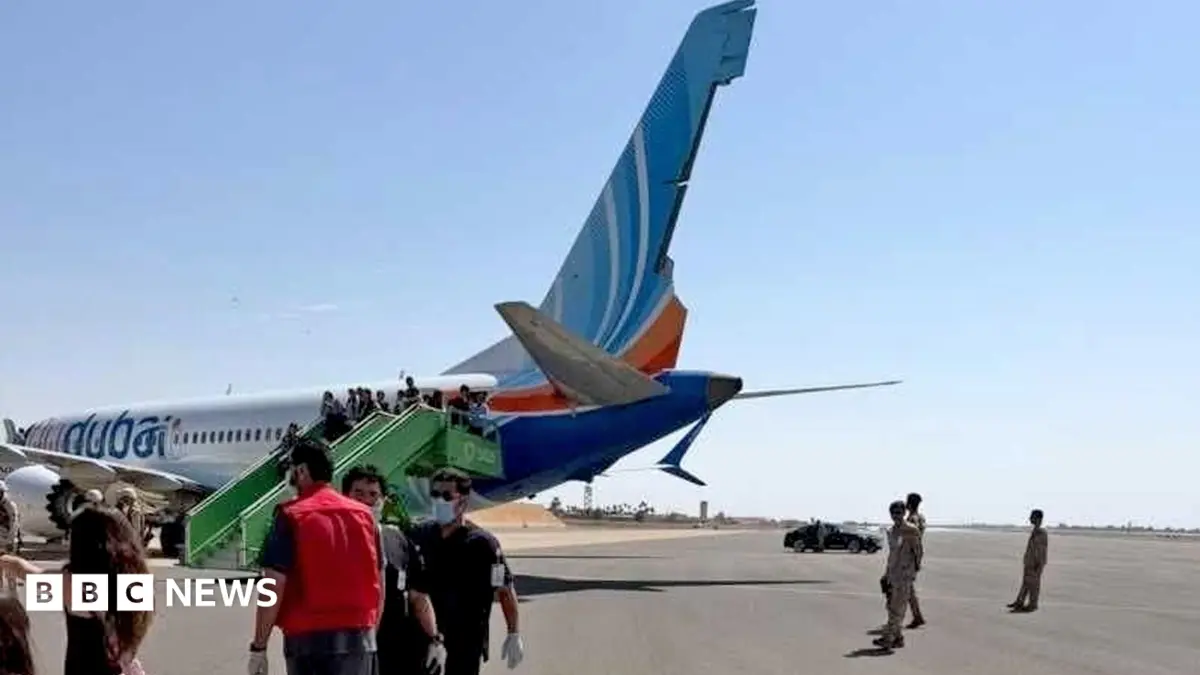
Australian security and law enforcement agencies have launched a comprehensive investigation into the domestic links of a Flydubai co-pilot accused of attempting to seize control of a commercial airliner bound for Israel. The suspect, identified by major international news organizations including Reuters, CNN, and The New York Times as Omani national Hamam al-Hammami, allegedly launched a violent attack against the aircraft’s captain with a cockpit crash axe during the flight. The incident triggered a terrifying, rapid descent before passengers and crew managed to intervene and overpower him.
The revelation of the co-pilot’s past residency in Australia has thrust the country’s counter-terrorism units into the center of a complex, multi-jurisdictional investigation. In an official statement, the Australian Federal Police (AFP) confirmed that it is actively investigating the suspect’s historical connections to Australia. The federal agency indicated that the ongoing probe is a highly coordinated effort involving state-level police forces as well as the nation’s primary domestic security and intelligence organization. AFP officials noted that further updates regarding the investigation would be made public at an appropriate time as more details are uncovered.
The violent incident took place on September 30 aboard a Flydubai flight transporting more than 170 passengers from Dubai to Tel Aviv. According to official reports from the United Arab Emirates prosecution, the flight had been in the air for approximately two and a half hours when the routine journey turned into a life-or-death struggle. While cruising, the Omani co-pilot suddenly retrieved the cockpit’s crash axe—a tool mandated on commercial aircraft for emergency escape purposes—and began a brutal assault on the pilot in command, Captain Smit Machchhar.
During the ensuing struggle on the flight deck, the aircraft experienced a sudden and dramatic loss of control, plunging approximately 17,000 feet (5,200 meters) from its cruising altitude. The rapid drop caused severe panic in the cabin as passengers and cabin crew realized the aircraft was in extreme danger.
Captain Machchhar, an Indian national, later provided a harrowing account of the moments when he had to fight to save the aircraft despite sustaining severe injuries. Speaking from his hospital bed, Machchhar described how he was lying incapacitated on the floor of the cockpit as the plane continued to lose altitude. Recognizing the imminent catastrophe, Machchhar realized he had to act immediately. He recalled telling himself to muster enough strength for one final, desperate push to reach the cockpit door mechanism and unlock it from the inside, which allowed those in the main cabin to enter and assist.
Once the cockpit door was opened, passengers rushed forward to intervene. Together with the cabin crew, they managed to overpower the combative co-pilot, restraining him and ending the physical threat to the flight deck. With the captain seriously injured and the attacker secured, two reserve pilots who were on board the flight took control of the aircraft. They stabilized the plane, corrected its flight path, and initiated an emergency diversion to land the aircraft safely in neighboring Saudi Arabia.
Upon landing on Saudi soil, emergency medical teams met the aircraft. Captain Machchhar was immediately transported to a local hospital for urgent medical evaluation and stabilization. He was subsequently airlifted to a medical facility in Abu Dhabi, where official reports indicate he is currently in a stable condition. Meanwhile, the Omani co-pilot was arrested at the scene by Saudi authorities. Israeli Prime Minister Benjamin Netanyahu later confirmed the arrest, stating that the suspect was being held and interrogated by Saudi security services.
In the United Arab Emirates, the country’s Attorney General, Hamad Saif Al Shamsi, announced that a full-scale investigation is underway to determine the precise circumstances, underlying motives, and any potential external networks associated with the attack. According to the UAE’s state news agency, preliminary findings from the attorney general’s office indicate that the co-pilot’s actions constituted a deliberate attempt to carry out a "terrorist act."
As international intelligence agencies piece together al-Hammami’s background, his historical ties to Australia have emerged as a primary focus for counter-terrorism investigators. According to sources familiar with the matter who spoke to Australian media, al-Hammami was first granted an Australian student visa in 2014. He arrived in the country the following year, living and studying in Australia between 2015 and 2017 before eventually departing.
Although he left the country in 2017, his formal legal status in Australia remained active for two more years. The Australian Broadcasting Corporation (ABC) reported that his student visa was officially cancelled by authorities in 2019. The cancellation was executed on the grounds that he was no longer enrolled in an approved course of study, making him legally ineligible to maintain his visa. Australian counter-terrorism investigators are currently examining his activities, associations, and online footprint during his multi-year stay in the country to determine if his radicalization began or intensified while he was living there.
In the days following the mid-air attack, additional troubling details have emerged regarding al-Hammami’s employment history and prior behavior within the aviation industry. US media outlets reported that during his previous employment with Oman Air, the national carrier of Oman, serious red flags had already been raised regarding his ideological beliefs. According to these reports, al-Hammami was officially removed from flight training at Oman Air due to deep concerns regarding his radical views. However, rather than being terminated from the company entirely, he was reassigned to a different, non-flying role within the airline. How he was later able to secure a position as a commercial co-pilot with Flydubai remains a key focus of the international inquiry.
In addition to his ties to Oman and Australia, investigators have mapped out al-Hammami’s academic activities in Europe. It has been confirmed that starting in 2020, he enrolled in a distance-learning degree program offered by Buckinghamshire New University in the United Kingdom. He completed the program remotely, graduating in 2023 with a Bachelor of Science degree in aviation management. Following the incident, the UK university issued a statement confirming his graduation but took steps to clarify that his curriculum was entirely academic and did not involve any practical pilot or flight training at their institution.
The incident has raised serious questions within the global aviation community regarding crew vetting procedures, mental health monitoring, and the security protocols surrounding access to emergency tools like crash axes within the cockpit. The fact that an individual who had previously been flagged and removed from flight training at one airline for radical views was subsequently hired and cleared to fly by another major international carrier has prompted calls for tighter oversight.
The investigation remains highly active and fluid, with security agencies in the UAE, Saudi Arabia, Australia, and other nations sharing intelligence. The Australian Federal Police, along with their state and federal security partners, continue to analyze al-Hammami’s past communications and financial records from his time in Australia to identify any potential accomplices or local influences that may have played a role in his path toward the attempted attack.