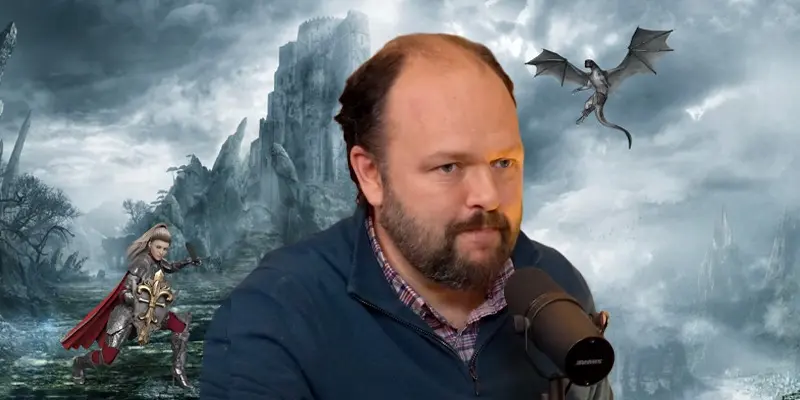
The news of the print deal brings a new level of permanence to a project that Douthat has been nurturing in the digital space for some time. "The Falcon’s Children" is presented as the opening installment of a planned trilogy, introducing readers to a densely layered universe featuring the Emperors of Narsil, the Mandoran Invasion of Brethony, and the geographical intricacies of the Skalbard Coast and the Mersana River. For followers of Douthat’s journalistic work, the shift to fiction might seem unexpected, yet the project is steeped in the same historical and theological preoccupations that have defined his career. The narrative is often described by the author as "speculative historical fiction," a genre that allows for the exploration of complex social and religious structures through a fantastical lens.
Douthat’s professional trajectory has recently seen him branching out from his established "knighthood" at the New York Times opinion page. While he continues to provide a conservative voice at the Grey Lady, he has increasingly collaborated with newer media ventures, most notably joining forces with Bari Weiss and her media company, The Free Press. His involvement there, which some have likened to a modern-day conservative version of Andy Rooney—albeit one deeply concerned with the state of the contemporary Papacy and the rise of "woke" ideology—has signaled a desire to reach audiences outside the traditional legacy media ecosystem. The Substack serialization of "The Falcon’s Children" was part of this broader trend toward independent, direct-to-reader publishing, but the partnership with Luminor suggests a return to the prestige of physical bookmaking within a specific ideological and religious niche.
The choice of publisher is particularly telling. Luminor, as an imprint of Word on Fire, aligns Douthat with an organization dedicated to the "evangelization of culture." By placing his fantasy work within this stable, Douthat is positioning "The Falcon’s Children" not merely as a commercial YA venture, but as a contribution to a specific tradition of Christian literary imagination. However, the path from political punditry to successful novelist is notoriously difficult, and Douthat’s foray into the genre has already met with a degree of critical skepticism.
In early 2023, as the initial chapters of the novel began appearing online, Slate’s veteran book critic Laura Miller offered a pointed assessment of the work. After reviewing the opening pages, Miller suggested that the prose struggled under the weight of its own ambitions, stating that if the remainder of the novel followed the trajectory of its first chapter, it would require a comprehensive "top to bottom" rewrite. The primary critique often leveled at the work involves its density; the narrative is frequently interrupted or supplemented by what some call "data-dumping"—extensive world-building documents that detail the lives of Great Viceroys, the history of the Nine Archangels, and the lineage of various imperial dynasties.
For some readers, this level of detail is a hallmark of the genre, reminiscent of the exhaustive appendices found in the works of J.R.R. Tolkien. Douthat’s commitment to the craft of world-building is evident in the supplemental materials provided to his Substack subscribers, which include hand-drawn maps of the Narsil Empire. In the community of high fantasy enthusiasts, a map is often seen as a prerequisite for legitimacy, signaling a commitment to a fully realized, immersive environment. Yet, the challenge remains for Douthat to translate this structural "magical thinking" into a compelling narrative that can hold the attention of a young adult audience.
The connection between Douthat’s conservative worldview and his interest in the utopian or fantastical has been noted before. A 2010 profile in Mother Jones characterized his vision of conservatism as falling into a "realm of the utopian," describing it as a form of "Tolkien-like thinking." This suggests that for Douthat, the creation of a secondary world is not a departure from his political philosophy, but rather an extension of it. In his columns, he often laments the loss of tradition and the flattening of the modern spiritual landscape; through fiction, he can construct a world where those traditions are vibrant, the stakes are cosmic, and the social order is governed by more than just materialist concerns.
The potential audience for "The Falcon’s Children" remains a subject of curiosity. Given Douthat’s prominence in conservative circles, the book may find a natural home among the "young apparatchiks" of think tanks like the Heritage Foundation or families looking for a contemporary alternative to the classics of the Western canon. There is a clear appetite within certain religious and political demographics for "wholesome" or "values-driven" fantasy that avoids the perceived pitfalls of modern mainstream YA literature. Douthat’s work, with its emphasis on history, hierarchy, and archangels, fits neatly into this demand.
However, critics of the project argue that there is no need to "reinvent" the wheel when it comes to Catholic or Christian-themed fantasy. The shadows of J.R.R. Tolkien and C.S. Lewis loom large over the genre, and their works continue to serve as the gold standard for blending theological depth with narrative mastery. Furthermore, readers seeking a different kind of spiritual or speculative experience have long turned to the works of Ursula K. Le Guin, particularly her Earthsea cycle, which offers a profound exploration of power and morality without the same ideological baggage.
For those looking for contemporary Christian writing that prioritizes poetic introspection over imperial world-building, names like Christian Wiman are often cited as alternatives. Wiman, a poet and essayist known for works such as "My Bright Abyss" and "Zero at the Bone," represents a more "open-hearted" and "non-regressive" approach to faith and literature. His writing focuses on the human condition, the struggle with illness, and the nuances of belief in a secular age, offering a contrast to the more structured and dogmatic world Douthat is constructing in his trilogy.
As the release of the print edition of "The Falcon’s Children" approaches next year, the literary community will be watching to see if Douthat can overcome the "ill reviews" of his early chapters and deliver a work that stands on its own merits as fiction. The transition from the "tower in the Square of Times" to the drafting of maps and the naming of viceroys is a bold move for a writer who has spent decades influencing the national conversation through the op-ed page. Whether the trilogy will be remembered as a successful expansion of the Catholic literary tradition or a curious footnote in the career of a political columnist remains to be seen.
Ultimately, "The Falcon’s Children" represents a unique intersection of modern media trends: the rise of the Substack "side-gig," the enduring appeal of the YA fantasy genre, and the desire of public intellectuals to find new ways to communicate their underlying worldviews. While the ravens may speak of mixed reviews, the final judgment will rest with the readers who journey into the Empire of Narsil when the physical volumes arrive on shelves. For now, the traveler in the landscape of contemporary letters has a new, if controversial, destination to consider.