
The photographer behind the lens, Brian Skerry, is no stranger to the world’s most formidable aquatic predators. With a career spanning decades and more than 10,000 hours logged beneath the surface of the world’s oceans, Skerry has dedicated his life to documenting the beauty and the brutal reality of marine ecosystems. However, even for a professional of his caliber, the footage captured this summer represents a significant milestone. Working in the often-turbid waters of the North Atlantic, Skerry spent several days collaborating with local charter boat captains to track and record the elusive behavior that many fishermen had described but few had ever seen from an underwater perspective.
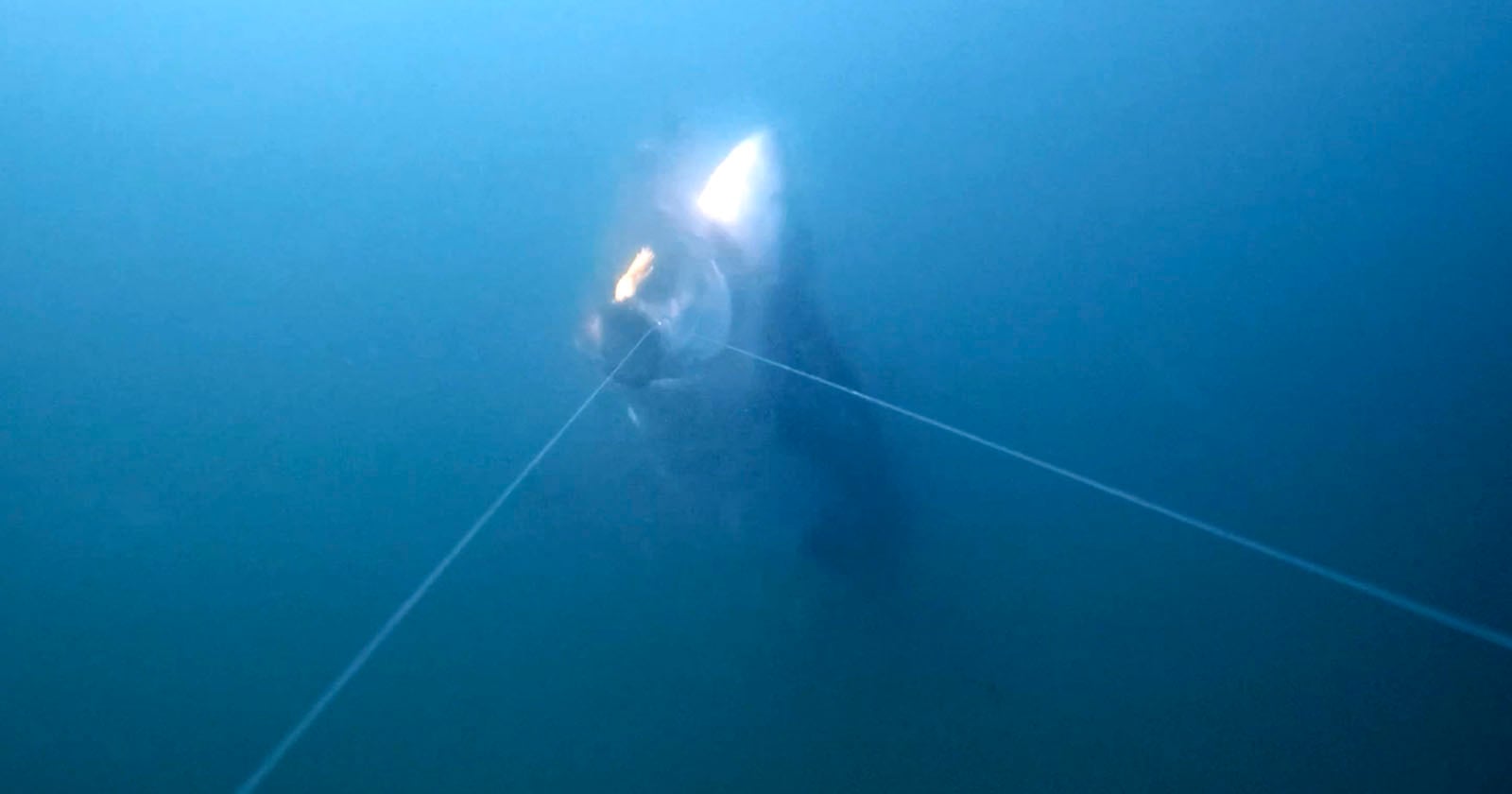
The specific incident occurred on June 29, during a period when reports of shark interference with fishing activities were reaching a fever pitch in the region. Skerry’s camera was positioned to catch the action as a fish, already hooked and being reeled in by a fisherman above, moved through the water. Suddenly, out of the murky blue-green depths of the Atlantic, a juvenile female great white shark appeared at a high rate of speed. With surgical precision, the shark lunged at the struggling fish, deftly removing it from the line in a flurry of motion before vanishing back into the gloom.
The speed and accuracy of the strike were remarkable, but it was the nuance of the shark’s approach that truly caught Skerry’s attention. In reviewing the footage, Skerry noted that the shark appeared to be making a calculated move to avoid the dangerous hardware associated with the fisherman’s catch. The shark grabbed the fish from the side, seemingly intentional in its effort to avoid the lure and the hook itself. To Skerry, this suggested a level of cognitive processing and caution that challenges the common perception of sharks as mindless eating machines. While he admitted that he might be reading too much into the animal’s actions, he noted that it appeared the shark was making specific decisions to secure a meal while minimizing the risk of getting hooked herself.
This behavior, while newly documented on film from this vantage point, is a familiar frustration for the fishermen who frequent the waters of Cape Cod and the Gulf of Maine. For years, charter boat captains and recreational anglers have reported a sharp increase in "taxing" by sharks—a slang term for when a predator takes a portion of a catch before it can be landed. According to reports from the area, it has become common for fishermen to reel in nothing but the heads of their intended catches, with the bodies having been sheared off by the powerful jaws of a great white.
Captain Hap Farrell, a veteran charter boat captain who has spent years navigating these waters, has observed this trend firsthand. He noted that the frequency of these encounters has escalated significantly over the past three years. According to Farrell, the sharks have become increasingly bold, often following a hooked fish all the way to the boat. He described instances where sharks would come within four or five feet of the vessel, aggressively chasing what remained of a catch as it was being pulled from the water. For the fishing community, this represents more than just a lost catch; it is a fundamental shift in the environment they have worked in for generations.
The rise in depredation is not a random occurrence but is deeply rooted in the changing ecology of the New England coast. The presence of great white sharks in such high numbers is directly linked to the booming population of gray seals. Once hunted to near extinction in the region, gray seals have seen a massive recovery following the implementation of the Marine Mammal Protection Act in 1972. Today, the seal population on Cape Cod numbers in the tens of thousands, creating a rich and reliable food source that has drawn great white sharks back to their ancestral hunting grounds in the North Atlantic.
While the return of these apex predators is a sign of a recovering and healthy ecosystem, it brings with it a complex set of challenges. For conservationists like Skerry, the presence of great whites is a cause for celebration—a testament to the resilience of nature when given the chance to heal. Skerry has long maintained that his goal is to help the public understand that the waters of Cape Cod and the Gulf of Maine are home to a healthy, recovering population of large predatory sharks. He views the presence of great whites as a "good thing for the ocean" and, by extension, a positive development for the planet’s overall health. An ocean with its top predators intact is an ocean that is functioning as it should, maintaining the balance of the species below them in the food chain.
However, this ecological success story creates a natural friction with the human activities that define the Cape Cod region. For beachgoers, the proximity of great whites to the shore is a source of persistent anxiety, leading to beach closures and a heightened sense of caution during the summer months. For the local fishing industry, the sharks represent a direct threat to their livelihoods. When sharks regularly take catches off the lines, it affects the efficiency of fishing trips, the satisfaction of charter clients, and the economic viability of the industry. The concern among conservationists is that this increased interaction could lead to a rise in conflict, potentially undermining the very protections that allowed the shark and seal populations to recover in the first place.
Skerry’s work aims to bridge the gap between these perspectives by providing a clearer understanding of how these animals behave. By capturing the first underwater footage of depredation, he provides scientists and the public with a new data point in the study of great white behavior. The footage allows for a closer look at the mechanics of the strike and the shark’s interaction with man-made objects, offering insights that cannot be gained from observing the water’s surface alone.
During his time on the water this summer, Skerry relied on real-time updates from the fishing fleet to position himself where the action was most likely to occur. This collaboration between a world-class photographer and local mariners highlights the shared interest in understanding the changes occurring in the Atlantic. While their motivations may differ—one seeking to document nature and the other seeking to navigate it—both parties recognize that the "new normal" of Cape Cod’s waters requires a deeper level of observation and adaptation.
The juvenile female shark captured in Skerry’s footage serves as a representative of a new generation of great whites that are reclaiming the New England coast. Her ability to navigate the murky waters and successfully scavenge a meal from a fishing line demonstrates the adaptability of the species. As these sharks continue to grow and mature, their impact on the local environment will only become more pronounced.
Ultimately, the footage captured by Brian Skerry is more than just a rare wildlife moment; it is a visual record of a changing world. It serves as a reminder that the ocean is a dynamic and often unpredictable environment where the lines between human activity and wild nature frequently blur. As the great white shark population continues to thrive alongside the recovering seal colonies, the waters of Cape Cod will remain a critical laboratory for studying the relationship between humans and one of the ocean’s most misunderstood inhabitants. Through his lens, Skerry continues to advocate for a perspective that values the presence of these predators, even as society grapples with the practical realities of sharing the sea with them. The sight of a great white emerging from the blue to claim its prize is a powerful symbol of a wilder, healthier Atlantic—one that is both a challenge to manage and a wonder to behold.