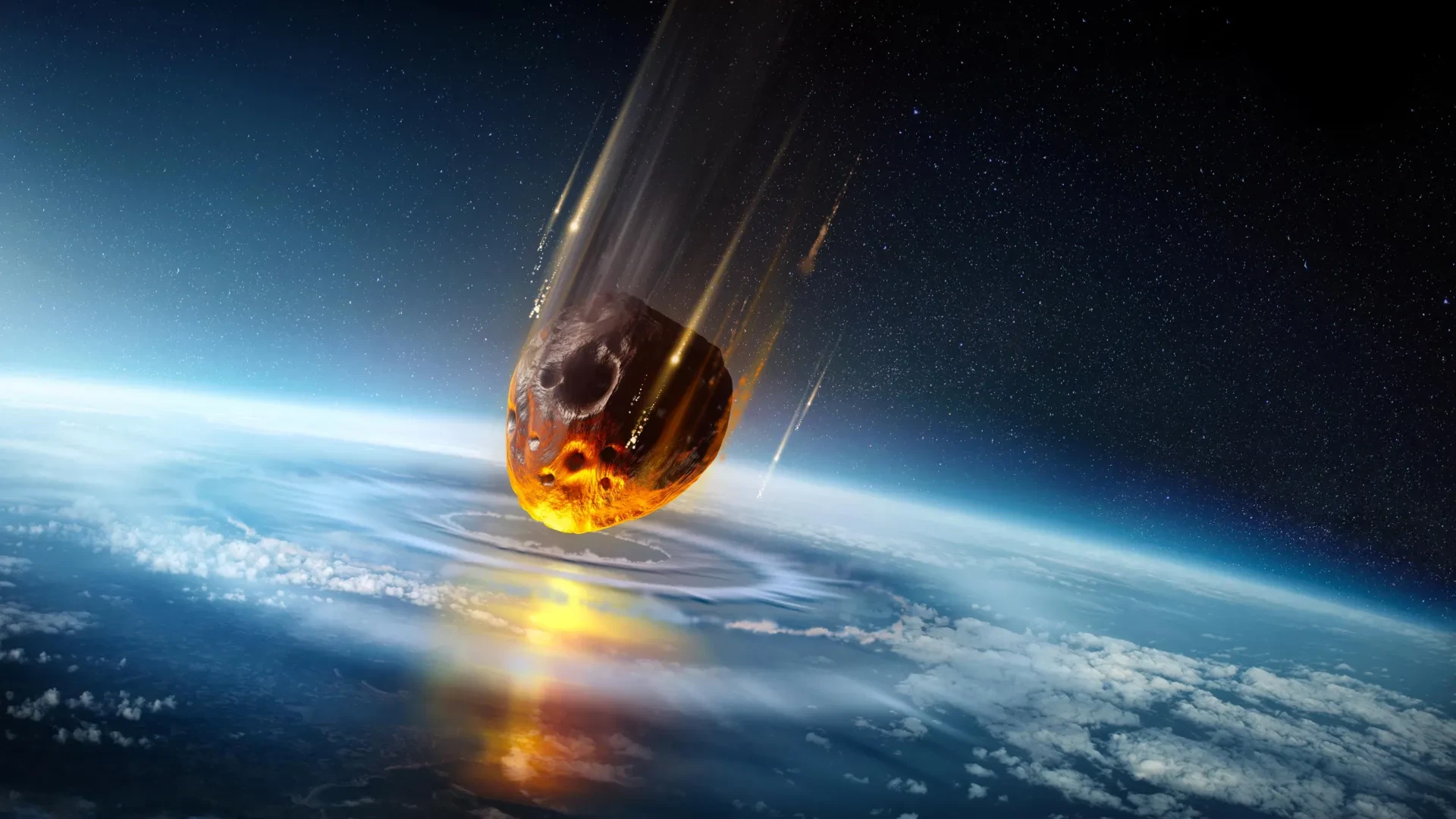
Deep beneath the quiet landscape of Major County, Oklahoma, lies a geological scar of cosmic proportions. For decades, the Ames impact structure—a massive crater buried under thousands of feet of sediment—has been a focal point for both energy exploration and scientific inquiry. Long believed to be a remnant of a specific, high-traffic period in Earth’s celestial history, new research from The University of Texas at Austin has fundamentally challenged that narrative.
By employing advanced geochronological techniques on microscopic crystals, a team of researchers from the UT Jackson School of Geosciences has determined that the Ames impact occurred approximately 370 million years ago. This discovery places the event in the Late Devonian period, making the crater nearly 100 million years younger than previously estimated. The revision does more than just update a map; it removes a cornerstone of a popular theory regarding Earth’s ancient past and provides a new potential culprit for one of the planet’s most devastating mass extinction events.
A Hidden Giant with Economic Weight
The Ames impact structure, often referred to locally as the "Ames Hole," is not visible from the surface. Located beneath the town of Ames, Oklahoma, it is a circular depression roughly eight miles in diameter. It was discovered in the early 1990s not by astronomers looking at the sky, but by geologists looking for oil.
Impact craters often create unique geological traps where hydrocarbons can accumulate. In the case of Ames, the violent collision shattered the local granite and carbonate rock, creating a highly porous reservoir. This structure became one of the most productive oil and gas fields in the region, leading to the drilling of numerous wells that provided researchers with something rare: physical core samples from deep within a buried impact site.
For years, these samples were the primary source of information regarding the crater’s age. Based on the presence of specific fossils within the layers of rock associated with the impact, scientists concluded that the meteor struck during the Middle Ordovician period, roughly 467.5 million years ago.
The Myth of the Ordovician Ring
The original dating of the Ames crater was significant because it aligned the Oklahoma site with a series of other major impact structures across North America and Europe. This clustering led to the development of the "Ordovician Meteor Event" theory.
According to this hypothesis, about 470 million years ago, a massive collision in the asteroid belt between Mars and Jupiter showered the inner solar system with debris. The influx of meteorites was so intense that some researchers proposed Earth may have briefly possessed a Saturn-like ring of asteroid fragments. This ring would have gradually decayed, leading to a prolonged period of frequent impacts that some scientists believe influenced the evolution of life during the Great Ordovician Biodiversification Event.
However, the new findings from the University of Texas suggest that the Ames crater was never part of this story.
"No matter what technique we used, it was coming back to this younger signal," said Elizabeth Catlos, lead author of the study and an associate professor in UT’s Department of Earth and Planetary Sciences.
The team’s research, published in the July issue of Meteoritics & Planetary Science, indicates that the Ames impact was an isolated event occurring long after the proposed Ordovician bombardment had ended. By removing Ames from the Ordovician timeline, the evidence for a concentrated "cluster" of impacts begins to thin, forcing scientists to reconsider the validity of the debris-ring hypothesis.
Why the Earlier Date Was Misleading
The discrepancy between the old and new dates stems from the methods used to age the crater. Historically, the Ames structure was dated using biostratigraphy—the study of fossils within rock layers.
Specifically, researchers had identified the remains of conodonts—tiny, eel-like creatures—within the impact breccia (the jagged, broken rock formed during the collision). These conodonts were known to have lived during the Ordovician period. Because their teeth were found embedded in the impact-altered rock, it was logically assumed that the impact occurred while those creatures were extant.
However, Catlos and her team suspected that these "index fossils" were providing a "reworked" age. In the violent chaos of a meteor strike, the ground is not simply compressed; it is excavated, flipped, and churned.
"The teeth were probably already millions of years old by the time the asteroid struck," Catlos explained. The impact likely struck a landscape where Ordovician sediments were already buried. The force of the collision unearthed this older material, mixing the ancient fossils into the newly formed impact rock. While the fossils survived the heat and pressure, they represented the target rock’s history, not the timing of the impact itself.
Tiny Zircon Crystals Preserve the Impact
To find a more reliable "clock," the researchers turned to zircon crystals. Zircons are incredibly durable minerals that can survive extreme heat and chemical erosion. They are also unique because they incorporate uranium into their structure when they form but reject lead. Over time, the uranium decays into lead at a known, constant rate. By measuring the ratio of uranium to lead within a crystal—a process known as U-Pb dating—scientists can determine exactly when the crystal formed or when it was last "reset" by a high-energy event.
Danny Stockli, dean of the Jackson School of Geosciences and a co-author of the study, noted that zircon dating is among the most rigorous tools available to geologists.
"These small crystals allow us to go back in time and learn about the major changes to Earth’s ancient landscapes," Stockli said.
However, dating zircons in an impact crater is a delicate task. The team had to distinguish between the original age of the granite (when the crystals first formed billions of years ago) and the moment the meteor struck. When a meteorite hits, the intense pressure and temperature cause the zircons to undergo "shock metamorphism." They may partially melt or recrystallize, effectively restarting their internal radioactive clocks.
To ensure they were looking at the right data, the UT team collaborated with NASA to image the crystals using advanced techniques: cathodoluminescence and electron backscatter diffraction. These methods allowed the researchers to see the internal structure of the zircons at a microscopic level. They looked for "shock features"—distinctive patterns of recrystallization that only occur under the extreme conditions of a cosmic collision.
Once they identified the zircons that had been physically altered by the impact, they dated those specific sections. The results were consistent: the clock had been reset 370 million years ago.
A New Piece of a Mass Extinction Puzzle
The shift from 467 million to 370 million years ago moves the Ames impact into a much more turbulent era of Earth’s history. The Late Devonian was a time of radical environmental change, culminating in the Frasnian-Famennian mass extinction.
Occurring roughly 372 million years ago, this extinction event was one of the "Big Five" in Earth’s history, wiping out approximately 75% of all species, with marine life—particularly reef-building organisms—taking the hardest hit. The cause of this extinction has long been a subject of intense debate among scientists. Was it triggered by internal forces, such as massive volcanic eruptions and climate change, or by external forces, such as a large-scale meteor strike?
By redating the Ames crater to 370 million years ago, the UT researchers have placed it within the immediate window of this biological catastrophe. While the Ames impact alone may not have been large enough to trigger a global extinction, its timing suggests it may have been part of a larger period of instability.
"With this research, we’re basically taking a major pawn out of the Ordovician Meteor Event and dumping it into the Frasnian-Famennian event," Catlos said. "We are saying, ‘This is where this impact belongs.’"
This reassignment helps clarify the "murder mystery" of the Late Devonian. It provides concrete evidence that Earth was indeed being struck by significant cosmic bodies during the lead-up to or the aftermath of the mass extinction, potentially compounding the stress on the planet’s ecosystems.
A Legacy of Research
The publication of this study marks the culmination of a multi-generational effort at the Jackson School of Geosciences. The project was initiated by Andrew Parisi, a former graduate student who conducted the foundational work of traveling to Oklahoma, obtaining the rock cores from the Oklahoma Geological Survey, and extracting the zircons.
Parisi, who graduated in 2018, passed away before the final results could be published. Similarly, co-author Michael Brookfield, an affiliated researcher at the school, passed away prior to the paper’s release. The final study stands as a tribute to their contributions, with additional support provided by Research Professor Sean Gulick and Professor Emeritus Mark Cloos.
The success of the Ames study has prompted a call for a broader re-evaluation of North American geology. Many other impact sites across the continent were dated using the same fossil-based methods that led to the original Ames timeline.
"It would be great to do this for more of the meteor impact sites across the continent so we could get a more accurate timeline for these major events," Stockli said.
As technology improves, the ability to peer into the heart of a single crystal of zircon is allowing scientists to rewrite the history of our planet. In the case of the Ames crater, the story is no longer one of a quiet addition to an Ordovician ring, but a violent punctuation mark at the end of the Devonian—a reminder of how space and Earth are inextricably linked in the cycle of life and extinction.