Republic of Ireland head coach Heimir Hallgrimsson has praised his players for utilizing their international platform to raise global awareness of the ongoing humanitarian crisis in Gaza. His comments followed a highly charged UEFA Nations League fixture in Hungary, where the Irish squad chose to bypass standard pre-match formalities before securing a commanding 3-0 victory over Israel. The match, played at a neutral venue, took place against a backdrop of intense domestic pressure, political campaigns, and deep internal debates within the Irish squad over whether they should participate in the game at all.
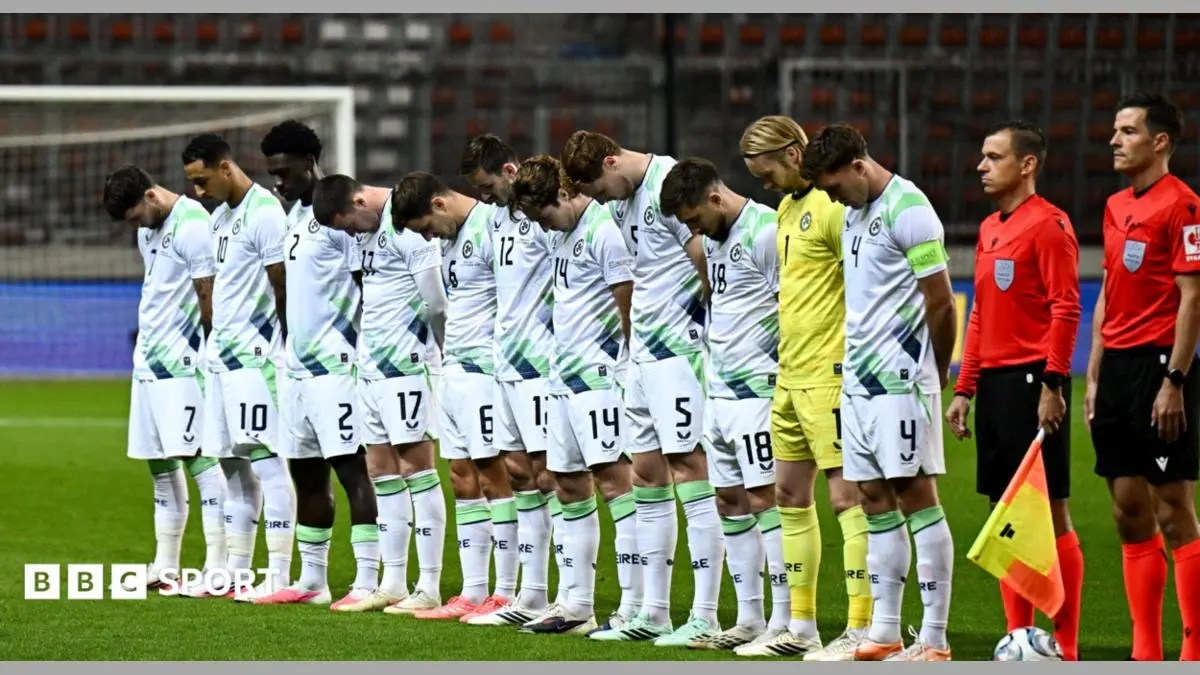
When the players emerged onto the pitch in Hungary, the traditional signs of sporting protocol were conspicuously absent. The Republic of Ireland and Israel players did not engage in the customary pre-match handshakes, a standard gesture of sportsmanship in international football. Furthermore, as the Israeli national anthem was played inside the stadium, the Irish squad stood in a line with their heads bowed in a silent, collective protest. This refusal to participate in the usual pre-game formalities extended to the team captains; Ireland’s Dara O’Shea and Israel’s Manor Solomon did not exchange pennants or shake hands before kickoff, marking a stark departure from UEFA’s standard matchday procedures.
Speaking to the broadcaster RTE after the final whistle, Hallgrimsson acknowledged the immense emotional and psychological strain the fixture had placed on his squad. He explained that navigating the political sensitivities surrounding the match had been incredibly challenging for the players, many of whom felt deeply conflicted. "It has been so difficult for so many players," Hallgrimsson remarked. He expressed a strong hope that the political controversy would not dominate future fixtures, suggesting that the team had already succeeded in making a powerful statement. "I hope that will not be in the next game because they have shown support to the protest, they have raised awareness worldwide, not only in Ireland, on the subject and that is normally the reason for protesting, to raise awareness of a situation."
Hallgrimsson emphasized that the players’ actions on the pitch spoke louder than words. He noted that while some members of the squad had chosen different ways to express their discontent, the collective effort of the team successfully drew global attention to the conflict. "I think these players have done that with all their actions, with all that they have been saying," Hallgrimsson added. "No more than Gavin Bazunu, but the others have done it here on the pitch and how they have shown their actions, so I hope people understand that."
The decision to fulfill the fixture was not reached easily and followed a day of high drama and intense deliberation at the team’s hotel in Debrecen, Hungary, on Saturday. The Irish players convened for a lengthy, emotionally charged meeting to discuss their stance on the match and whether they should proceed with playing. The meeting went on for hours, causing significant disruption to the team’s pre-match schedule. The squad’s official pre-match news conference, originally scheduled for Saturday morning, had to be postponed as the players debated their options and sought to reach a consensus.
When the news conference finally commenced at 14:30 BST—more than five hours later than originally planned—Football Association of Ireland (FAI) Chief Executive David Courell addressed the gathered media. Courell revealed that the players had held a vote on whether to fulfill the fixture, which ultimately passed by a "significant majority." However, to reflect their collective concerns and show solidarity with those affected by the conflict, the players decided they would not participate in any pre-match formalities, including handshakes.
During the match, the Irish players wore black armbands, a gesture that Courell had confirmed on Saturday was intended "in recognition of all lives lost in the [Gaza] conflict." The symbolic weight of the armbands was highlighted further during the game. After scoring the Republic of Ireland’s third goal, forward Jack Moylan removed his black armband and kissed it, before kissing his team’s badge, underlining the personal and collective significance of the protest to the players.
The atmosphere inside the stadium reflected the tense and polarized nature of the fixture. When the Republic of Ireland players emerged onto the pitch for their pre-game warm-up, they were met with loud jeers from the small contingent of Israeli supporters in attendance. Although the FAI had previously confirmed that no tickets would be sold to Republic of Ireland fans due to safety and operational concerns, a handful of Irish supporters managed to gain entry and were spotted inside the stadium during the match.
Goalkeeper Gavin Bazunu’s decision to withdraw from the squad on Saturday added another layer of complexity to the weekend’s events. Bazunu confirmed his withdrawal publicly, stating that he felt it "would be wrong to participate" in Sunday’s match, as well as the return fixture against Israel scheduled for October 4 in the Serbian town of Backa Topola. Despite his absence, Hallgrimsson confirmed that there was no animosity within the camp regarding Bazunu’s stance.
"I think he is very happy that we have won the game," Hallgrimsson said of the goalkeeper. He clarified that the squad fully respected Bazunu’s personal convictions and that his decision had not caused division within the team. "Nobody was questioning his decision. It was only the timing that was difficult for us to kind of react to it, but none of us were asking him not to take his stand and now he’s flying back with us on the plane." Hallgrimsson confirmed that Bazunu would be reintegrated into the squad for the upcoming match against Austria in Dublin on Thursday, though he will not travel for the second fixture against Israel in October.
When questioned about whether the varying political opinions and personal stances of the players influenced his tactical decisions or starting lineup, Hallgrimsson was unequivocal. "Absolutely not," the head coach stated firmly. "This team selection was about who we thought could make the best performance for Ireland." He emphasized that once the collective decision to play was made, his sole responsibility was to field the most competitive team to secure the Nations League points.
The controversy surrounding the fixtures had been brewing since February, when the Republic of Ireland and Israel were drawn together in Group B3 of the UEFA Nations League. From the moment the draw was announced, the FAI faced intense domestic pressure to boycott the matches. The "Stop The Game" campaign, organized by the pressure group Irish Sport for Palestine, quickly gathered momentum, reflecting widespread public anger in Ireland over the devastating human cost of the Israel-Gaza war.
In the weeks leading up to the match, calls for a boycott intensified significantly. More than 160 prominent Irish athletes signed an open letter organized by the Irish Sport for Palestine group, urging the national football team