In the vast, sun-drenched expanse of rural Kansas, a long-standing dispute over water rights has created a delicate balancing act between the survival of a premier wildlife refuge and the economic lifeblood of local farming communities. At the center of this struggle is U.S. Senator Roger Marshall, a Republican who recently sought to resolve the tension through a significant infusion of federal cash. However, the $4.2 million earmark requested by the senator has drawn intense scrutiny, not only for its departure from his vocal opposition to "pork-barrel" spending but also for its proximity to a private hunting ranch in which he holds a financial stake.
The funding request, documented in official Senate records, was designed to finance infrastructure improvements aimed at increasing the flow of water into the Quivira National Wildlife Refuge. While the project is framed as an environmental and agricultural necessity, Marshall’s personal connection to the land bordering the preserve has raised questions about potential conflicts of interest. The senator is a part-owner of Rattlesnake Ranch, a property that sits directly adjacent to the refuge and stands to benefit from the very water stabilization efforts he championed in Washington.
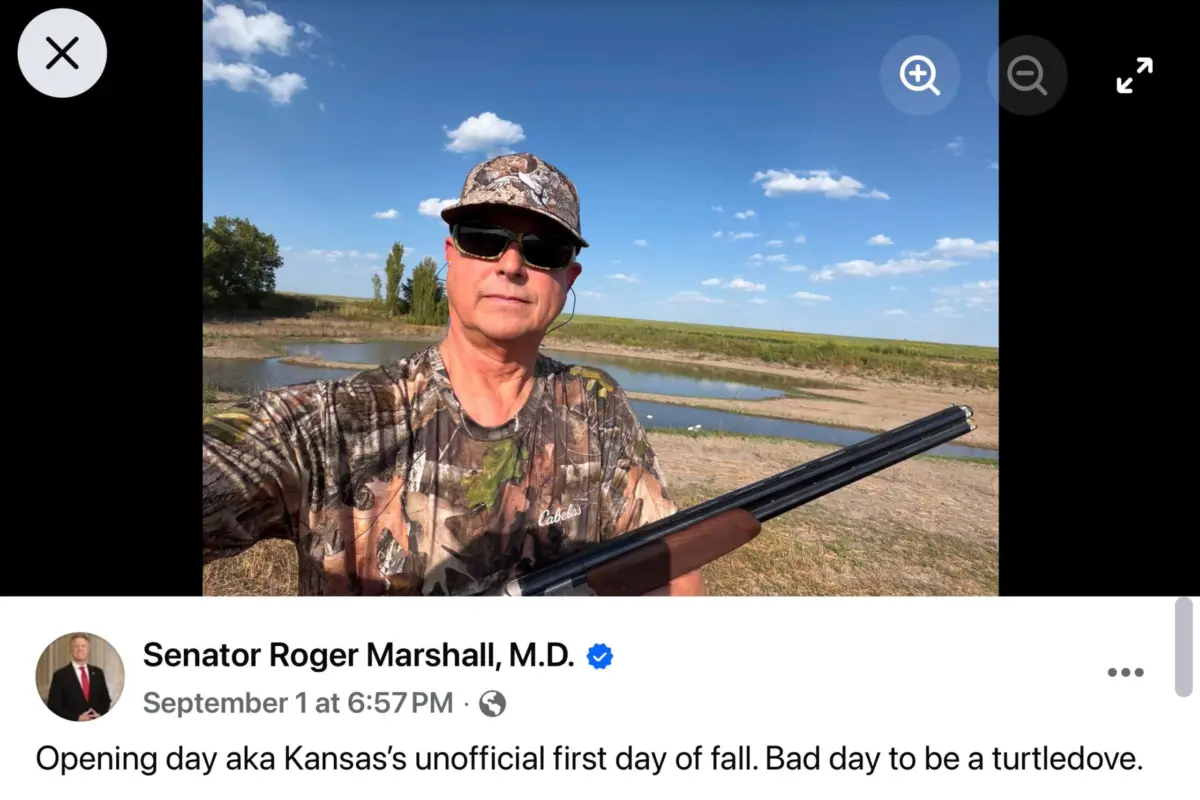
The situation presents a complex intersection of public policy, environmental conservation, and personal financial interest. As an avid outdoorsman who frequently shares photos of his hunting expeditions, Marshall has long portrayed himself as a steward of Kansas’s natural resources. Yet, the intersection of his legislative power and his private landholdings has provided critics with ammunition, suggesting that the senator’s efforts to "save farms" might also be an effort to preserve the value of his own backyard.
Plan will ensure refuge gets more water to help birds
The Quivira National Wildlife Refuge is a crown jewel of the Great Plains, serving as a critical stopover for hundreds of thousands of migratory birds, including the endangered whooping crane and various species of waterfowl. For decades, hunters and naturalists have been drawn to the region every autumn to witness the spectacular descent of birds onto the marshes. However, the expansion of industrial agriculture in the surrounding counties has placed an immense strain on the local water supply. To irrigate vast fields of corn and soybeans, farmers have increasingly tapped into the groundwater, a practice that has steadily diminished the natural flow of Rattlesnake Creek into the refuge.
The federal plan supported by Marshall’s earmark proposes a technical solution to this ecological crisis. According to federal records, the project involves pumping water from a separate, more robust watershed and transporting it via a new pipeline into Rattlesnake Creek. From there, the water would flow downstream directly into the Quivira marshes. Because Rattlesnake Creek runs alongside Marshall’s Rattlesnake Ranch, the project would effectively stabilize the water levels in the immediate vicinity of his property before the water reaches the refuge.
This legislative maneuver comes at a pivotal moment for Marshall’s political career. Though Kansas remains a reliably red state—President Donald Trump won the state by 16 percentage points in 2020—the political landscape has shown signs of shifting. Kansas has not sent a Democrat to the U.S. Senate since 1932, but the current reelection cycle has proven more competitive than many observers anticipated.
The tightening race has seen millions of dollars in Republican spending directed toward advertising to protect Marshall’s seat against his challenger, Adam Hamilton. Hamilton, a former Republican and a prominent leader of one of the nation’s largest United Methodist churches, has mounted a campaign that appeals to moderate and independent voters. In this high-stakes environment, the optics of a multi-million-dollar earmark that benefits a senator’s private holdings have become a flashpoint for debate.
When asked for comment, Senator Marshall’s office declined to make him available for an interview. His staff also did not provide answers to specific questions regarding the valuation of his property or the details of his business interests at Rattlesnake Ranch. Instead, spokeswoman Payton Fuller issued a brief statement emphasizing the public benefits of the project.
"All the water for this project would go into Quivira Wildlife Refuge," Fuller said. "Rattlesnake Ranch would not benefit from it." She further noted that the initiative was designed to "literally save farms" by preventing the federal government from forcing farmers to shut off their irrigation wells during times of drought.
Watchdog group says Marshall’s earmark was a conflict of interest
Despite the assurances from Marshall’s office, ethics experts and water rights specialists argue that the situation is a textbook example of a conflict of interest. Burke Griggs, a law professor at Washburn University and a former attorney for the state of Kansas specializing in water rights, noted that the economic value of land in this region is inextricably tied to the presence of water and wildlife.
"Waterfowl hunting is big business in Kansas," Griggs explained. He pointed out that the federal funding would help establish a more reliable water supply than the refuge has seen in half a century. "That will increase the value of the land. Think about it: If Quivira doesn’t have water, we don’t have as many ducks and waterfowl staying in that area for hunting season. That would absolutely diminish the value of the property."
While Griggs acknowledged his history of donating to Democratic causes, his assessment of the region’s hydrology and land economy is shared by non-partisan government watchdogs. Craig Holman, a lobbyist for the advocacy group Public Citizen, stated that the senator’s involvement in the funding request was inappropriate.
"He should not be involved in any legislative effort that provides a direct or substantial financial benefit to himself," Holman said. "He should have recused himself."
Under current Senate rules, members are prohibited from seeking earmarks where the "principal purpose" is to further their own financial interests or those of their immediate family. Holman noted that proving a violation of this specific rule is difficult, as the Quivira project clearly serves a broader public purpose by aiding the refuge and local farmers. However, the ethical "gray area" remains a concern for those advocating for greater transparency in how taxpayer dollars are allocated.
Adding to the controversy is Marshall’s own history of vocal opposition to earmarks. Throughout his career, he has frequently joined other fiscal conservatives in railing against "pork-barrel" spending, a practice where lawmakers direct funds to specific projects in their home districts without the usual competitive bidding or administrative oversight. Marshall has voted four times to eliminate earmarks entirely, famously describing such appropriations as "not American" and a waste of public funds.
In 2021, Marshall told reporters he would "do everything I can to blow up the process so that no one does earmarks." He has previously described spending bills loaded with such projects as "dripping with grease." Yet, in 2024, the senator found himself utilizing the very process he once vowed to destroy. While his specific request was part of a bill that did not pass in its original form, the funding was eventually secured through broader spending legislation that Marshall supported.
Marshall has deep ties to the Quivira Refuge area
Senator Marshall’s connection to the land around the Quivira National Wildlife Refuge is not a recent development. He and his family have deep roots in the region, and his financial disclosures reveal a long history of property ownership in the area. At one point, the senator owned or co-owned more than 1,000 acres of land near the refuge, a collection of holdings he once described in glowing terms as a hunting "mecca."
These properties have been more than just a place for recreation; they have been a consistent source of revenue. Over the years, Marshall’s financial disclosures have listed income from building rentals as well as oil and gas leases on his Kansas land. Since being elected to the Senate in 2020—following two terms in the House of Representatives—Marshall has sold off a significant portion of his holdings near the refuge.
However, he retained a 20% stake in Rattlesnake Ranch. The ranch is registered as a business in Kansas and is categorized as a commercial property. Records indicate that the ranch includes a building available for rent and that Marshall serves as a director of the company. The remaining shares of the ranch are owned by a group that includes long-time hunting companions and campaign donors.
While Marshall’s spokeswoman asserted that the ranch is not used for hunting waterfowl, the senator’s own public persona is heavily tied to the sport. He frequently posts images of his hunts on social media, and regional news outlets have covered his participation in sandhill crane hunts near the preserve. In a 2022 article posted to his own Senate website, Marshall was quoted as saying, "I hunt as often as I can."
The proximity of a commercial ranch—owned by a sitting senator and his donors—to a multi-million-dollar federal water project creates an optics problem that is difficult to ignore. If the project succeeds in restoring the wetlands and attracting more wildlife, the surrounding land, including Rattlesnake Ranch, becomes more attractive for recreation, commercial rental, and potential future sale.
Marshall’s earmark sought middle ground between farmers and environmentalists
The urgency of the water crisis at Quivira cannot be overstated. For years, the U.S. Fish and Wildlife Service has warned that the refuge is failing to meet its legal water rights, which date back to the mid-20th century. Under Kansas law, water rights are governed by the "prior appropriation" doctrine, which essentially means "first in time, first in right." Because the refuge’s rights are senior to many of the surrounding farms, the federal government has the legal authority to demand that farmers stop pumping water to ensure the refuge stays hydrated.
In 2023, the Biden administration moved to exercise these rights, sparking an uproar among Kansas agricultural groups. Farmers argued that being forced to cease irrigation would lead to crop failures and economic ruin for the region. The tension reached a boiling point, with local leaders and state officials pleading for a compromise that would avoid a "regulatory disaster."
Marshall and other members of the Kansas congressional delegation stepped in to mediate. When the Fish and Wildlife Service eventually agreed to pause its enforcement action, Marshall was among the first to celebrate the reprieve. He pledged to find a "voluntary, collaborative solution" that would provide water to the birds without destroying the livelihoods of the farmers.
"As a property owner along Rattlesnake Creek for three decades," Marshall said in a statement at the time, "protecting our local agricultural communities and the environment is something I take very seriously."
The resulting $4.2 million earmark was presented as the centerpiece of this collaborative solution. By bringing in water from an outside source via pipeline, the project aims to satisfy the refuge’s legal requirements without requiring the state to shut down agricultural wells. It is a plan that, on the surface, offers a "win-win" for two of Kansas’s most important constituencies: farmers and conservationists.
However, the intersection of this policy success with the senator’s private financial interests remains a point of contention. As the project moves forward, the question of whether the senator’s actions were motivated by a desire to help his constituents or a desire to protect his own investment continues to linger over the marshes of Quivira. For the birds returning to the refuge this fall, the source of the water matters little—but for the taxpayers and voters of Kansas, the source of the funding and the motivations behind it remain under a microscope.