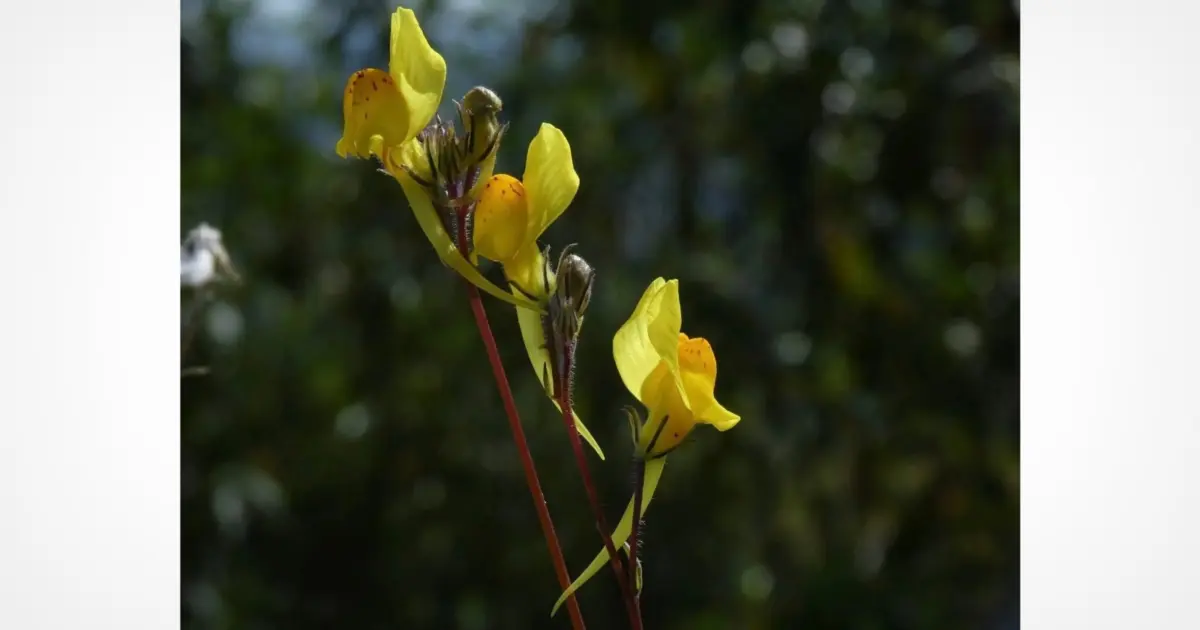
The story began in March 2023, when an unnamed German tourist was exploring the rugged terrain near Monchique, a town nestled in the mountainous interior of the Algarve. While traversing the area around Cerro do Castelo de Alferce, she encountered a striking yellow flower that caught her eye. Using her camera, she documented the plant—a vertical stalk adorned with spurred, yellow blossoms featuring distinct reddish-brown spots. Like many modern nature enthusiasts, she chose to share her find on iNaturalist, a global social network where members of the public record and share observations of plants and wildlife. At the time, the image was tentatively identified by the community as a known species, but its digital presence soon caught the expert eye of João Farminhão, a botanist and researcher at the University of Coimbra’s Centre for Functional Ecology (CFE).
Farminhão, who has spent years studying the flora of the Iberian Peninsula, noticed something unusual about the photograph. While the plant bore a resemblance to other members of the Linaria genus, certain morphological characteristics seemed out of place for any species recorded in that specific geographic region. The "toadflax" genus is known for its complex floral structures and diverse evolutionary adaptations, but the specimen in the tourist’s photo exhibited a unique combination of traits. Intrigued by the possibility that this was not merely a variation of a common plant but something entirely new, Farminhão decided to investigate the site in person.
A year after the original photograph was taken, Farminhão traveled to the specific coordinates in Monchique to conduct a field survey. In the spring of 2024, he successfully located a small, isolated population of the plants at Cerro do Castelo de Alferce. Upon close physical examination, his suspicions were confirmed: the species had never been described in scientific literature. The discovery was later detailed in a study published in the journal Plant Ecology and Evolution, a collaborative effort involving Farminhão and researchers from the University of Lisbon, the University of Barcelona, and the Royal Botanical Garden in Madrid.
The new species was officially named Linaria alfercensis, or Alferce ansarina, paying homage to the locality where it was first identified. Morphologically, the flower is distinguished by its speckled yellow petals and two prominent dark stripes on the underside of the bloom. Beyond its coloration, the plant is characterized by an erect growth habit, which sets it apart from its closest botanical relatives that often exhibit more sprawling or prostrate growth patterns. These physical nuances, while perhaps subtle to the untrained eye, represent significant evolutionary distinctions that justify its classification as a unique species.
However, the excitement of the discovery is tempered by the precarious nature of the plant’s existence. During his field research, Farminhão found that the population of Linaria alfercensis is alarmingly small, consisting of only a few dozen flowering individuals. This limited distribution has led the research team to propose that the species be classified as "Endangered" under international conservation standards. The fragility of this newly discovered life form is exacerbated by several environmental pressures specific to the Monchique region.