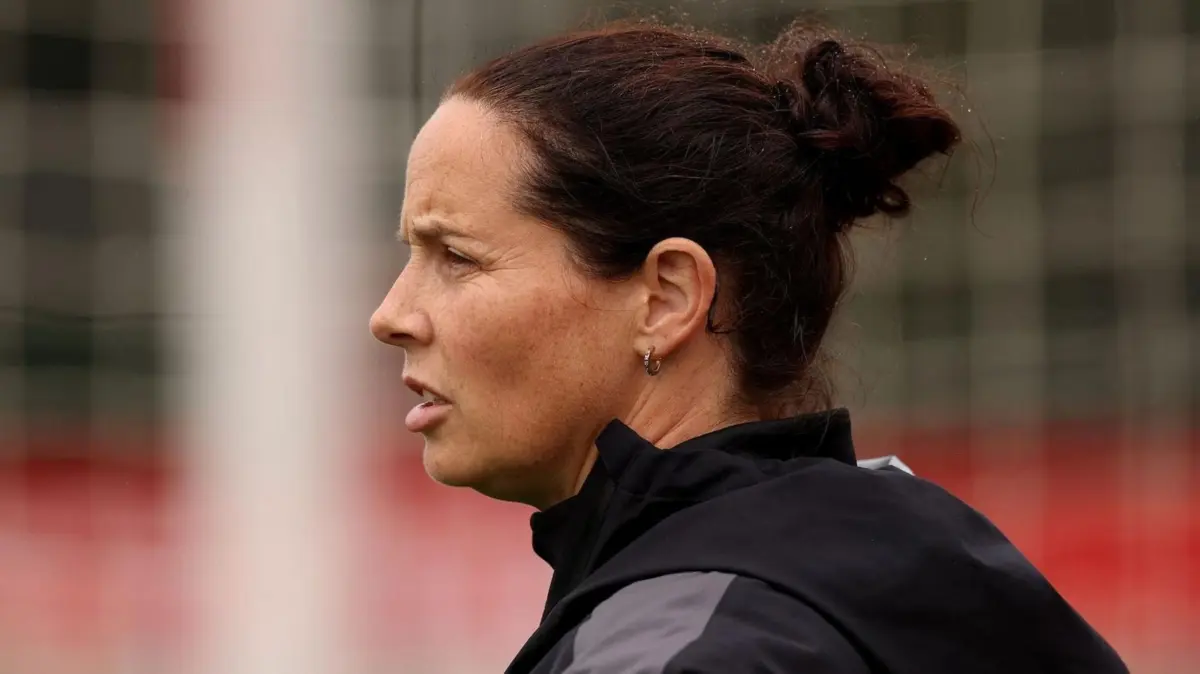
As the Wales women’s national team prepares to embark on the next critical phase of their journey toward a first-ever major global tournament, manager Rhian Wilkinson has made her priorities clear. Heading into the first leg of their Women’s World Cup play-off semi-final against Albania, Wilkinson has identified a clean sheet as the primary objective, viewing defensive stability as the essential foundation for progress in a tie that has been complicated by an unprecedented injury crisis.
The Dragons are set to face the Albanians at the 16,000-capacity Loro Borici Stadium in Shkoder on Friday, with the return leg scheduled for the following Tuesday in Llanelli. While Wales enters the tie as the higher-ranked side, the circumstances surrounding the squad have shifted significantly since their last meeting, forcing Wilkinson to rely on a blend of seasoned stalwarts and unproven youth.
The importance of the away leg cannot be overstated in the context of a two-legged play-off. For Wilkinson, the logic is simple: preventing Albania from finding the net in Shkoder provides Wales with the ultimate platform to finish the job on home soil. When asked what would constitute a successful first-leg result, Wilkinson was concise and unwavering. "I’ll stick with a clean sheet and a strong performance," she stated, emphasizing that the technical execution of the game plan is just as vital as the scoreline itself.
Navigating the Challenges of a Two-Legged Tie
The play-off format presents a unique psychological and tactical challenge, one that differs significantly from the standard group stage matches Wales navigated earlier this year. Wilkinson is acutely aware that these back-to-back fixtures require a different level of game management, where emotional regulation and tactical discipline over 180 minutes are paramount.
"I think what I would say is this is home and away, back-to-back play-off and we’ve had some experiences with this," Wilkinson explained. "We continue to grow through those and it’s about taking care of delivering a performance away and then making sure we come home and deliver another one in the next few days."
Wales is no stranger to the Albanian side. During the group stages of the World Cup qualifying campaign in April, the two nations met twice, with Wales emerging victorious on both occasions. The home fixture was a dominant display, resulting in a 4-0 win that showcased the gulf in class between the two sides at the time. However, the away fixture in Albania proved to be a far more difficult affair. Wales labored to a 1-0 victory in a match described as "scrappy," a reminder that playing in Shkoder is rarely a straightforward task.
That difficult away win serves as a cautionary tale for the upcoming semi-final. While Wales dominated possession in their previous visit, they struggled to break down a resilient Albanian defense and were occasionally vulnerable on the counter-attack. Wilkinson’s insistence on a clean sheet this time around suggests a desire to avoid the nervy moments that characterized that April encounter.
An Unprecedented Personnel Crisis
The challenge facing Wales is magnified by a staggering list of absentees. Wilkinson confirmed that nine regular members of her squad are unavailable for this window, a blow that would test the depth of any international side, let alone one from a nation with a relatively small talent pool.
The injury list reads like a "who’s who" of the Welsh starting lineup. Perhaps most significant is the absence of Ceri Holland. Since the retirement of the legendary Jess Fishlock, Holland has emerged as the team’s most influential creative force, providing the drive and vision in midfield that often unlocks stubborn defenses. Her absence leaves a creative void that Wilkinson must find a way to fill.
The defensive and goalkeeping ranks have been equally depleted. Olivia Clark, the first-choice goalkeeper, is among those sidelined, along with back-up keeper Poppy Soper. This leaves the Dragons thin in the most specialized position on the pitch. The defensive unit is further weakened by the loss of Rhiannon Roberts, Hayley Ladd, and Ella Powell—all players with significant international experience and tactical reliability.
Further up the pitch, the absences of Laura Hughes, Mia Ross, and the pacey Ffion Morgan limit Wilkinson’s options for rotation and tactical adjustments. Aside from Soper, every player on the injury list would have been a strong contender for a starting spot or a primary role off the bench.
A Youthful New Look for the Dragons

The silver lining of such an extensive injury list is the opportunity it affords the next generation of Welsh talent. The squad traveling to Albania has a distinctly youthful appearance, featuring six uncapped players and several others who are only just beginning their international careers.
Among the newcomers looking to make their mark are goalkeepers Soffia Kelly and Lucy Farrell-Shrouder, who find themselves thrust into the senior setup following the injuries to Clark and Soper. The defensive line sees the inclusion of centre-back Cadi Rodgers, while wide player Heidi Hills and forwards Casi Gregson and Olivia Francis round out the group of potential debutants.
They are joined by a cohort of players who, while capped, possess minimal international experience. Scarlett Hill, Phoebie Poole, Tianna Teisar, and Chloe Williams have only a handful of appearances between them, yet they may be called upon to play significant minutes in what are arguably the highest-stakes matches of their careers.
Wilkinson, however, remains confident in her young charges. She pointed to a long-standing policy of integrating youth players into senior training sessions as the reason why these players are ready to step up. "I think it would be silly for me to say that having nine injuries was predictable—I think that was out of the norm," Wilkinson admitted. "If I could have had no injuries I would have, but equally this is football and we adapt and we are a small country. I don’t think we can pretend that we have unlimited players, so the fact that I’m able to put together a team of 23 that has such strength and with a lot of experience is a good thing."
The manager insisted that the inexperienced players are "absolutely" ready for the pressure of a play-off. "They’ve trained with a great intensity, they’ve done their work off the pitch and really involved themselves in meetings," she added. "They’ve done everything they can to put themselves in the best possible position to get minutes."
Analyzing the Opposition: The Albanian Threat
Despite being ranked 68th in the world—37 places below Wales at 31st—Albania represents a significant hurdle. Under Wilkinson, Wales has learned not to underestimate lower-ranked opposition, particularly those with a clear identity and home-field advantage.
Wilkinson spoke candidly about the threat Albania poses, recalling the second group game where the scoreline perhaps flattered Wales. "I think I’ve spoken quite honestly [about how in] the second group game against them, they definitely could have scored at least once or twice," she noted.
Albania is characterized as a team that understands its limitations and plays to its strengths, often relying on a compact defensive block and clinical efficiency on the break. "I expect it to be a resilient performance from both teams, to stick in it and try to bring our best versions of ourselves," Wilkinson said. "They give everything for their badge like we will for ours, so it’ll be a tough match."
Wales’ away form has been a point of concern. While they topped their qualifying group thanks to emphatic home wins over the Czech Republic, Albania, and Montenegro, their performances on the road were less consistent. Draws against the Czechs and in Montenegro highlighted a difficulty in maintaining the same level of dominance away from home—a trend Wilkinson will be desperate to buck on Friday.
The Long and Winding Road to Brazil
The stakes for this tie are immense. Success against Albania over two legs would earn Wales a place in the World Cup play-off final in early December. Their opponent in that final would be either Romania or Norway. The latter, currently managed by former Wales boss Gemma Grainger, would likely enter as heavy favorites, adding a layer of narrative intrigue to Wales’ potential path to the tournament.
However, even a victory in the play-off final does not guarantee a ticket to the 2027 World Cup in Brazil. The qualification process is notoriously complex. Of the eight European play-off winners, seven will progress directly to the finals. The eighth team—determined by being the lowest-ranked nation based on their performance in the group stages of qualifying—will be forced into an inter-confederation play-off tournament scheduled for February.
When asked about the convoluted nature of the qualification path, Wilkinson preferred to stay focused on the immediate task. "This is above my pay grade," she remarked. "What I will say is it doesn’t help to get stuck in what could be or what comes afterwards. There’s different scenarios here, but it’s not for us to change that. For right now, this is our path and we’ll just keep taking care of what’s in front of us one step at a time."
For a nation that recently celebrated its first-ever qualification for a major tournament in the form of Euro 2025, the prospect of reaching a World Cup represents the ultimate evolution of the women’s game in Wales. Despite the injuries and the difficult road ahead, the mood within the camp remains one of determined optimism. On Friday night in Shkoder, the first step toward Brazil begins, and for Rhian Wilkinson, that step starts with keeping the ball out of the Welsh net.