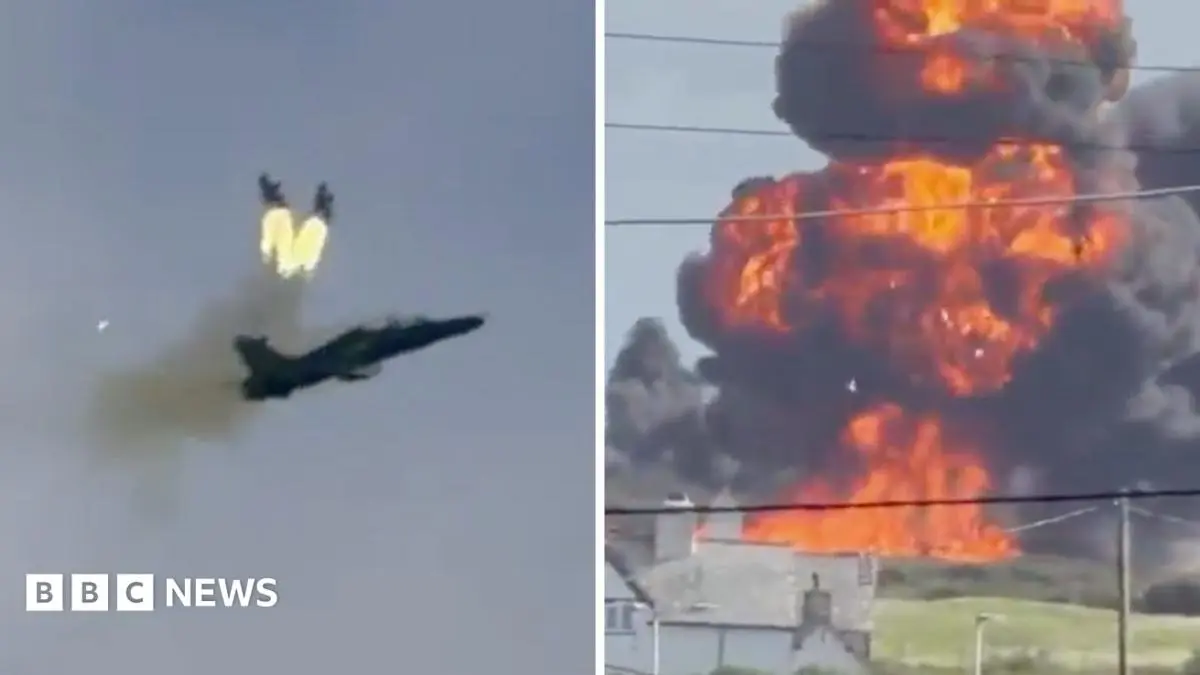
A Royal Air Force Hawk T2 training aircraft has crashed near the RAF Valley base on Anglesey, plummeting to the ground in the nearby village of Pencarnisiog. The incident, which occurred shortly after takeoff, saw both pilots on board successfully eject from the aircraft seconds before it nosedived and erupted into a fireball upon hitting the ground. Dramatic footage captured the moments leading up to the crash, showing the pilots being thrown clear of the falling jet as it narrowly missed nearby residential properties.
RAF Valley, situated on the island of Anglesey in Wales, serves as a critical hub for military aviation, where both basic and advanced fast-jet training are provided to future fighter pilots. The base and its surrounding environment offer an ideal landscape for complex aerial maneuvers and training programs. According to Mikey Kay, a BBC Security analyst and former RAF pilot who served in the air force for 20 years, the geography of Anglesey and the wider region is perfectly situated for training pilots. The area is heavily integrated into the UK’s specialized low-flying system, providing student pilots with the challenging terrain necessary to hone their skills.
The Ministry of Defence maintains 20 designated low-flying areas across the United Kingdom, which are formally referred to as tactical training areas. These areas are strategically located in regions characterized by demanding topography, including central Wales, northern Scotland, the borders area of southern Scotland, and northern England. The proximity of RAF Valley to these zones allows student pilots and their instructors immediate access to environments where they can practice low-level navigation and high-speed maneuvers.
Furthermore, RAF Valley is situated close to the world-renowned Machynlleth Loop, commonly known as the Mach Loop. This famous training area consists of a series of deep, sweeping valleys nestled between Dolgellau in Gwynedd and Machynlleth in Powys. Because military aircraft regularly fly through these valleys at extremely low altitudes, the Mach Loop has become a major attraction for aviation enthusiasts and photographers from around the globe, who gather on the hillsides to capture high-speed, low-altitude flights.
Explaining the rigorous nature of the training conducted in the skies above Anglesey, Kay noted that the region is essential for developing a wide array of pilot competencies. He explained that these pilots train extensively in low-level flight, instrument flying, formation flying, and general aircraft handling. The accessibility of these diverse and challenging landscapes makes the Anglesey area a perfect fit for the stringent demands of military flight training, offering student pilots a realistic and highly demanding environment to prepare for front-line operational duties.
The crash has drawn intense scrutiny, particularly following the emergence of video footage on social media. Kay, who grew up just three miles away from the RAF Valley base, shared a video online that appears to show the initial moments of the flight. The footage captures flames rising from the rear of the Hawk T2 jet as it accelerates down the runway during its takeoff roll. As the aircraft climbs into the air, the visible flames appear to dissipate, leaving questions about the exact timeline of the flight and the precise moment the pilots made the decision to eject.
To understand the anomaly seen in the takeoff video, Kay provided crucial technical context regarding the propulsion systems of the Hawk T2. He explained that these specific training aircraft are non-reheated jets. This means they are not equipped with a reheat system, which is more commonly referred to as an afterburner in the United States. An afterburner is a secondary combustion system designed to inject raw fuel directly into the jet engine’s exhaust stream behind the turbine. This process ignites the fuel, providing a massive, short-term boost in thrust, which is often used during takeoff or high-speed combat maneuvers.
This lack of a reheat system makes the Hawk T2 fundamentally different from front-line combat aircraft such as the F/A-18 Hornet or the Panavia Tornado. On those aircraft, the activation of the afterburner routinely produces bright orange flames shooting out of the exhaust nozzle. According to Kay, under normal operating conditions, you should never see flames coming out of the back of a Hawk jet. The presence of any visible fire on a Hawk is an immediate indicator of a severe malfunction rather than a standard operational characteristic.
Upon closer analysis of the takeoff footage, Kay pointed out a highly significant detail regarding the location of the fire. The flames visible in the video did not appear to be exiting directly from the engine nozzle. Instead, they seemed to be coming off the side of the engine housing. This distinction is critical because the side of the engine is where the aircraft’s main hydraulics system is located. The hydraulics system is the primary mechanism that controls how the plane flies, operating the control surfaces that allow the pilot to maneuver the jet.
Based on these visual observations, Kay suggested that while it is still far too early to make a definitive assessment, it is highly possible that the underlying cause of the crash was not a primary engine failure. A fire in the hydraulic bay could lead to a catastrophic loss of control, forcing the pilots to abandon the aircraft even if the engine itself was still producing thrust. Air accident investigators will examine the hydraulic lines and engine casing to determine whether a leak or mechanical failure triggered