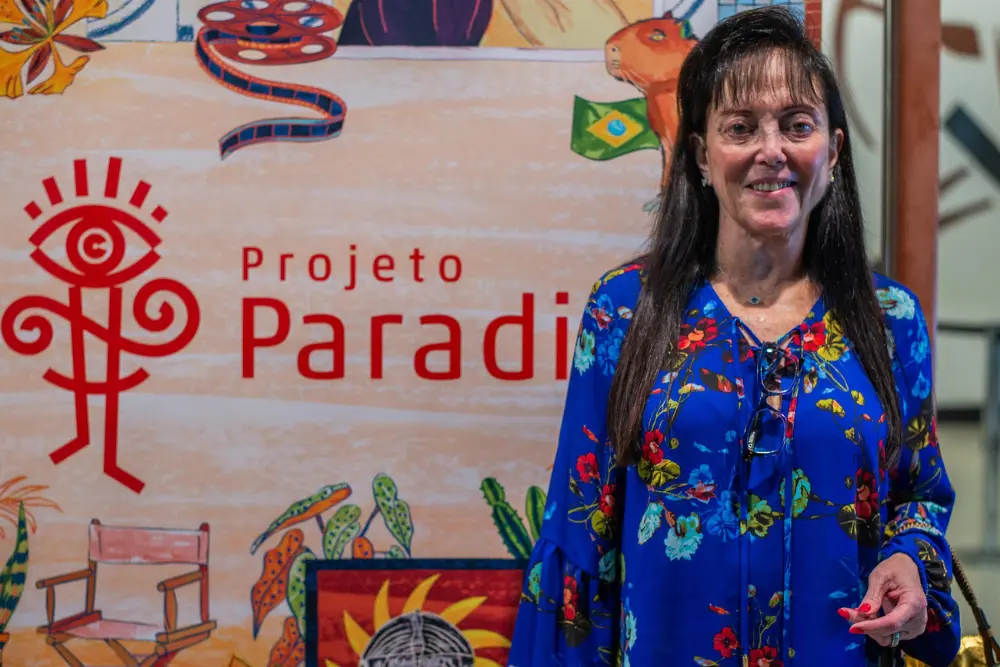
The landscape of Brazilian cinema has undergone a profound transformation over the last decade, driven not only by the resilience of its creators but also by a burgeoning movement of private philanthropy aimed at securing the industry’s future on the global stage. At the heart of this movement is Olga Rabinovich, a philanthropist whose dedicated support for the audiovisual sector has become a cornerstone of contemporary Brazilian film production. In recognition of her significant contributions, Rabinovich will be the first-ever recipient of the Prêmio Encontros (Encounters Award), a new honor debuting at this year’s Encontro de Ideias Audiovisuais, the dedicated industry platform of the São Paulo International Film Festival.
The award serves as a formal acknowledgment of Rabinovich’s enduring commitment to the advancement of Brazilian cinema. Through her work with the Olga Rabinovich Institute and its primary initiative, Projeto Paradiso, she has played a pivotal role in elevating the international profile of Brazilian films and fostering the development of domestic talent. The Prêmio Encontros was specifically designed to spotlight the transformative power of private investment in the cultural sector, highlighting the essential synergy between private funders and the creative professionals who bring audiovisual projects to life.
The inaugural ceremony is scheduled to take place during the festival’s opening gala on October 14. This prestigious event will precede a highly anticipated "in-conversation" session featuring Jeff Deutchman, the president of Neon, the acclaimed U.S. distribution company behind such hits as Parasite and Anatomy of a Fall. The pairing of Rabinovich’s honor with a discussion involving a major figure in international distribution underscores the central mission of her work: bridging the gap between Brazilian creativity and the global marketplace.
Rabinovich’s journey into the world of film philanthropy is as unique as the institution she founded. Born in São Paulo, she spent many years of her life away from the red carpets and production offices of the film industry. Instead, her early career was defined by a commitment to service, as she spent years volunteering in hospitals and working closely with terminally ill patients. This background in human-centric care and empathy informed her later philosophical approach to the arts. By 2018, she sought a way to channel her philanthropic efforts into a medium that could achieve a different kind of healing and connection. She founded the Olga Rabinovich Institute with the core conviction that "stories can change the world."
This belief led directly to the launch of Projeto Paradiso. The initiative was born out of a strategic decision to invest in the people behind the camera—the writers, directors, and producers—rather than just the final products. Rabinovich’s vision was to provide these creators with the resources they needed to share their unique perspectives with audiences not just in Brazil, but across the globe. She has frequently described cinema as a "magical art form," noting in past interviews that the experience of entering a darkened theater to be moved, disturbed, or elated is a uniquely transformative and communal human experience.
The timing of the institute’s founding was particularly significant for the Brazilian film community. Renata de Almeida, the director of the São Paulo International Film Festival, recalls the emergence of Rabinovich’s vision during a period of deep uncertainty for the country’s cultural sectors. According to Almeida, the name Olga Rabinovich first came to her attention in early 2018, when Josephine Bourgois, who would become the executive director of Projeto Paradiso, approached the festival about a private sector investor looking to establish a dedicated cinema institute.
The formal announcement of the Olga Rabinovich Institute took place during the 42nd edition of the Mostra (the São Paulo International Film Festival). At the time, the Brazilian film industry was facing severe economic and political headwinds that threatened to stifle production and limit international reach. Almeida notes that the institute’s arrival brought a "breath of hope" at a moment that promised to be particularly difficult for Brazilian film and culture.
In the eight years since its inception, the impact of Projeto Paradiso has been substantial and measurable. The organization has moved from a hopeful newcomer to a foundational pillar of the industry. It has successfully identified and championed a new generation of talent, providing the structural support necessary to navigate the complex international film circuit. Almeida points out that the success of the initiative is a testament to its professional team and its ability to foster meaningful "encounters"—the very concept that gave the new award its name.

Almeida recalls a specific, personal memory of the institute’s early days that captures the spirit of the collaboration. She describes a meeting where Rabinovich climbed the winding stairs of the festival’s modest office building for a "somewhat chaotic coffee." This image of grassroots engagement and personal connection remains a defining characteristic of how the institute operates. "In the end," Almeida observed, "almost everything really does begin with an encounter."
The practical support offered by Projeto Paradiso is extensive and multifaceted. It is designed to maximize the presence of Brazilian screen professionals on the global stage through a variety of targeted programs. These include fellowships, residencies, workshops, and various training initiatives that help creators refine their stories and understand the mechanics of international co-production and distribution. Central to this effort is the Paradiso Talent Network, an ever-growing community that now includes nearly 300 Brazilian professionals.
This network acts as a bridge, connecting Brazilian talent with an impressive array of more than 250 partner institutions worldwide. These partnerships include some of the most prestigious names in the global film industry, such as the Hubert Bals Fund of the International Film Festival Rotterdam, La Fabrique Cinéma de l’Institut français, the TorinoFilmLab, Film Independent, and the Sundance Institute. By facilitating these connections, Projeto Paradiso ensures that Brazilian filmmakers are not working in isolation but are instead integrated into the global network of independent cinema.
The fruits of these efforts have been visible at major film festivals around the world. Recently, the initiative supported several high-profile projects that have garnered international acclaim. Among these are Allan Deberton’s Gugu’s World, which found success at the Berlinale, and Grace Passô’s Our Secret. The Talent Network itself boasts a roster of directors who have become staples of the international circuit, including Anita Rocha da Silveira (director of the acclaimed Medusa), Juliana Rojas (Good Manners), and Dira Paes (Manas).
The institute’s commitment to the industry continues to evolve and expand. In 2025, Projeto Paradiso took a significant step forward by teaming up with the Embratur Brazilian Tourism Board to launch Screen Brasil. This initiative is focused specifically on the international distribution of Brazilian films. It offers support to four films per year through two distinct calls for submissions—the most recent of which closed in early October. Screen Brasil assists with international distribution campaigns, with submissions handled by the international sales agents who hold the commercial rights to the films.
Announced at the Cannes Marché du Film this past May, the program has already begun backing significant titles. These include Gabriel Mascaro’s The Blue Trail, Rafaela Camelo’s The Nature of Invisible Things, and the animated feature Papaya. By focusing on the distribution phase, the institute is addressing one of the most significant hurdles for Brazilian cinema: ensuring that once a film is made, it actually reaches a global audience.
The relationship between the São Paulo International Film Festival and Projeto Paradiso has only deepened over time. Since 2023, the institute has presented the annual Paradiso Distribution Support Award at the festival, which provides a direct grant for the theatrical release of a fiction feature film within Brazil. Furthermore, in 2024, the institute was a driving force behind a new partnership with the Hubert Bals Fund (HBF), leading to the creation of HBF+Brazil. This program, which grew out of discussions at previous editions of the Encontro de Ideias, provides specific funding for co-productions between Brazil and international partners.
As the São Paulo International Film Festival prepares for its landmark 50th edition, the honoring of Olga Rabinovich stands as a tribute to the power of visionary philanthropy. Her work has proven that private investment, when guided by a deep respect for the artistic process and a strategic understanding of the global market, can provide the stability and growth necessary for a national cinema to thrive. The 50th edition of the festival, running from October 15 to 29, will serve as a backdrop for celebrating these achievements and looking toward the next era of Brazilian storytelling on the world stage.