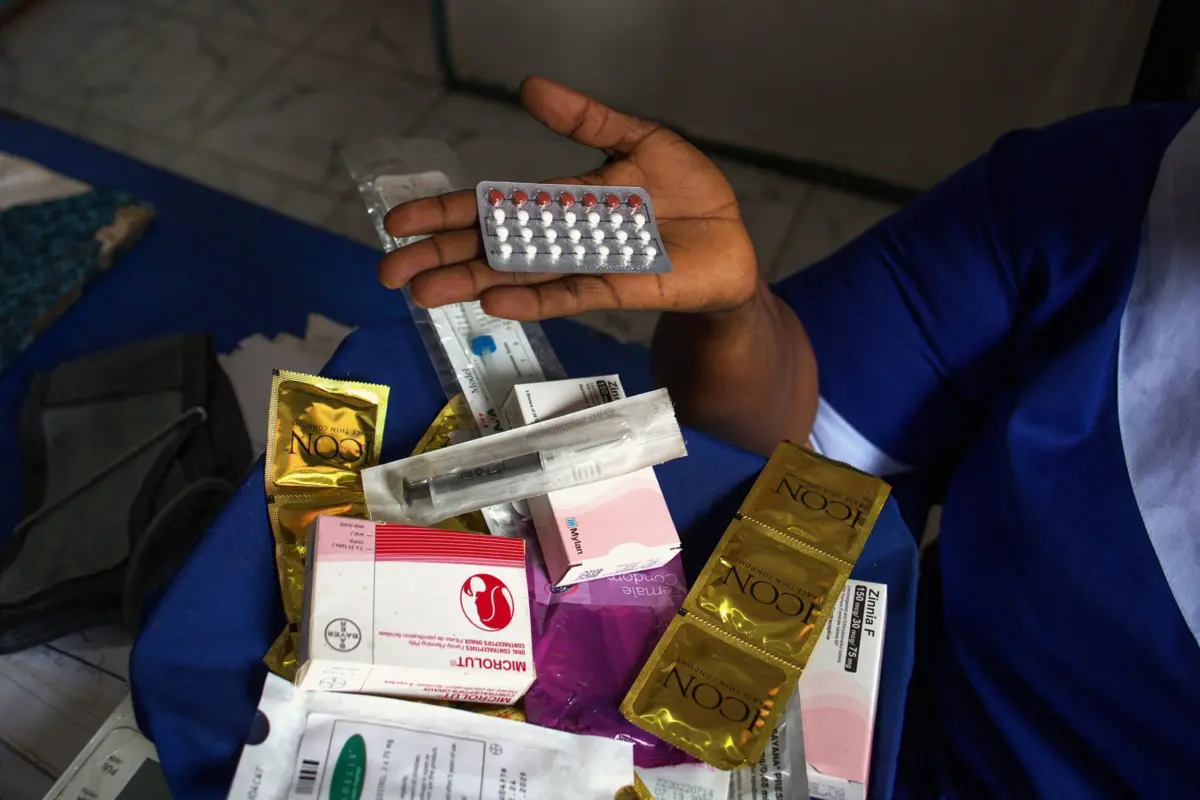
EPWORTH, Zimbabwe — For 18-year-old Kelly Nhedega, the trajectory of her life was once clearly defined. Like many young women in Zimbabwe, she had a vision for her future that involved completing her secondary education, enrolling in a nursing program, and securing a professional career before even considering the responsibilities of motherhood. It was a roadmap designed to lift her out of the economic uncertainty that many in her community face.
However, that map was redrawn two years ago. When Nhedega became sexually active at 16, she found herself trapped between the biological realities of adolescence and a rigid wall of social and systemic barriers. While contraception existed in theory, it felt entirely out of reach in practice. The prospect of standing in a crowded public clinic to ask for condoms, birth control pills, or a hormonal implant was more than just an errand; it was a gauntlet of potential humiliation. In a society where the actions of young girls are closely monitored by neighbors, relatives, and health workers, the fear of judgment—or worse, having her parents informed of her choices—was enough to keep her away.
The result was a predictable but life-altering consequence: Nhedega became pregnant at 16 and was forced to drop out of school. Today, she is the primary caregiver for an 18-month-old child, her dreams of nursing temporarily shelved while she navigates the daily demands of motherhood. Recently, however, she managed to obtain contraception through a discreet mobile service, a move she hopes will allow her to finally return to the classroom and finish what she started.
“That’s a mission I have to complete first,” Nhedega said, her toddler fidgeting on her lap as she spoke. “More babies will mean less or no time for school.”
Nhedega’s experience is a microcosm of a much larger, more complex crisis unfolding across sub-Saharan Africa. As international aid budgets are slashed and global shipping routes are disrupted by conflict, the basic human right to reproductive healthcare is becoming increasingly precarious for millions of girls. Experts warn that the challenge is not merely a matter of whether contraceptives are being manufactured or stocked; it is a multifaceted problem involving parental opposition, restrictive national policies, deep-seated cultural stigma, and the sheer fear of being seen at a medical facility. Even as local governments attempt to fill the void left by shrinking foreign aid, the "last mile" of delivery—getting the products to the people who need them most—is under threat.
The stakes could not be higher. Contraception is recognized by global health organizations as a critical tool for helping adolescent girls avoid unintended pregnancies and the significant physical risks associated with childbirth. In sub-Saharan Africa, where maternal mortality rates remain the highest in the world, the inability to plan a family is often a matter of life and death.
This crisis is part of a broader, harrowing trend in maternal mortality across the region. Sub-Saharan Africa currently has the world’s fastest-growing population, yet it accounts for a staggering 70% of global maternal deaths. Every year, approximately 180,000 pregnancy-related deaths are recorded across the continent, many of which are preventable through adequate reproductive health services and family planning.
The financial infrastructure supporting these services is currently in a state of upheaval. The United Nations Population Fund (UNFPA) estimates that global aid cuts will result in a $185 million shortfall in contraceptive funding this year alone. The impact is already visible on the ground. According to the International Planned Parenthood Federation, nearly 1,400 reproductive health service facilities had been forced to close their doors by December, with 1,175 of those closures occurring in Africa. These closures have left an estimated 5.9 million women without access to essential services.
For girls like Nhedega, the loss of these facilities is devastating. They often rely on small, non-traditional clinics where they can seek help without the fear of being scrutinized by their communities. In Epworth, a densely populated settlement on the outskirts of Harare, Nhedega found her solution in an aging blue-and-white caravan tucked into a quiet corner of a hospital grounds.
The caravan is a converted family travel trailer that has been repurposed as a mobile clinic. It provides a sanctuary of privacy, allowing adolescents to access contraception, counseling, and health information away from the prying eyes of neighbors, church members, or judgmental relatives.
“No one will know, it becomes your own secret,” Nhedega said. She noted that even when there is an agreement with a partner to use protection, the weight of community stigma remains a daunting hurdle to overcome.
Foreign aid support is drying up
The mobile clinic in Epworth is operated by Population Services Zimbabwe (PSZ), an affiliate of MSI Reproductive Choices. Since 2021, this single caravan has provided more than 100,000 adolescents in Epworth and its surrounding farming communities with a range of services, including contraceptives, treatment for sexually transmitted infections, and vital reproductive health counseling.
Pester Siraha, the director of Population Services Zimbabwe, explained that these mobile units are essential for reaching vulnerable populations who cannot or will not visit traditional hospitals. However, the future of these services is now in jeopardy as international funding streams evaporate.
The organization recently suffered a major blow when it lost a five-year, $9 million grant that had been awarded in 2023. The funding was rescinded after the Trump administration in 2025 dismantled various foreign aid programs. According to the organization, over $6 million of that grant remained unspent when the plug was pulled.
In an attempt to stabilize its operations, PSZ turned to Swedish development funding. While this provided a temporary lifeline, that support also came to an abrupt end in August. The Swedish government made the decision to phase out development assistance to several countries, including Zimbabwe, Tanzania, Mozambique, Liberia, and Bolivia, in order to prioritize aid for Ukraine following the ongoing conflict there.
“We were quite excited when Sweden came in,” Siraha said. “Then, suddenly, boom, Sweden said they were leaving.”
Siraha warned that the withdrawal of these funds will almost certainly lead to an increase in unplanned pregnancies and a rise in unsafe abortions, which are a leading cause of maternal death in the region. The financial strain is so severe that the four-decade-old organization may be forced to shut down its outreach activities entirely, or potentially its entire country program.
While the Zimbabwean government has attempted to step in, the scale of the need is immense. Health Minister Douglas Mombeshora stated that Zimbabwe has spent approximately $6.3 million on purchasing contraceptives since 2022. The government has further pledged to allocate $2.25 million annually for contraceptives in 2026 and 2027. However, health advocates argue that government procurement is only one piece of the puzzle.
Stigma and consent barriers limit access
Even when contraceptives are physically present in a country, social and legal barriers often prevent them from reaching the hands of adolescent girls. Across Africa, the issue of parental consent remains a significant point of contention and confusion.
In neighboring Zambia, Inonge Wina Chinyama, the director at MSI Zambia, highlighted how uncertainty regarding consent laws can effectively block access for minors. She pointed out that the cultural expectation of parental involvement is often at odds with the reality of adolescent behavior.
“How many young people can go and say, ‘Mommy, I want to have sex tonight. Can you allow me to go and get a contraceptive method?’” Chinyama said. “It doesn’t happen in Africa.”
Furthermore, the logistical "last mile"—the process of moving supplies from central government warehouses to remote rural health centers—is failing. Chinyama noted that the loss of U.S. support for distribution networks in Zambia has been particularly damaging. Contraceptives may be sitting in a provincial hub, but they are of no use to a girl living in a distant village if there is no fuel, no vehicle, and no personnel to deliver them.
Global geopolitical instability has added another layer of difficulty. Shipping disruptions, particularly in the Red Sea and surrounding waterways, have forced carriers to reroute vessels, leading to significant delays in the delivery of medical supplies. In March, the UNFPA reported that several shipments of contraceptives destined for Africa had been delayed by months. In Zambia, a shipment ordered in November arrived more than 90 days late.
“At first, we thought Zambia was a low-risk country with the Iran war, because it felt like it was very far out there,” Chinyama said. “But we are only just receiving the products this week.”
Big demand for mobile clinics despite aid cuts
The consequences of these combined pressures are most visible in Zimbabwe’s most remote and impoverished regions. In Binga, an isolated district in the northwestern part of the country, the impact of funding cuts was felt immediately when Population Services Zimbabwe was forced to scale back its mobile outreach.
When the mobile clinics were able to return briefly in August after a six-month hiatus, the reception was overwhelming. Engeline Mawere, the organization’s operations director, described scenes of desperation and relief.
“Sixteen, 17-year-olds, some with children on their backs, were racing toward us when they saw our vehicle,” Mawere said. She explained that the team often has to park their vehicles in the bush or away from main roads so that both married and unmarried girls can access the services without being spotted by their community.
The rush for services in Binga underscores a fundamental truth: the demand for family planning is high, but the avenues for safely accessing it are narrowing. For young mothers like Kelly Nhedega, the ability to access contraception discreetly is the only way to regain control over their lives and futures.
“So here, you just do it secretly and plan better,” Nhedega said, reflecting on her experience with the mobile caravan in Epworth. “There is no child who should be attributed to a mistake. We should be able to plan and decide when to have a baby.”