For generations of North American students, the arrival of the Scholastic Book Fair was a singular event, a vibrant, circus-like disruption of the quiet monotony of the school library. It was characterized by the crinkle of a multi-paged, glossy catalog and the frantic filling out of order forms. To those who grew up in the latter half of the 20th century, the fair represented a rare moment of autonomy—a chance to browse shelves and select a world to inhabit, away from the watchful eyes of teachers and the prescribed curriculum of the classroom. However, as the fair continues its decades-long run, a growing chorus of critics and parents is beginning to question whether this cherished cultural touchstone has traded its literary soul for the hollow rewards of corporate cross-promotion.
The conversation was recently reignited by critic Michelle Cyca, who, in a poignant and evocative essay for The Walrus, explored the tension between her own nostalgic memories of the fair and the reality her daughter now faces. Cyca, a Millennial who remembers the fair as a gateway to box sets of Animorphs and the thrill of wholesome consumerism, found herself disheartened when her young daughter brought home a contemporary Scholastic catalog. The sorrow that replaced her nostalgia stemmed from a stark observation: today’s offerings appear less like a curated selection of literature and more like an extension of global toy and television franchises.
Cyca noted with distress that the current catalogs are saturated with titles tied to brands like Lego, Pokémon, and Paw Patrol. The concern is not merely the presence of these brands, but the way they are marketed. In Cyca’s view, these books seem to sell themselves not on the strength of their prose or the depth of their imaginative storytelling, but rather on their proximity to more "stimulating" forms of entertainment. This shift raises a fundamental question about the role of the book fair in an era defined by a national reading crisis: Is the traditional fair "dead," or are we simply viewing the past through rose-colored glasses?
To understand the current state of the Scholastic Book Fair, one must first look at its historical trajectory. Scholastic’s foray into schools began long before the first metal carts rolled into libraries. In 1948, the company launched its first teen-targeted book clubs. The "Pocket Book" program was a revolutionary concept for its time, allowing students to access affordable literature by ordering directly from magazines stationed in their classrooms. It democratized book ownership for a generation of students, making literature accessible to those who might not live near a traditional bookstore.
The physical book fairs as we know them today did not debut until 1982. In their early years, these fairs were instrumental in the success of Scholastic’s own internal titles, such as the Clifford the Big Dog series. As the decades progressed, the fair became a kingmaker for Young Adult properties. It was the engine behind the massive growth of R.L. Stine’s Goosebumps series in the 1990s and, later, the explosive popularity of The Hunger Games. The fair was a place where a series could transition from a library book to a cultural phenomenon.
However, the idea that the fair was once a "pure" literary space is a claim that requires closer scrutiny. Critics of the nostalgia-driven narrative point out that spin-off books and merchandise are far from a new development. As far back as 2002, the Arrow Top 10 bestseller list for Scholastic included a Pokémon guide, proving that franchise-driven content has been a staple of the fair for over twenty years. Even the beloved Animorphs series, cited by many Millennials as a hallmark of "real" reading, was a piece of intellectual property that eventually spawned its own television drama. This suggests that the distinction between the "quality" books of the past and the "merchandise" books of the present may be more aesthetic than substantive.
Despite the criticisms regarding content, the Scholastic Book Fair remains an essential financial pillar for the North American education system. In a landscape where public schools are chronically under-resourced, the fair serves as a vital supplemental funding pipeline. According to a Scholastic representative, the fairs have helped raise more than $2 billion for American schools in the last decade alone. This revenue often goes toward purchasing new library books, funding school programs, or providing resources that the standard school budget cannot cover. In the current economic climate, many school administrators find it difficult to "yuck the yum" of a program that provides such significant financial support, even if the quality of the books in the stacks is perceived to have been compromised.
*
Yet, for Cyca and others, the earlier iterations of the fair were defined by a sense of "permissible, wholesome consumerism." There was a specific ritual to the catalog: the careful deliberation, the penciling in of choices, and the anticipation of the order arriving. Cyca recalled the thrill of choosing Scott O’Dell novels or the R.L. Stine books that would inevitably lead to nightmares. This ritual, she argues, was as much about the freedom of choice as it was about the books themselves.
But for many, the experience of the fair was less about the joy of reading and more about the stress of social class. In the high-pressure environment of an American public school, the book fair could be a stark reminder of economic disparity. While some children had the means to buy piles of books and expensive Snoopy-branded stationery, others were left with only enough lunch money for a single sticker sheet. For those who could afford nothing at all, the fair was not a celebration of literacy, but a "torturous rite" of exclusion.
Danika Ellis, an editor at Book Riot and a former bookseller, expressed her long-standing skepticism of the fair’s model to the CBC. She pointed out the inherent paradox of a for-profit entity operating within a public education space. When some kids walk away with stacks of posters and toys while others leave empty-handed, the goal of "exciting kids about reading" becomes overshadowed by the reality of commercial competition. This observation highlights what some call the "original sin" of the fair: the conflation of buying books with the act of reading them.
If the fair has always been an imperfect educational tool that exacerbated micro and macro inequalities, then the current lamentations over its decline may be rooted more in aesthetics than in a genuine loss of educational value. There is a certain "analog library" aesthetic that many adults miss—the smell of the paper, the specific font of the 90s-era catalogs—but purely aesthetic nostalgia can be a misleading guide. It can lead us to mourn the loss of a "purity" that never truly existed.
*
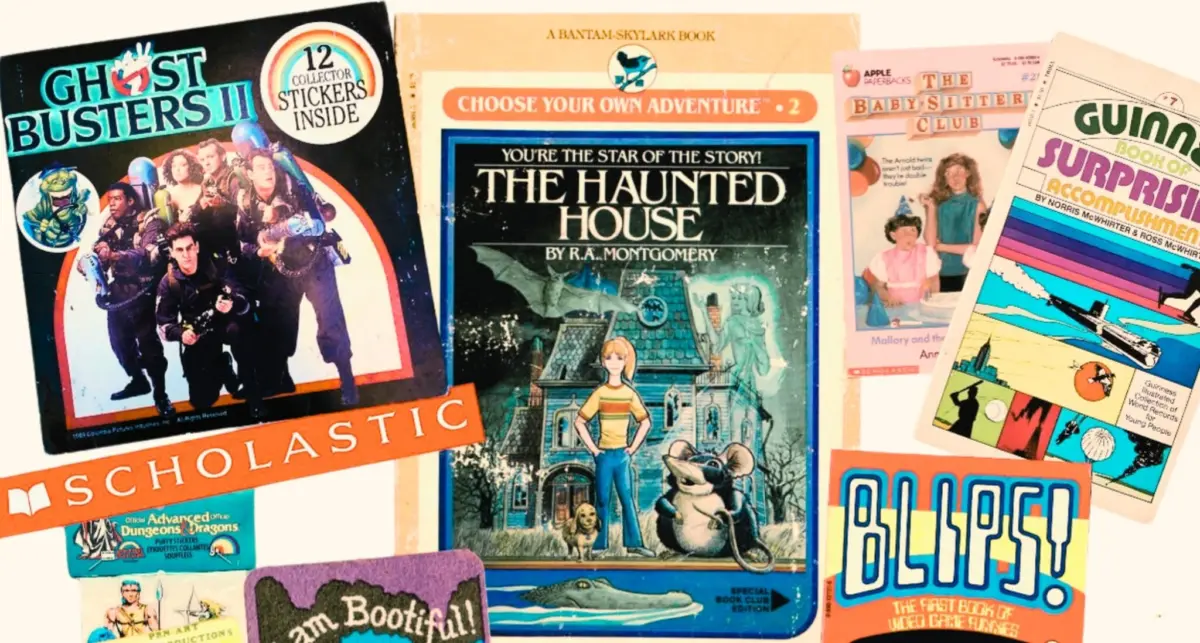
In truth, many of the books that children coveted in previous decades were just as "un-classy" as today’s Minecraft novels. Many students used their autonomy at the fair to buy the very things their parents would never have bought for them elsewhere: Garfield comics, The Baby-Sitters Club, or Teenage Mutant Ninja Turtles books. These titles were often marketed precisely because of their proximity to "more stimulating" television shows and movies. The thrill was the act of possession—the ability to own a piece of a favorite franchise.
This leads to a larger cultural critique involving the concept of "enshittification," a term coined by author Cory Doctorow. Originally used to describe the degradation of digital platforms as they prioritize corporate value over user experience, the term has become a shorthand for the way late-stage capitalism can cause any product or experience to "feel worse" over time. In the context of the book fair, enshittification suggests that the experience has been hollowed out, with the educational mission increasingly sidelined in favor of extracting value through high-margin toys and tie-in merchandise.
However, as Kyle Chayka noted in The New Yorker, identifying enshittification is not the same as solving it. Lamenting that everything has "gone to seed" is a natural byproduct of nostalgia, but it can also lead to a paralyzing sense of "doomerism." When we expect things to be bad, we often stop looking for ways to improve them. We risk assuming that the decline is inevitable rather than a result of specific economic choices.
The debate over the Scholastic Book Fair ultimately lands in a grey area. There is undeniable schlock on the shelves, and the fair remains a vehicle for corporate capitalism within the classroom. Yet, it also continues to provide millions of dollars to schools and, for some children, the only opportunity they have to choose and own a book of their own. Perhaps the fair hasn’t changed as much as we think. Perhaps it was always a fraught, imperfect frenzy of consumerism and coveting. It may be that the fair is the same as it ever was, and it is simply the readers who have finally grown up and seen it for what it is.