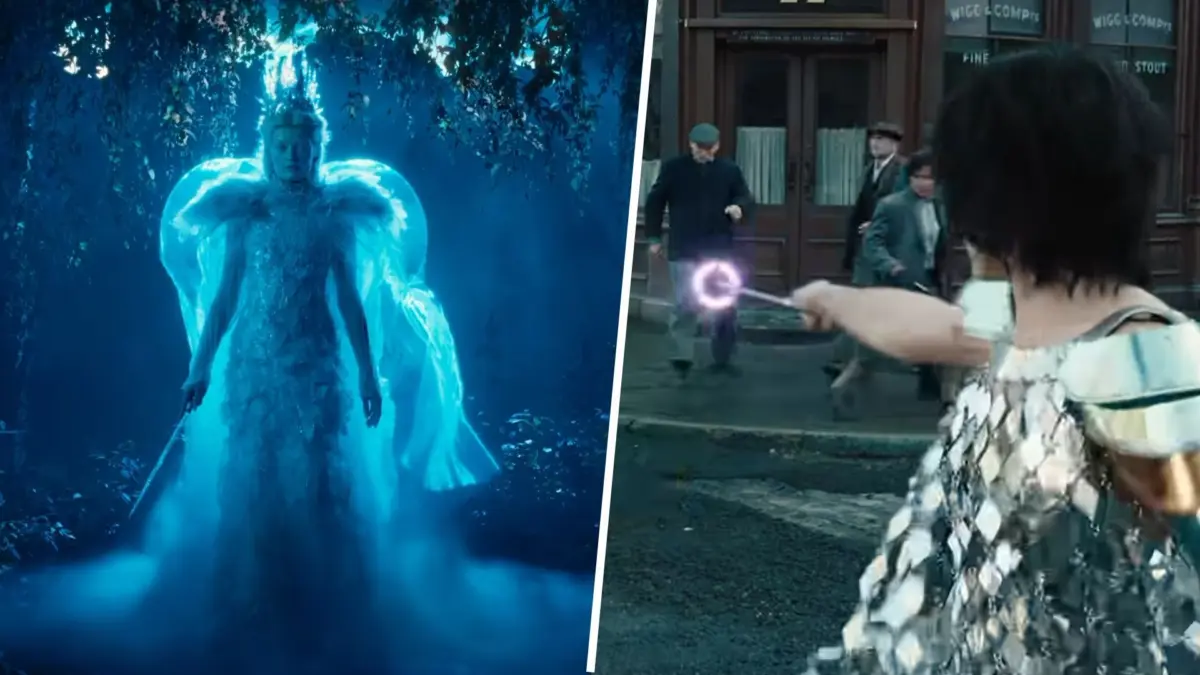
The debut of the trailer for Greta Gerwig’s highly anticipated adaptation of The Magician’s Nephew has sent ripples through the global film community this week. Netflix’s foray into the world of Narnia, led by the visionary director behind Barbie and Little Women, appears to be anything but a traditional retelling of C.S. Lewis’s beloved children’s classic. Instead, the footage reveals a psychedelic, cosmic fantasy that recontextualizes the source material through the lens of the era in which it was written, rather than the period in which it was originally set.
The trailer has quickly become a focal point for intense analysis, with audiences dissecting everything from the high-concept visual effects to the philosophical underpinnings of the narrative. Among the most discussed elements is the depiction of Aslan, the Great Lion, whose character design has elicited a wide range of emotional responses from long-time fans. Beyond the aesthetic choices, there is a growing sense that Gerwig is using the novel’s creation myth—the story of how Narnia was sung into existence—as a vehicle to explore the profound act of creation itself and the complex nature of the creative spirit. However, amidst these grand thematic discussions, a segment of the Narnia fandom has fixed its attention on a minute background detail appearing at the 1:48 mark of the trailer, sparking a debate that touches upon literary history and the ethics of adaptation.
In a scene set toward the conclusion of the trailer, the character of Jadis, the White Witch, is shown appearing in the streets of London. In a significant departure from the mechanics of the original novel, she is seen actively wielding magic within the human world. In Lewis’s text, Jadis found her powers largely nullified or significantly weakened upon her arrival in our reality, relying instead on her formidable physical strength and intimidating stature. By allowing Jadis to use magic in London, Gerwig’s adaptation signals a fundamental shift in the stakes of the story. Yet, it is what Jadis does with that magic that has caused the most consternation among purists: she appears to be systematically destroying a streetscape that includes a very specific reference to C.S. Lewis’s personal life and literary circle.
The background of the scene features a pub prominently named "The Eagle & Child." For those familiar with the biography of C.S. Lewis and his contemporary J.R.R. Tolkien, the name is instantly recognizable. The Eagle & Child is the historic pub located on St Giles’ Boulevard in Oxford where the literary discussion group known as The Inklings would regularly meet. It was within those walls that Lewis, Tolkien, Charles Williams, and others shared drafts of their work, including early chapters of The Chronicles of Narnia and The Lord of the Rings. While the name is not unique—many pubs across England share the moniker—the context of the film makes a coincidental inclusion seem highly improbable. The scene is presumably set in London, not Oxford, which further suggests that the inclusion of the pub is an intentional "Easter egg" or a piece of meta-commentary.