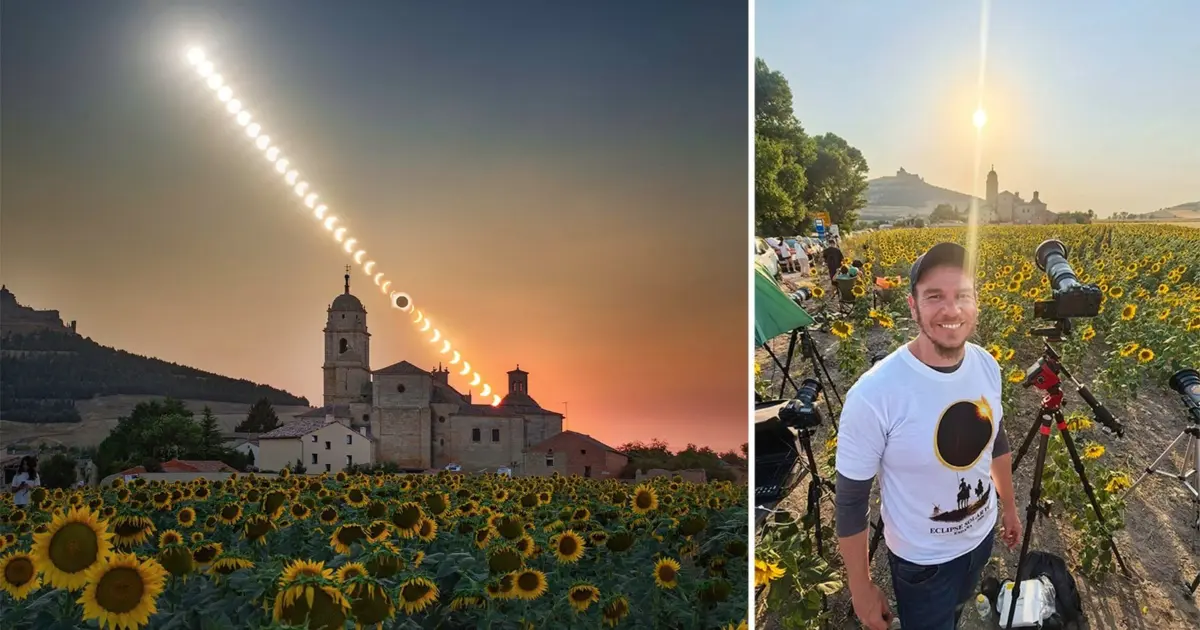
The celestial mechanics of a total solar eclipse are as precise as they are fleeting. For photographers, the event represents the ultimate high-stakes assignment: a rare alignment of the cosmos that offers only a few minutes of opportunity, preceded by months or even years of meticulous preparation. For Brazilian photographer Kiko Fairbairn, the total solar eclipse of August 12, 2026, over northern Spain was the culmination of more than a year of digital scouting, technical rehearsals, and anticipation.
Fairbairn, an award-winning astrophotographer, knew that a successful image required more than just pointing a lens at the sky. It required a narrative. While thousands of people would capture the sun’s corona against a black sky, Fairbairn sought a composition that grounded the astronomical event in the ancient, sun-drenched landscape of the Iberian Peninsula. His journey to the Burgos region was a quest to find the perfect intersection of earthly history and celestial wonder.
The Search for the Perfect Foreground
The planning began thousands of miles away in Brazil, where Fairbairn spent over a year studying maps, weather patterns, and solar trajectories. However, as any seasoned landscape photographer knows, digital maps can only take you so far. The true work began upon his arrival in Spain.
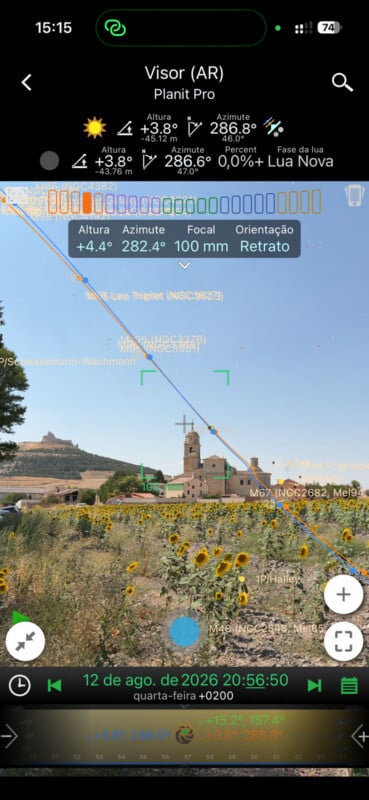
“Once I arrived near Burgos, the real photographic search began,” Fairbairn told PetaPixel. “I spent time scouting the landscape, using planning apps to fine-tune how the path of the eclipse would align with the terrain and the elements I was finding in the foreground.”
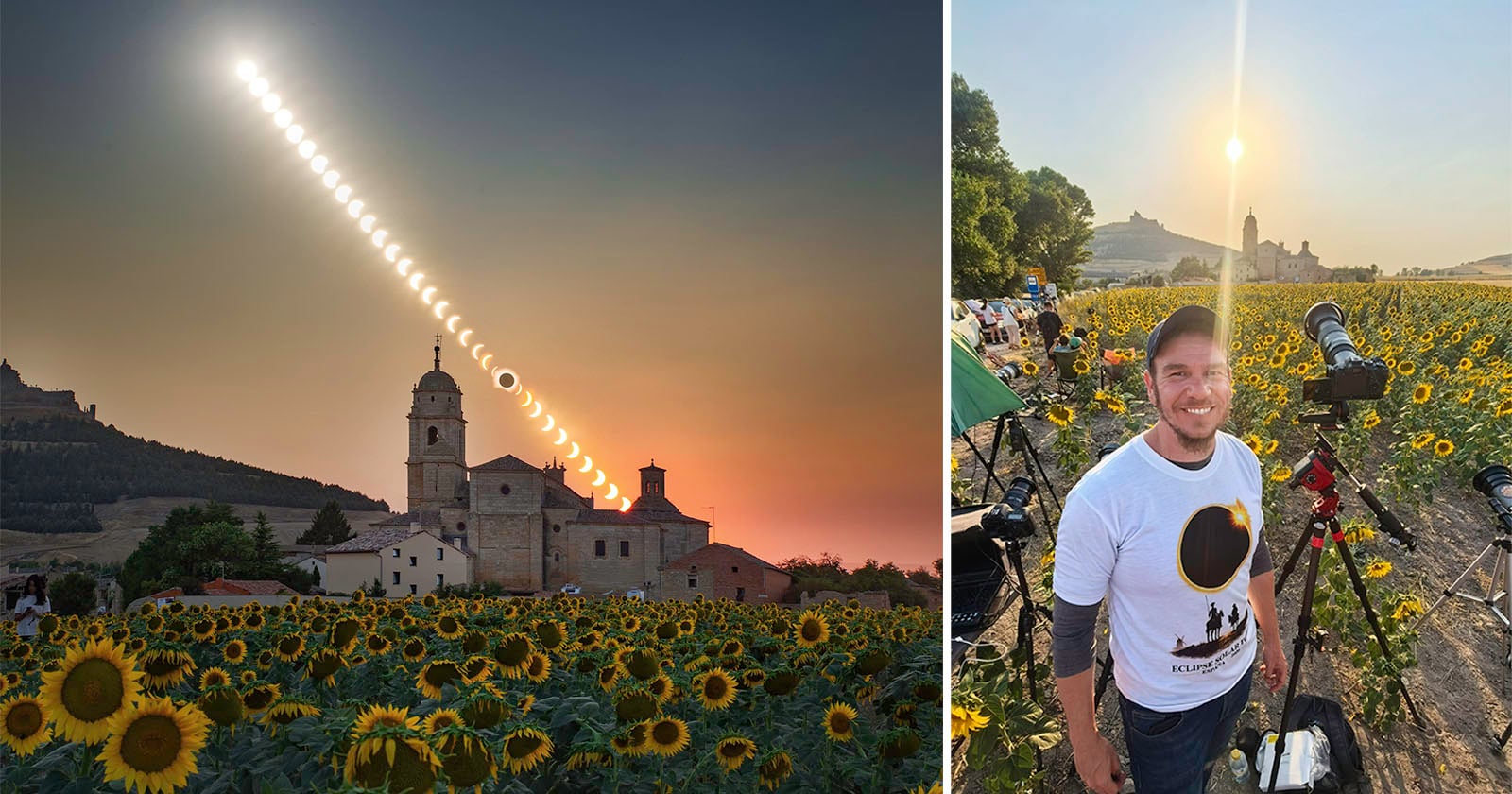
The breakthrough occurred near the town of Castrojeriz, a historic stop along the Camino de Santiago. There, Fairbairn discovered a vibrant field of sunflowers, their heads bowed toward the very star that was about to be obscured. Behind the field rose the stone architecture of a local church and the weathered ruins of a hilltop castle, providing a sense of scale and timelessness.
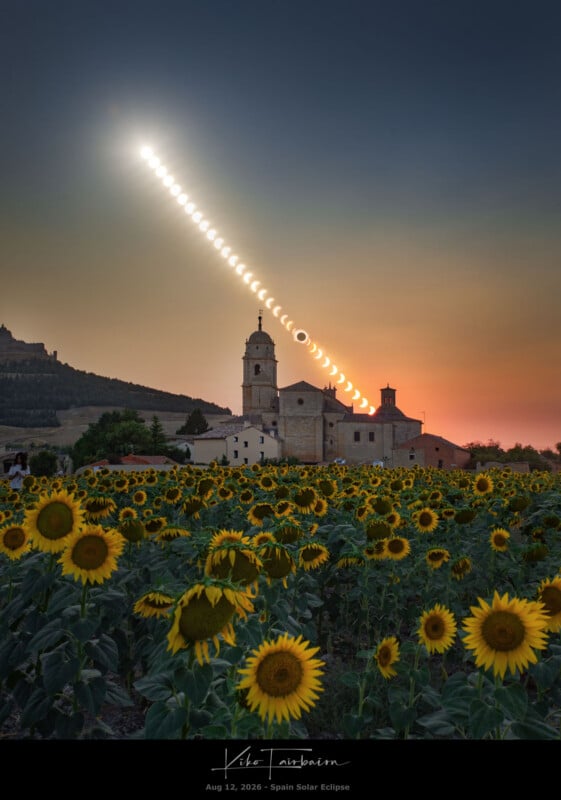
“The moment I saw that scene, something clicked,” Fairbairn recalled. “After months thinking about this eclipse, suddenly I could actually see the photograph in front of me. The landscape, the sunflowers, the old architecture and the path of totality all seemed to come together.”
The choice of sunflowers was not merely aesthetic; it was symbolic. These flowers, whose visual identity and biological rhythm are inextricably linked to the sun, provided a poetic counterpoint to the eclipse. However, Fairbairn was careful not to let the symbolism feel forced. The composition had to be photographically sound, requiring a layered approach that balanced the immediate foreground with the distant horizon.
A Multi-Camera Approach to a Fleeting Event
To ensure he captured every facet of the event, Fairbairn employed a sophisticated multi-camera strategy. This allowed him to document the scientific details of the eclipse while simultaneously focusing on the artistic storytelling of the landscape.
His primary solar rig was designed for high-resolution, close-up imagery. He used a Canon EOS R6 Mark III paired with a 150-600mm telephoto zoom lens. To gain even more reach, he added a 2x teleconverter and mounted the entire system on a specialized tracker. This setup, protected by a solar filter, allowed the camera to follow the sun’s movement across the sky with pinpoint accuracy.
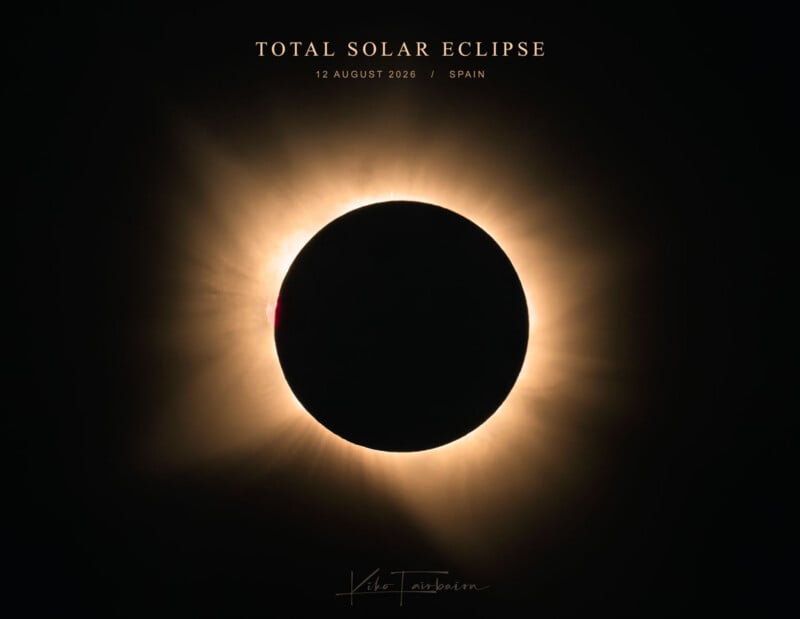
“Knowing that this camera was continuously recording the eclipse gave me the freedom to concentrate on something completely different with my second camera: the landscape and the storytelling,” Fairbairn explained.
For the landscape sequence, Fairbairn turned to a trusted companion: the Canon EOS 5D Mark III. Despite being an older model in the age of mirrorless dominance, the 5D Mark III remains a favorite for its reliability and color science. “It’s an old workhorse,” Fairbairn said, “but it was perfect for what I wanted to do here.”
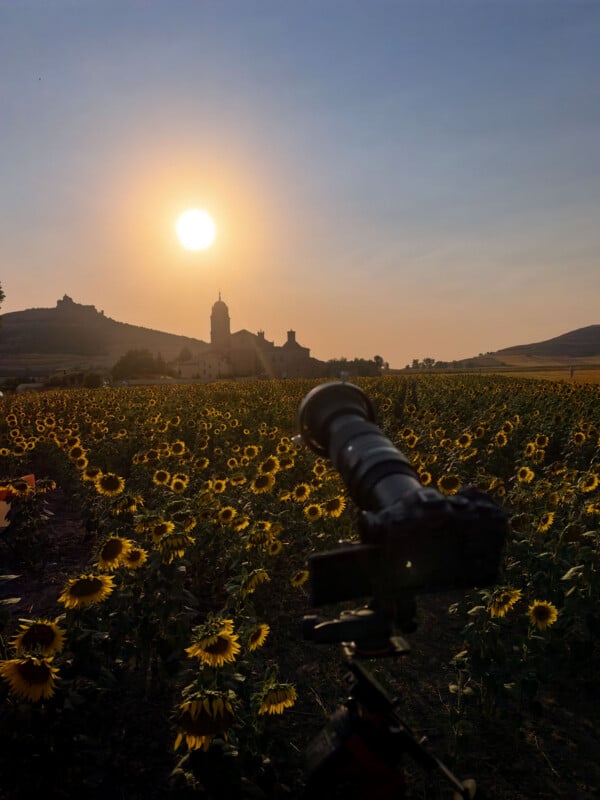
The technical challenge lay in choosing the right focal length to balance the various elements. While he initially experimented with a 16-35mm wide-angle lens, he found that it made the distant church and castle ruins appear too small and insignificant. He eventually settled on a 24-70mm lens, locking the focal length at 38mm. This "sweet spot" allowed the sunflowers to remain prominent in the foreground while maintaining the prominence of the architecture and the progression of the eclipse in the sky.
Technical Decisions in the Field
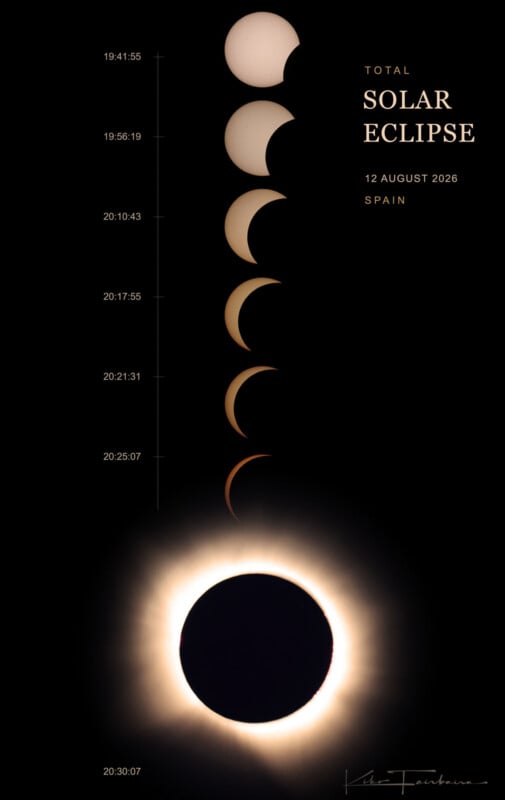
Capturing an eclipse requires a rigorous exposure strategy. As the moon moves across the sun, the ambient light drops precipitously, shifting from broad daylight to an eerie, twilight-like gloom in a matter of seconds. To manage this extreme dynamic range, Fairbairn utilized a method of aggressive bracketing.
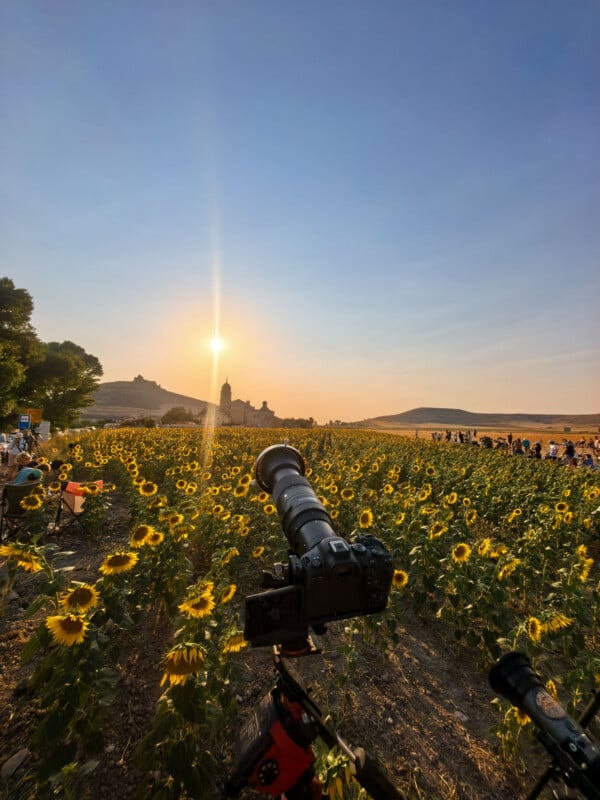
For every frame in his sequence, he captured three separate exposures: a base exposure, one two stops darker, and one two stops brighter. This safety margin ensured that he would have enough data in the RAW files to recover details in both the brilliant solar corona and the darkening sunflower field. During the event, he shot nearly 300 frames, using a Haida ND 3.0 filter to manage the intensity of the light.
To prevent any technical failures during the critical moments of totality, Fairbairn powered his landscape camera via a dummy battery connected to a high-capacity power bank. This ensured the system could run uninterrupted, allowing him to automate the capture process and step away from the viewfinder.
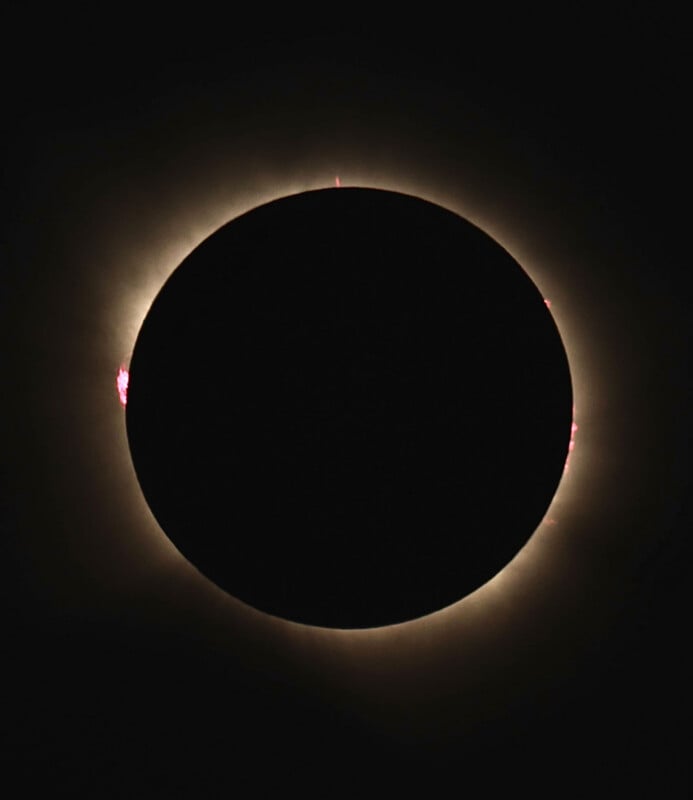
“I wanted the technical side to become almost invisible once everything was running,” he said. “I had spent so much time preparing the composition, exposure strategy and automation precisely so that, when totality finally arrived, I wouldn’t have to spend those extraordinary seconds looking at the back of a camera.”
The Precious Moments of Totality
At his location near Castrojeriz, Fairbairn had exactly 106 seconds of totality. In the world of astronomy, a minute and 46 seconds is a heartbeat; in the world of photography, it is a lifetime of pressure. Yet, Fairbairn’s primary goal was to ensure he didn’t miss the experience itself.
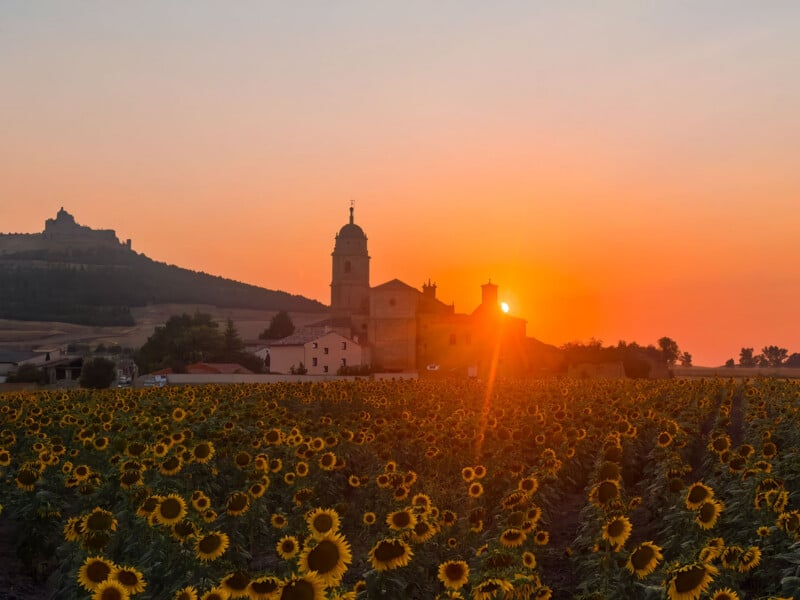
“One of the biggest mistakes we can make as photographers during an eclipse is becoming so focused on capturing it we forget to actually experience it,” Fairbairn noted.
He was accompanied by his sister, who managed the behind-the-scenes documentation, including a video of the moment Fairbairn finally looked up from his equipment to witness the eclipse with his own eyes. The resulting footage captured a raw, emotional reaction to the "shock and awe" of the cosmic alignment.
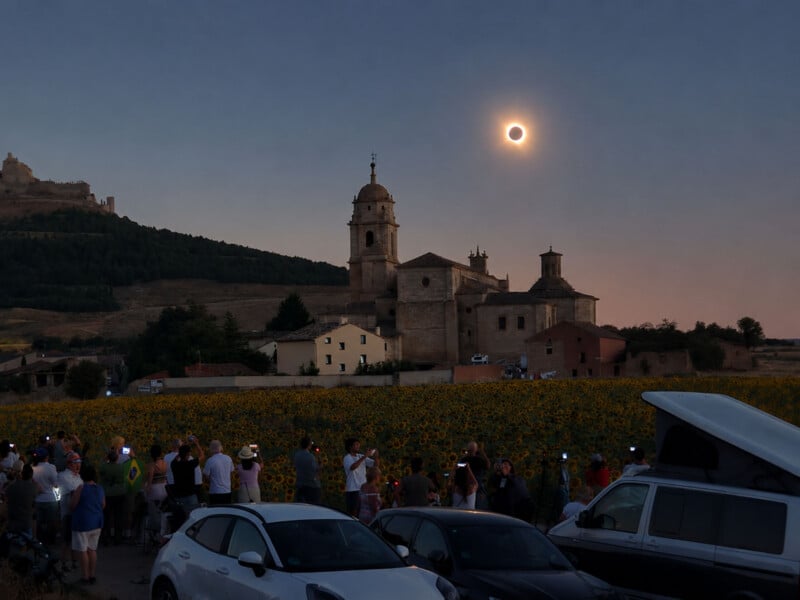
“I had spent more than a year planning the photographs… but none of that really prepares you for the visual and emotional impact of totality,” Fairbairn said. “The light changes, the landscape changes, and suddenly the Sun that you have seen every day of your life looks completely unfamiliar. It is beautiful, surreal, and, in the best possible way, genuinely shocking.”
Fairbairn emphasized that while the final image is the goal, the memory of the moment is the true reward. He advised other photographers to ensure they take the time to witness the event directly. “Some photographs stay with you because of the image you bring home. Others stay with you because you remember exactly what it felt like to be standing there when you made them.”
The Astrophotography Connection
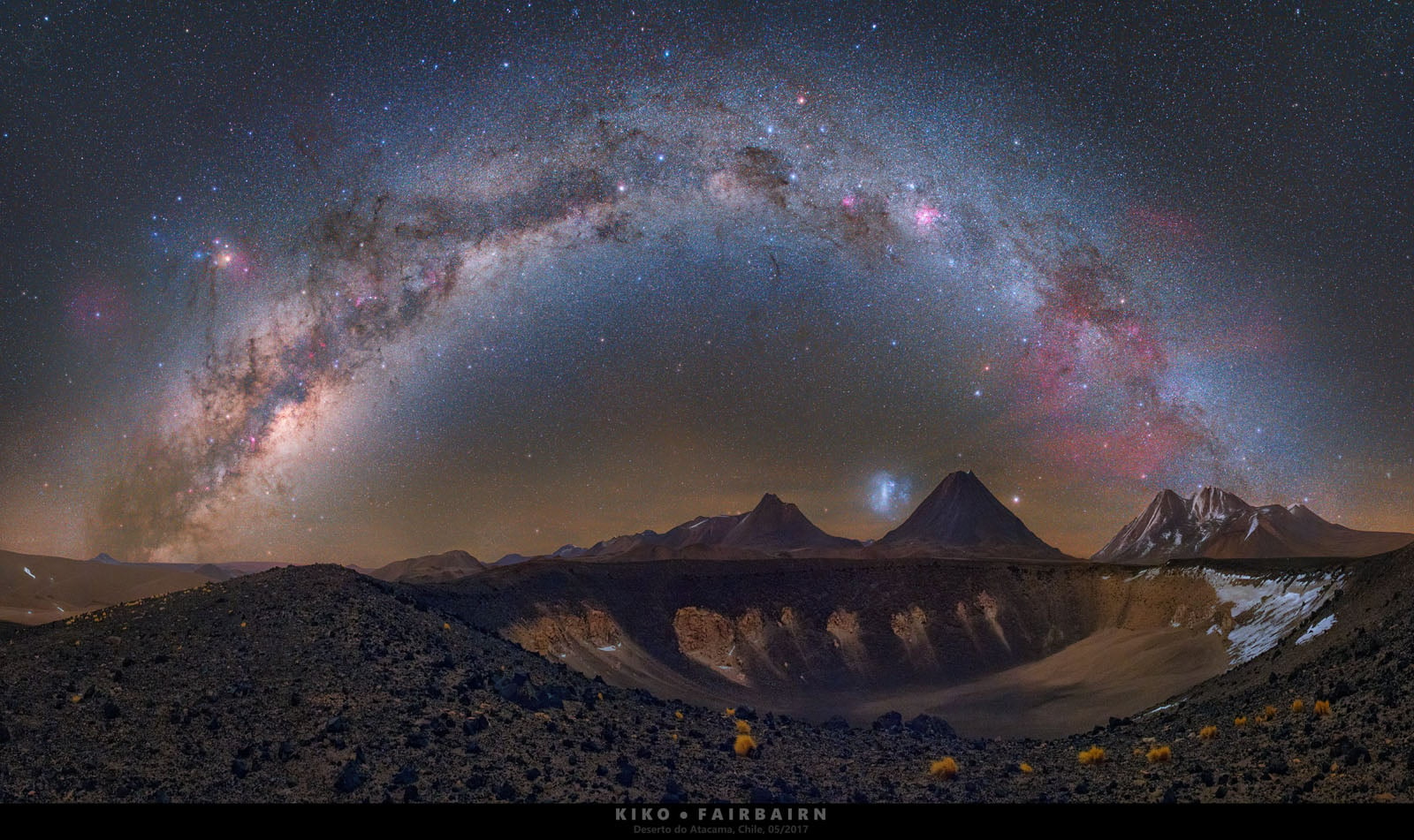
Fairbairn’s success in Spain was built on a foundation of more than 15 years in the field of astrophotography. His work, which ranges from deep-sky imaging to complex tracked panoramas, has been recognized by some of the most prestigious institutions in the world, including NASA, National Geographic, and the BBC. In 2019, he was awarded the Sir Patrick Moore Prize in the Astronomy Photographer of the Year competition, a testament to his technical skill and artistic vision.
Beyond his personal work, Fairbairn is a dedicated educator and speaker. He has delivered TED talks and lectured at schools and observatories, often focusing on the intersection of science and art. For Fairbairn, an eclipse is not just a photographic opportunity; it is a profound scientific phenomenon that highlights the unique "extraordinary coincidence" of our solar system.
“The Sun is roughly 400 times larger than the Moon, but it is also roughly 400 times farther away from us, so from Earth they appear almost exactly the same size in the sky,” Fairbairn explained. “It is this extraordinary coincidence of angular size that allows the Moon to cover the brilliant surface of the Sun so precisely during totality, revealing the solar corona around it.”
Despite the tension and the year of preparation, Fairbairn found that the most meaningful part of the trip was sharing the experience with his sister and his colleagues from the Brazilian astronomy community. The collective nerves and the shared relief when the trajectory of the sun aligned perfectly with his composition created a bond that exceeded the technical achievements of the day.

“Sharing those 106 seconds with my sister and with dear friends is something I will carry with me for the rest of my life,” Fairbairn said. “It was genuinely one of the highlights of my life.”
As the moon moved away and the light returned to the sunflower fields of Castrojeriz, Fairbairn left Spain not just with a collection of RAW files, but with a visual story that captured the rare, delicate dance of the cosmos over an ancient landscape. His work serves as a reminder that in photography, as in astronomy, everything depends on being in the right place at the right time—and having the presence of mind to look up.