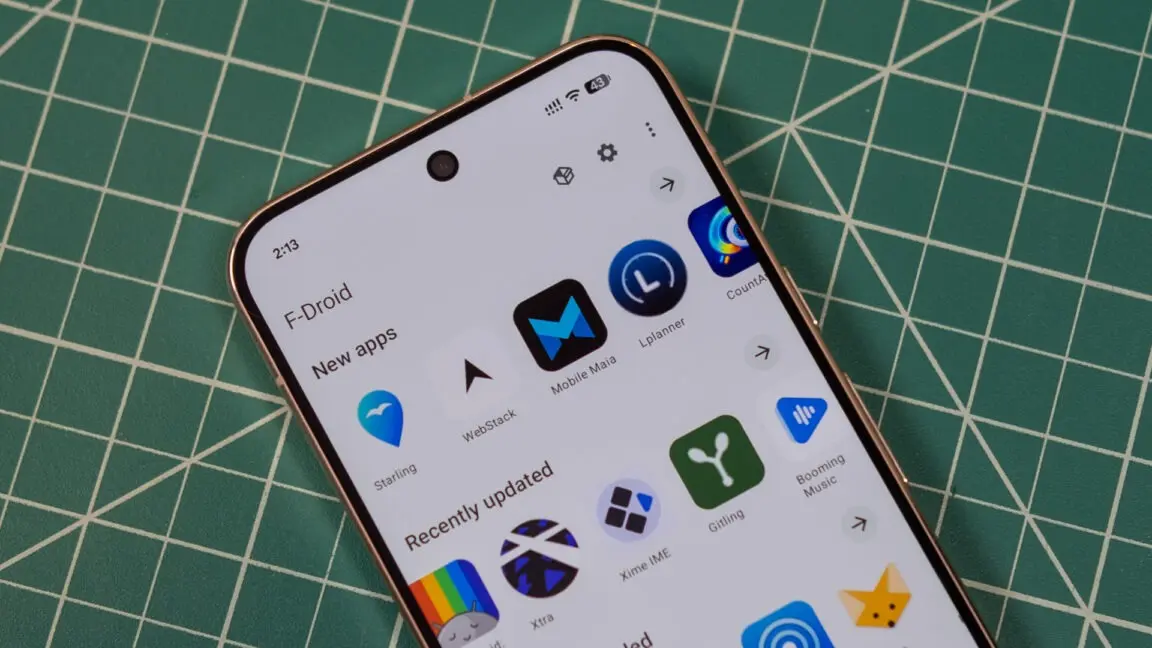
Virtually every Android smartphone and tablet shipping to consumers today comes with the Google Play Store preloaded as its primary gateway for software downloads. However, the open nature of the Android ecosystem has long permitted alternative avenues for acquiring mobile applications. Among these alternatives, F-Droid has stood out for over a decade as the premier community-driven marketplace dedicated exclusively to free and open-source software. Now, following a multiyear development initiative, the team behind the open-source platform has officially announced the rollout of F-Droid 2.0, marking the application store’s first major client update in ten years.
The arrival of F-Droid 2.0 represents a comprehensive overhaul of an application that had remained largely unchanged in its core design architecture for a decade. During the ten years leading up to this release, the broader Android operating system underwent dramatic visual and functional evolutions, leaving F-Droid’s legacy interface feeling increasingly dated compared to modern software standards. To bridge this generational gap, the project’s development team rebuilt the client from scratch using Kotlin Compose, which has become the industry standard for modern Android software development.
The transition to Kotlin Compose brings immediate performance and visual benefits to the user experience. The entire interface is substantially more responsive to touch inputs, delivering fluid navigation throughout the store’s various views. Additionally, the updated client now includes optional native support for Android’s Material theming system, allowing the application’s visual presentation, color palettes, and interface elements to adapt seamlessly to system-level customization settings across modern Android devices. Beyond visual styling, the user interface has been thoroughly decluttered and restructured. The layout reorganizes essential navigation, placing the store’s most vital functions within immediate reach while relocating secondary options and administrative controls into clean overflow menus.
This structural redesign arrives at a critical juncture in the growth of the repository. When F-Droid first launched, its overall catalog was relatively modest, containing only a small collection of basic utilities and independent software projects. Over the past decade, however, the ecosystem has expanded significantly, and the platform now hosts thousands of free and open-source applications built by developers around the globe. Managing such a vast catalog under a decade-old interface presented increasingly obvious usability challenges, making a complete architectural refresh necessary to help users discover and manage software effectively.
Unlike commercial software marketplaces—most notably the Google Play Store—F-Droid maintains a fundamentally different approach to user data and software distribution. Standard commercial storefronts rely heavily on user telemetry, actively tracking taps, search queries, installation histories, and usage patterns across individual devices. These commercial platforms utilize that data to serve targeted advertising, generate algorithmic recommendations, and influence user discovery. F-Droid operates on a privacy-respecting model that completely eschews these practices. The platform does not track user interactions, monitor app installations, or log activity to push sponsored content or personalized recommendations. Its primary focus is providing a direct, transparent channel to locate and install open-source software without background surveillance.
To assist users in navigating its expanding library without relying on invasive tracking algorithms, F-Droid 2.0 introduces a refined categorization and search architecture. The main client screen features a dedicated Discover page that highlights broad, high-level app categories, offering an intuitive starting point for casual browsing. For users seeking specialized software, the client’s Search tab now organizes applications into a wide array of specific technical niches. These granular categories make it much easier to browse focused software classes, including specialized tools like network firewalls, encrypted password managers, and virtual private network (VPN) utilities.
Alongside refined app categorization, F-Droid 2.0 incorporates a fundamental upgrade to its underlying search engine logic. In previous iterations of the client, searching for software relied primarily on matching query terms against exact application names. This limited approach often made it difficult for users to find relevant tools unless they already knew the specific name of the application they were looking for. With the release of F-Droid 2.0, the search functionality has been upgraded to scan full application descriptions rather than restricting queries solely to app titles. As a result, users searching for broad functional terms or specific features can now discover relevant open-source applications much more efficiently.
Beyond visual upgrades and improved discovery mechanisms, F-Droid 2.0 introduces significant operational changes to how applications are installed onto user devices. Installing software from sources outside the preinstalled Google Play Store—a process commonly referred to as sideloading—has historically involved multi-step technical friction. Operating system developers like Google have consistently placed hurdles in the path of sideloaded applications, citing platform security risks and malware mitigation as the primary justifications for restricting external software sources. These ongoing security policies form the backdrop for Google’s broader efforts to tighten software distribution rules across the ecosystem, including its upcoming developer verification system designed to enforce stricter identities and origins for software running on Android.
In legacy versions of F-Droid, navigating these operating system restrictions required a disjointed and potentially alarming installation sequence. Users had to manually download an Android Package (APK) file through the client, open the downloaded package file, and then navigate through a series of prominent system pop-up warnings warning of the potential dangers of installing software from unknown sources before finally approving the installation. This manual sequence often discouraged non-technical users from utilizing alternative app repositories.
F-Droid 2.0 streamlines this installation workflow by integrating support for Google’s native pre-approval API. By leveraging this system API, F-Droid alters the timing of system permission checks, eliminating the need for standalone APK file management and intimidating security banners. Under the new process, users verify their explicit intention to install an application before the package download actually begins. Once that intent is confirmed, the installation proceeds seamlessly with minimal input required.
In practice, this new integration reduces the entire installation process down to a straightforward two-tap interaction. A user simply taps the "Install" button inside the F-Droid client interface, and then taps "Install" a second time on a standardized system pop-up prompt to confirm the action. While this flow still requires one additional tap compared to the single-click installation experience provided by the Google Play Store, it represents a major usability improvement over the legacy sideloading process, removing significant friction for users who rely on open-source software.
The release of F-Droid 2.0 marks the successful conclusion of a long-term development effort aimed at modernizing alternative Android app distribution. By combining a contemporary Kotlin Compose interface, privacy-focused application discovery, description-based search capabilities, and a simplified installation pipeline utilizing native system APIs, the community-driven platform has updated its client to align with modern mobile operating system standards while preserving its core commitment to open-source software distribution.